
Bitcoin to Zcash and Back: The 2026 ZEC – BTC Swap Guide with GhostSwap and More


2026 has seen a large number of investors swapping BTC to ZEC and back. Users exit BTC and go into ZEC because they need privacy. ZEC selectively shields some transactions, suitable for highly critical businesses where the details should not be public.
However, ZEC isn’t as liquid as BTC, which is why many people swap Zcash back to Bitcoin. Regulatory crackdown on privacy coins is another reason behind this outflow. Despite this, the demand for bidirectional swapping between Zcash and Bitcoin remains high.
Phemex revealed that Zcash’s shielded pool has grown by 304% since last year, the Orchard shielded pool has doubled, and the number of shielded ZEC held in addresses has gone from 11% to 30% today.
Why the growth? One, Zcash alongside Monero are the two major privacy coins in the market. And two, Zcash has a fixed supply of 21 million, which gives investors a sense of familiarity.
This guide will showcase the best ways to swap BTC to ZEC and back, how to get started, which are the best service providers, what fees you should be aware of, and what mistakes you must always avoid when making the swap.
What You’ll Need to Make a BTC-ZEC Swap
Before you commit to exchanging BTC to ZEC or vice versa, get ready by fulfilling the following three requirements:
Bitcoin Wallet
A Bitcoin wallet is the first instrument you need. Any type of Bitcoin wallet will do, be it a hardware wallet, exchange-based or a software wallet. If you are concerned about security, a hardware wallet is the best option. But if you want something simple and custodial, exchange-based wallets are a good pick. Software wallets are good too, but many of them don’t have the highest score when it comes to security.
ZCash Wallet With Shielded Address Support
The second tool you need is a Zcash wallet that supports shielded addresses. Our recommendations are Zashi, which is specially built for Zcash and has native shielded address support. If you are looking for something more lightweight, then Ywallet offers quick sync times.
Edge is a multi-asset wallet with shielded support for Zcash. And Trust Wallet is a broad chain wallet that you should consider too, but only after confirming whether it supports shielded addresses.
Understanding t-addr vs z-addr
T-addr is a transparent address. Like Bitcoin addresses, it is publicly visible. Z-addr on the other hand, is a shielded address. It encrypts senders/receiver’s details and the amount using zk-sNARKs.
If you are conscious about privacy, choose a z-addr wallet. If not, t-addr can be your default choice, but it defeats the privacy purpose of swapping BTC to ZEC.
Best ways to swap BTC to ZEC
Here is a comparison table showing each platform and their strengths when it comes to providing Bitcoin to Zcash swapping services:
| Service | KYC | Min BTC | Fee | Time | Shielded ZEC Delivery | Best For |
| GhostSwap | No | 0.00039115 BTC | Embedded in rate | Minutes | Yes | Maximum anonymity, no account |
| Exolix | No (large swaps may trigger AML hold) | Varies | ~1.93% (embedded) | 5 to 30 min | Yes | Small-to-mid privacy swaps |
| FixedFloat | No | 0.00013028 BTC | ~0.5% | Fast | Yes | Micro-swaps, rate-lock clarity |
| SideShift | No | Varies | ~0.5% | Fast | No | Streamlined no-login swaps |
| SimpleSwap | No (KYC possible in disputes) | Varies | ~0.5% | Minutes | No | Fixed-rate swaps, mobile users |
| StealthEX | No (KYC above ~€700) | Low | Embedded | Minutes | Yes | Privacy-first, large coin selection |
| Swapuz | No | Varies | Embedded | Minutes | Unconfirmed | Fast UI, no-frills execution |
| Trocador | No | Varies | Aggregator spread | Varies | Yes (via partners) | Tor users, KYC-filtering aggregator |
Given below are mini assessments of each platform, making it easy for you to pick amongst them.
GhostSwap
Ghostswap offers a direct service for BTC to ZEC swap. It requires no account, no email, and no KYC. As a non-custodial solution provider, it also makes the fees transparent, hiding no charges.
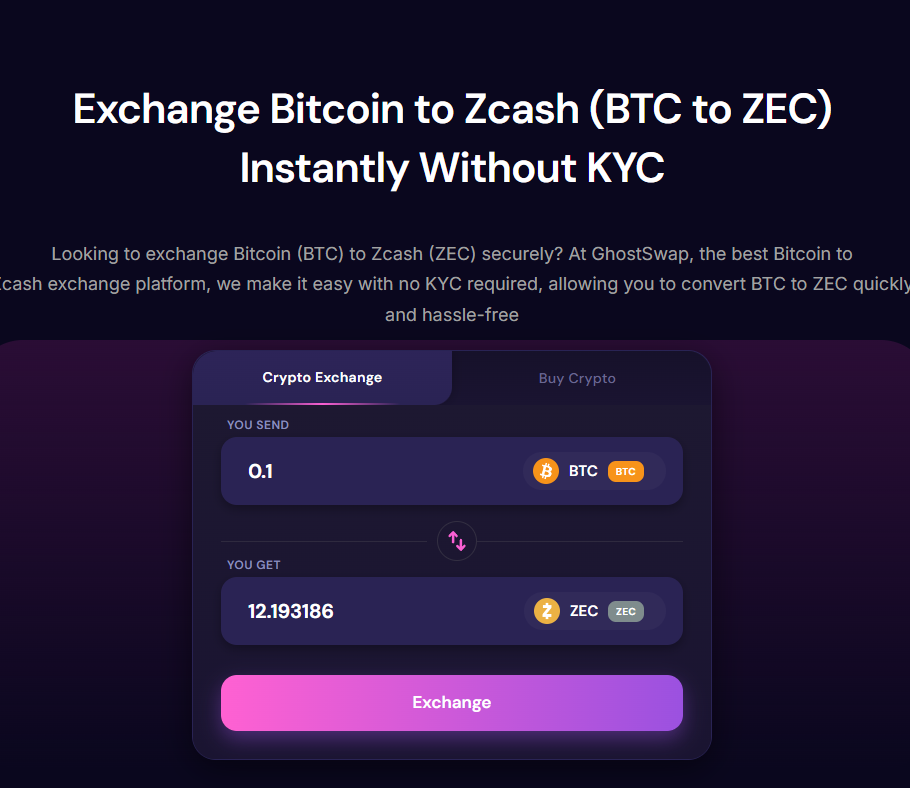
All transactions settle on-chain, and being compatible with Tor makes it suitable for privacy-conscious users.
Exolix
Exolix is a swapping service provider that does not require any registration. It also does not impose any KYC for standard swaps. The fee it charges is embedded in the quoted rate, which is determined by whether you choose fixed or floated rates. Generally, the fee is 1.93%.
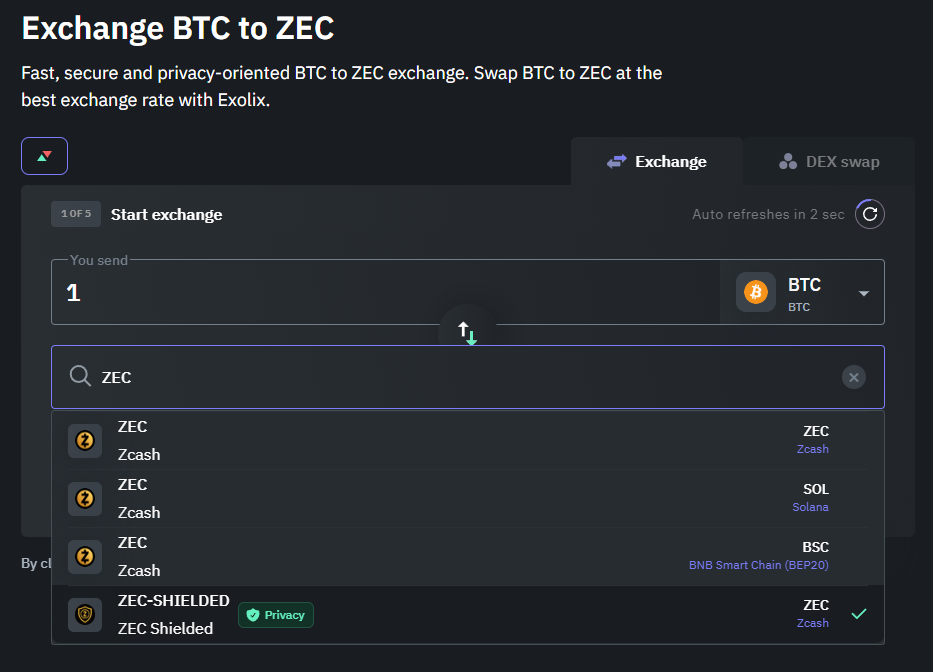
Settlement takes anywhere between 5 to 30 minutes. Large swaps, however, may take longer. And if these swaps go out of bound or suggest any suspicious activity, Exolix’s AML policies could trigger.
FixedFloat
FixedFloat is another platform that lets you swap BTC to ZEC without asking for any KYC requirements. In addition to being a fully automated platform, FixedFloat’s fees are also low. You can choose this swap service if you only need competitive smaller swaps.
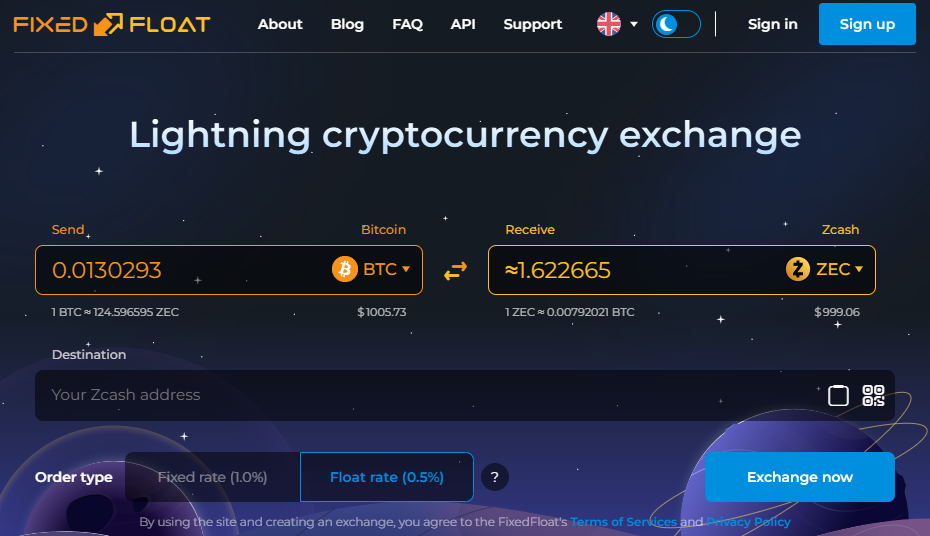
The platform is known for its rate-lock clarity, which makes it suitable if you want predictable returns. And thanks to its integration with the Bitcoin lightning network, it’s best for exploring micro-swaps at low cost. It does not support shielded ZEC delivery.
SideShift
SideShift is a simpler solution for BTC to ZEC swap. It does not have deep features, and does not force users to create an account. Placing automatic swap execution as default, SideShift charges a low fee of 0.5%.
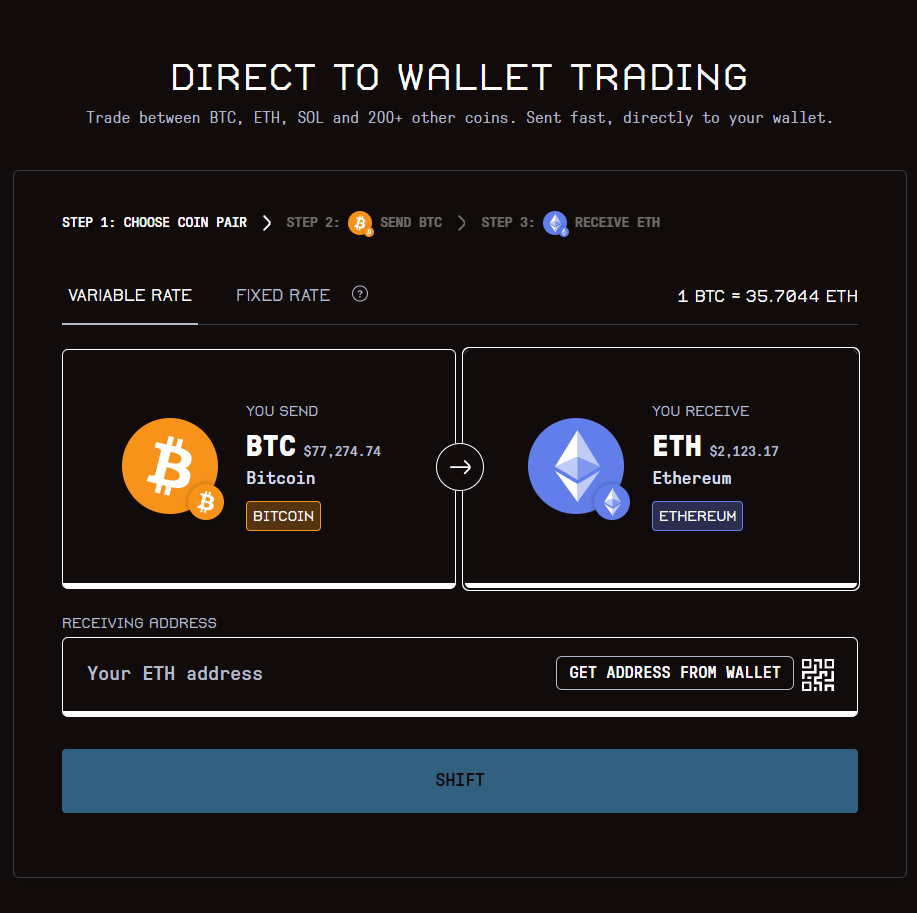
The only drawback is that SideShift blocks US IP addresses. But it is not clear whether it has strict rules against using VPN. Furthermore, ZEC may not be permanently available on the platform. Verify that before using SideShift.
SimpleSwap
If you use SimpleSwap under normal conditions for small transactions, you won’t need any KYC. If there is a disputed case, however, you will need to provide verification.
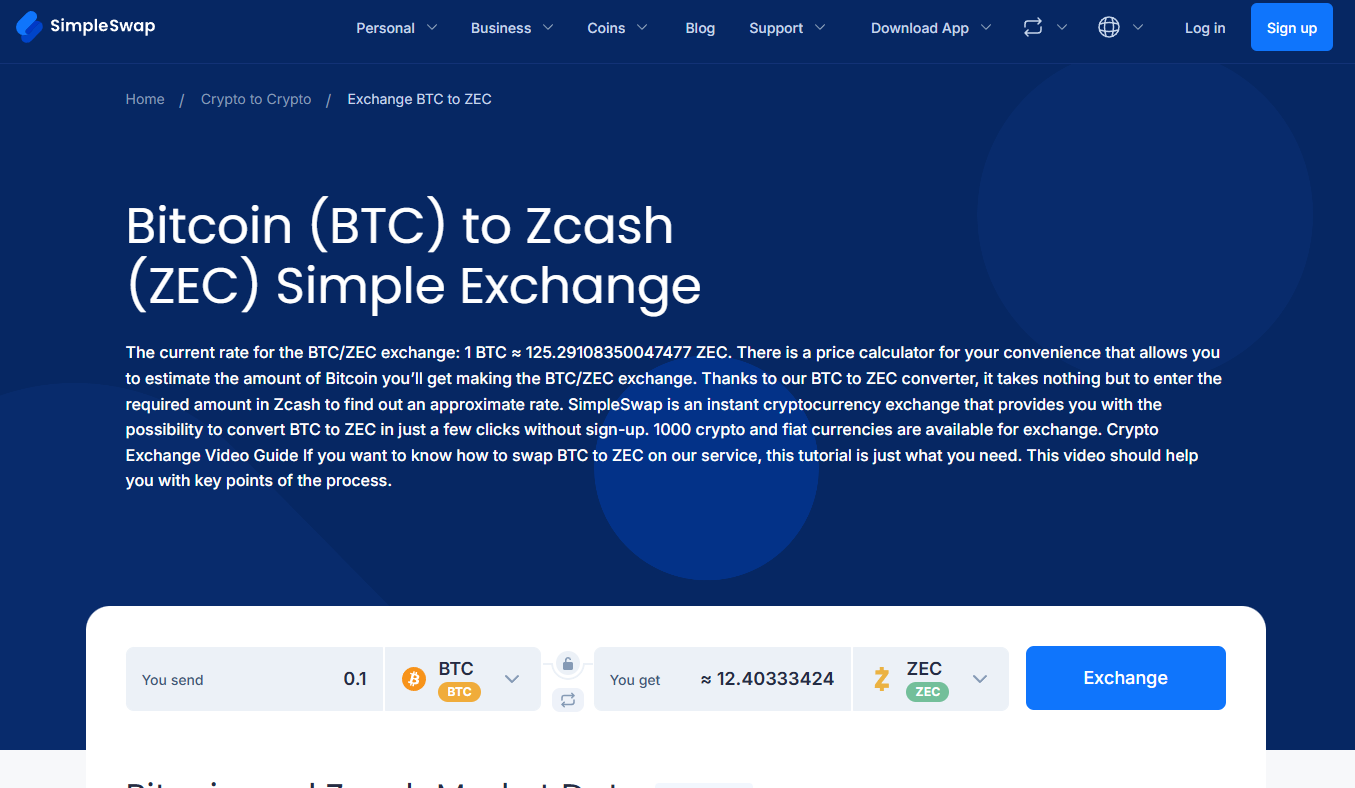
It offers only fixed rate swaps, and calculates transparent spreads openly to reveal the charges. It has a validation system in place to verify the address before execution, and offers a mobile friendly application.
StealthEX
StealthEX, like other platforms on this list, does not need any KYC verification if your swaps stay under approximately €700. Like most platforms, the fees are embedded in the cost itself, which means the charges depend on liquidity routing.
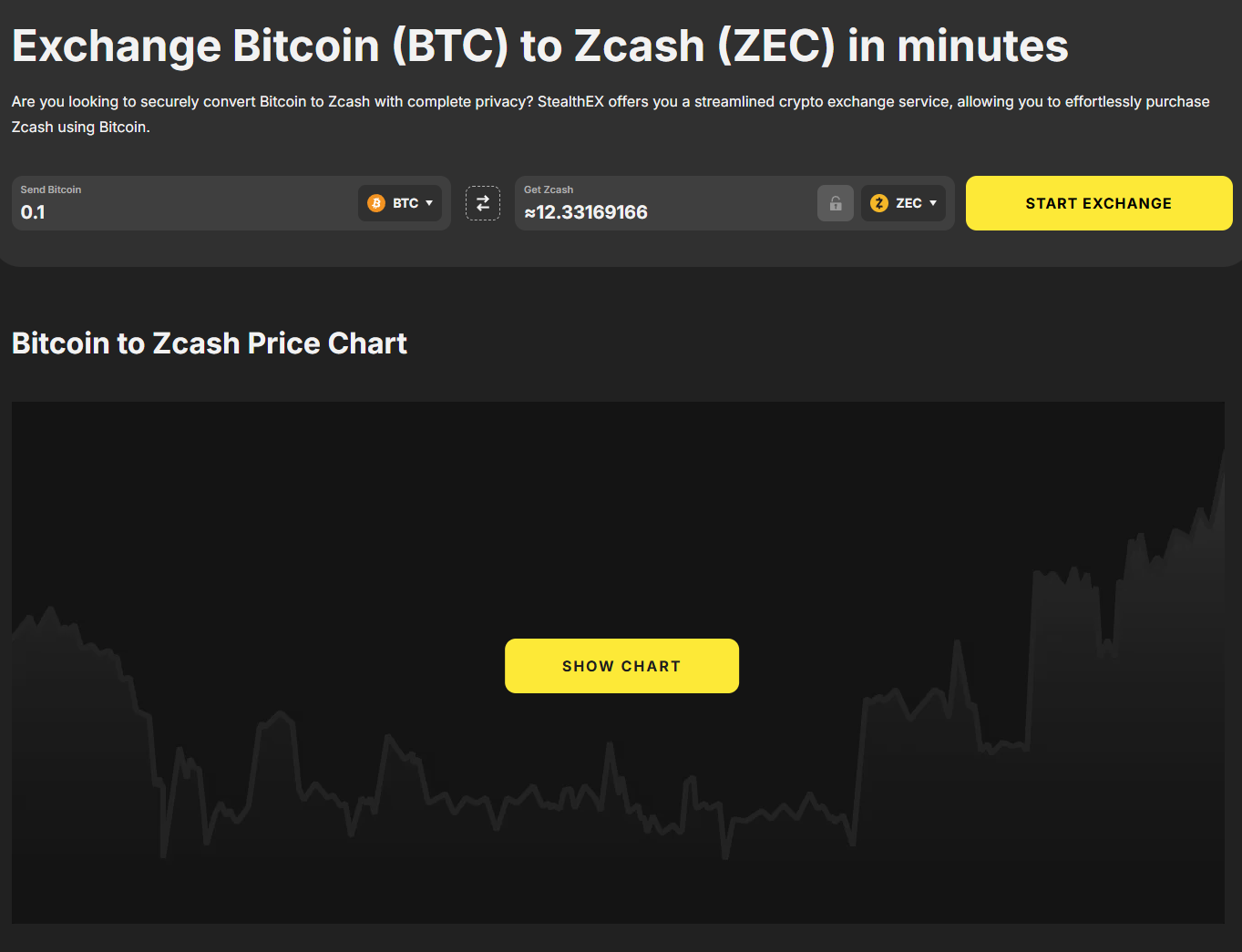
Alongside supporting BTC to ZEC swaps, it also offers exchange between over 2,000 assets. A non-custodial platform, it purges the transaction logs fast, giving you an added sense of privacy.
Swapuz
Swapuz is a straightforward service provider for swaps and executes exchanges quickly. It does not ask for KYC, or any account registration. You can just come to the website, complete the process, and exit. The fee is embedded in the rate, and it is competitive.
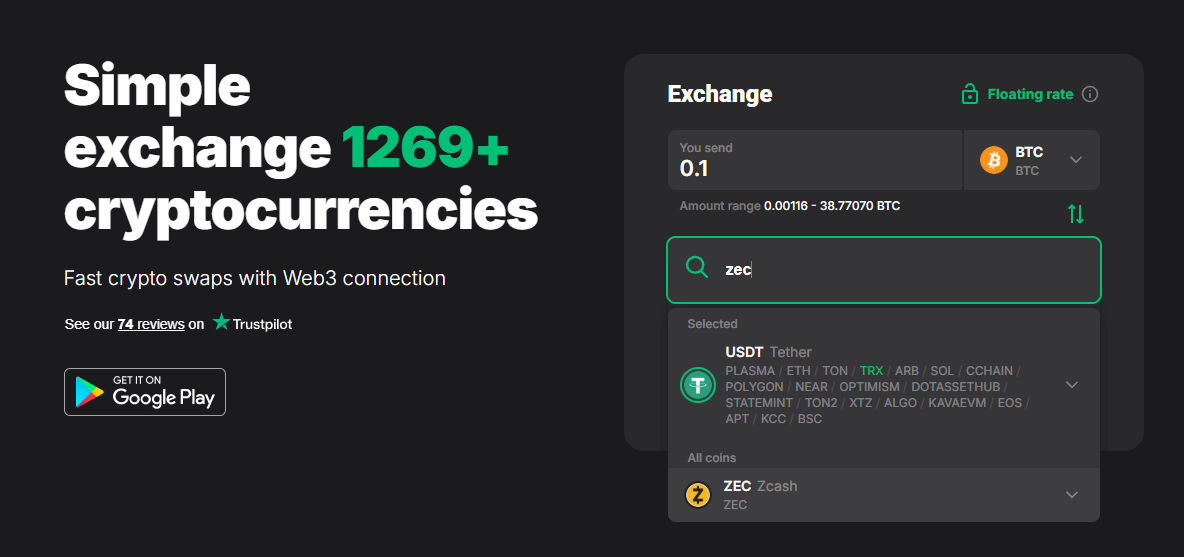
The platform has a backend connection with Exolix as well, which widens the scope of assets it supports.
Trocador
Trocador is different from the rest of the platform on this list because it is an aggregator, not a direct swap service. It simply routes transactions through multiple providers. It does not require JavaScript, and is fully compatible with Tor.
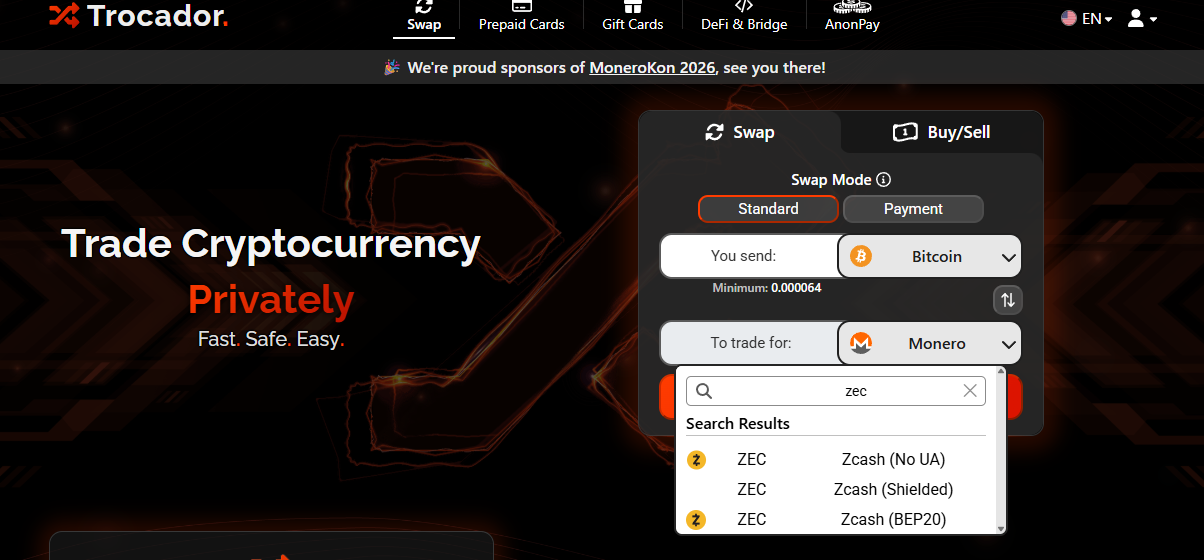
KYC is conditional on which provider you select. Trocador makes the selection easy by giving you a filter to exclude any provider asking for KYC. The only issue is that shielded ZEC delivery depends on which provider you pick. Thankfully, it lists Zcash (shielded) as an explicit option.
Best ways to swap ZEC to BTC
You can take help from the same providers to swap ZEC to BTC.
| Service | KYC | Min ZEC | Fee | Time | Accepts Shielded ZEC Send | Best For |
| Exolix | No (large swaps may trigger AML hold) | Varies | ~1.93% (embedded) | 5 to 30 min | Yes | Small-to-mid exits to BTC |
| FixedFloat | No | Varies | ~0.5% | Fast | Unconfirmed | Rate-locked ZEC exits |
| GhostSwap | No | None stated | Embedded in rate | Minutes | Yes | Anonymous ZEC→BTC with no account |
| SideShift | No | Varies | ~0.5% | Fast | Unconfirmed | Clean no-login ZEC exit |
| SimpleSwap | No (KYC possible in disputes) | Varies | ~0.5% | Minutes | Unconfirmed | Fixed-rate ZEC→BTC |
| StealthEX | No (KYC above ~€700) | Low | Embedded | Minutes | Yes | Privacy-first ZEC exits |
| Swapuz | No | Varies | Embedded | Minutes | Unconfirmed | Fast no-frills ZEC exit |
| Trocador | No | Varies | Aggregator spread | Varies | Yes (via partners) | Tor users exiting ZEC |
Here is the assessment of the platforms with respect to them swapping ZEC to BTC:
Exolix
Exolix does accept ZEC as input, and as output, it returns BTC to your specified address. However, the same AML hold risk is applied, which means large amounts are subject to verification.
Floating and fixed rates are available, but you should confirm which one to choose because refunding ZEC usually takes longer than BTC.
FixedFloat
FixedFloat supports ZEC to BTC swap, while offering rate-locks. It is suitable if you want to get a predictable amount of BTC for your ZEC. Thanks to the Lightning network, the BTC withdrawal option is faster with this method.
GhostSwap
GhostSwap is a platform that offers wallet-to-wallet, direct ZEC to BTC, swap without requiring any account.
Processing on Ghostswap begins by accepting shielded ZEC as input. Select shielded ZEC as the transfer path beforehand to prevent any errors.
SideShift
SideShift offers automated execution for swapping ZEC for BTC. The downside is that the platform is not allowed in the US. The upside, however, is that there is no login or email requirement, which means you may bypass the restrictions using VPN.
SimpleSwap
If you are looking for a fixed-rate ZEC to BTC swap, SimpleSwap is a good pick. However, it is recommended that you validate the address on the BTC output properly to prevent any errors.
The platform is simplified, as it has no hyper-advanced trading tools, making it highly suitable for quick swaps.
StealthEX
StealthEX is another non-custodial option if you are looking to swap your ZEC for BTC. The €700 threshold is still present, which means as long as your ZEC input is lower than that amount, you don’t need to provide any KYC document.
The platform is best for ZEC to BTC swap because of the added advantage thanks to faster log purge. You can exit ZEC without a long data trail.
Swapuz
If you are looking for a more straightforward execution, Swapuz offers a simple ZEC to BTC swap. Since there is no KYC requirement for general transactions, you won’t need to worry about any data trail. The fee is embedded, which simplifies the transaction even more.
Trocador
Since Trocador is an aggregator, it routes ZEC to BTC swap through one of its provider networks. The best thing is that the moment you select shielded ZEC as input, it automatically offers you a list of providers that provide that facility.
It is recommended that you use a KYC filter if you don’t want the provider to ask for any verification.
How long do ZEC swaps take?
ZEC swaps go through three layers and each one finishes according to its own timeframe. The total time it typically takes to finish the transaction is somewhere between 20 to 35 minutes. Here is the complete breakdown.
Bitcoin Confirmation Takes 10 Minutes
Most swap services wait for at least one Bitcoin confirmation before they begin processing. Since Bitcoin blocks average at 10 minutes, the wait time for the first layer is 10 minutes. However, there are some services that may require more than one Bitcoin confirmation, lengthening the time even more.
Service Processing Takes 2 to 5 Minutes
After Bitcoin confirmation, the swap service starts executing the exchange and begins the ZEC send process. It is the fastest part of the execution, taking anywhere between 2 to 5 minutes to complete. However, the time taken generally depends on liquidity routing.
ZCash Confirmation Takes Approximately 8 Minutes
Zcash confirmation time per block is 1.25 minutes (75 seconds). In most cases, service providers require 6 blocks to consider the transaction complete. So, taking 75 seconds for one block and multiplying it by 6, we get 7.5 minutes, or roughly 8 minutes.
Taking into account all the layers mentioned above, the total processing time hangs between 20 to 35 minutes.
It can take longer if the Bitcoin network is congested. ZEC confirmation is nothing to worry about though. It is fast and rarely causes a delay.
Shielded vs Transparent: Which Zcash Address to Use
While a shielded address gets the most favor because it boosts privacy, at the end of the day, the choice of address depends on what you are asking for. Here is a breakdown to make that choice simpler.
T-addr
With t-addr, transactions are fully visible. Since all details are public, you can say that it works in a fashion similar to Bitcoin. As a result, most exchanges, swap services and wallets support it. It is also the default option if you are withdrawing ZEC from CEXs like Coinbase or Binance.
Z-addr
With z-addr, zk-SNARKS encrypts the transaction. It makes all details, including that of sender, receiver and amount, invisible to the public. It is this address that makes Zcash different from Bitcoin. The problem is that not all exchanges and swap services support it and you need a shield-capable wallet to store, send, and receive it.
The Trade-Off
So, if you receive Zcash to a t-addr (transparent address), the transaction is there for all to see through the public ledger. This entire system weakens the reason to use Zcash.
But if you use z-addr, privacy is maintained, and you can keep the funds shielded as long as you want.
The swap service only becomes the weak point if Zcash is being output through t-addr. Otherwise, there is no need to worry.
Change That Came Late 2025
After late 2025, it has become much easier to find swap services that support shielded z-addr. It is a significant development because the presence of new swap services removes the need for you to transfer Zcash to shielded funds by yourself.
Fees: BTC to ZEC vs ZEC to BTC
The fees you pay for a BTC to ZEC swap and vice versa happen in three layers. They determine how much the entire process costs you in the end.
BTC Network Fee
The first cost layer that you will face is the BTC network fee, which you pay to send BTC to the swap services. The amount depends on how congested the network is. During low activity, you only need a couple of dollars. But during high traffic, the fees can rise to above $20.
This layer represents the priciest element of the cost.
Service Spread (0.5% to 2%)
Service spread is what swap service providers charge. The spread is often built into the quoted rate and ranges between 0.5% to 2%.
Spreads for floating rate swaps are higher than fixed rate ones because fixed rate offers predictable output. On the other hand, floating rate shifts depending on market conditions.
ZEC network fee (~$0.001)
ZEC network fee is negligible, costing only around $0.001 per transaction. While it rarely factors into cost calculation, you should know about it if you are doing a ZEC to BTC swap.
Here is an example that demonstrates the entire fee structure:
You begin with swapping 0.01 BTC to ZEC. BTC first goes through the Bitcoin network that, if only moderately congested, charges around $5. Add service spread to that of say, 1%, or $6, the total comes out to be $11.
At the receiving end, the ZEC receipt fee is only $0.001 approximately. By the end of a $600 swap, you are spending roughly $11, about 1.8% of the total amount.
Now what about the fee for swapping ZEC to BTC?
ZEC network fee, as already mentioned, is negligible, around $0.001. Add $6 service spread to that, you only need to pay around $6 in the end. Bitcoin receipt fee does not get counted because the service absorbs it. No separate charge.
Privacy: How Does Zcash Compare to Monero?
Both Zcash and Monero are privacy coins, but the way they implement it is different.
Monero, for instance, keeps every transaction private by default by implementing ring signatures, stealth addresses and RingCT. It does not require the user to do anything to implement the privacy measure.
ZCash has made privacy optional. Transactions are transparent by default and users need to specifically choose a shielded address and a compatible wallet to enforce privacy.
The key differentiating factor is the shielded pool. Zcash implements privacy that relies on users to use it correctly. They must send to a z-addr to make their transactions opaque. Although zk-SNARK is considered superior to Monero’s ring signature, the fact that it needs user intervention is an issue.
When it comes to regulatory pressure, both coins face it. While Zcash bypasses much of the scrutiny through its transparent address, Monero, being private by default, doesn’t get any choice. Exchanges like Binance, Kraken, and others have removed XMR completely.
Zcash, on the other hand, still gets a place on exchanges, all because its transparent mode matches the compliance requirements.
Which one should you use? If you want maximum privacy but want to be able to control it, use Zcash. The t-addr and z-addr options give you more control and make choosing exchanges more flexible.
But if you seek strict privacy, Monero is a better option.
Common Mistakes
Here are some of the most common mistakes you might make swapping between BTC and ZEC
Sending to the Wrong Address Type
If you send ZEC to a transparent address when your goal is to receive it to a shielded wallet, you defeat the main purpose of using Zcash: privacy. Therefore, you must always confirm your swap service output before making the exchange.
Exchanges Rejecting Shielded Deposits
Centralized exchanges aren’t kind to Zcash coming from z-addr. They require transparent addresses. If you don’t, at best the transaction is rejected, at which point you can choose another option. At worst, however, the transaction may get stuck. Fixing that requires getting aid from the exchange’s customer support team.
Slippage on Volatile Pairs
Since ZEC has lower liquidity than Bitcoin, its price may move between the time the exchange starts and the time it ends. So, if you have chosen floating rate swaps, the amount of ZEC you receive may be lower than the amount of BTC sent to you.
The fix is simple. Only choose fixed-rate swaps, and avoid swap services that only support floating rates.
FAQ
Is Zcash truly private?
Only when you use it correctly. Transactions sent through shielded addresses are encrypted using zk-SNARKs, hiding the sender, receiver, and amount. But if you are using a transparent address, your transactions are fully public, which is no different from Bitcoin. Privacy on Zcash is opt-in, not default.
Can I swap BTC to Zcash without KYC?
Yes. Most services in the comparison table above require no registration or identity verification for standard swap amounts. GhostSwap, StealthEX, and Trocador are the strongest options for no-KYC swaps. Some platforms may trigger verification on larger amounts, so check thresholds before initiating.
What is the difference between t-addr and z-addr?
A t-addr is a transparent address: transactions are visible on the public blockchain. A z-addr is a shielded address: sender, receiver, and amount are all encrypted. If privacy is your reason for holding ZEC, you need a z-addr wallet and a swap service that delivers to one.
Why convert Bitcoin to Zcash?
BTC is liquid but fully transparent on-chain. ZEC gives you optional privacy through shielded addresses without abandoning the hard-money model; both assets share a 21 million fixed supply. For users who want selective transaction privacy without switching to a completely different asset structure, ZEC is the natural step.
How long do shielded transactions take to construct?
Shielded transactions take longer to build locally, roughly 2 to 3 times longer than transparent ones, because the zk-SNARK proof needs to be generated on your device. Once broadcast, on-chain finality is identical. The delay is on your end before the transaction even hits the network.
Can I swap ZEC back to BTC the same day?
Yes. Most services in this guide finalise ZEC to BTC swaps within 20 to 35 minutes under normal network conditions. The near-zero ZEC network fee also means initiating the return swap costs almost nothing. Same-day round trips are entirely practical.
Conclusion
Both directions of the ZEC↔BTC swap corridor are well-served in 2026. The services in this guide cover the full range, from fixed-rate exits to fully anonymous, no-account swaps. The choice comes down to how much privacy you need and which direction you are moving.
Before you close the tab after your swap, save your order ID. If something goes wrong mid-execution, it is the only reference point you have to chase a resolution.
For the most private BTC to ZEC swap with no account and no email. The top crypto swapping sites have these features. GhostSwap remains the cleanest entry point into the shielded Zcash ecosystem.


- Bitget Launches Open Custody Network, Giving Institutions Choice in Custody and Access to Markets
- ETHSpain 2026 Puts Infrastructure at the Center of Ethereum’s Next Chapter
- Compounding vs Drawdown: The Math Active Traders Often Underestimate
- A 1960s-Style Evening Is Coming to TOKEN2049 Singapore, Courtesy of ChangeNOW
- Smart Money Signals vs Whale Tracking: What Solana Traders Should Actually Follow in 2026