


CLARITY Act Faces Crucial Two Weeks as Senate Eyes July Crypto Vote


Highlights
- Senate recess delays CLARITY Act talks until lawmakers return July 13.
- Senator Tim Scott pushes for July vote on the crypto legislation.
- Despite Scott's support, crypto market remains uncertain on passage timeline.
The CLARITY Act is gaining traction as it enters a crucial phase, with the next two weeks shaping crypto regulation in the United States. While the US Senate remains in recess until July 13, lawmakers, administration officials, and industry representatives are working behind closed doors to resolve key disagreements over the CLARITY Act.
The outcome of these negotiations could determine whether the long-awaited crypto market structure bill reaches the Senate floor in July. On the other hand, the market is also speculating whether the CLARITY Act would lose its momentum before Congress begins its summer recess.


CLARITY Act Enters Crucial Phase
Although senators are away from Washington, negotiations around the CLARITY Act have entered a decisive phase. Congressional staff from both parties, White House officials, and crypto industry representatives are trying to bridge several policy differences before lawmakers return.
According to journalist Eleanor Terrett, discussions are focused on reconciling separate versions prepared by the Senate Banking and Agriculture Committees. Negotiators must also settle disagreements over ethics standards, anti-money laundering provisions, and rules governing digital asset markets.
However, the report noted that even if negotiators reach an agreement, the Senate calendar presents another hurdle. Senate Majority Leader John Thune has already indicated that lawmakers will first prioritize the National Defense Authorization Act when they return in mid-July.
That schedule could push the CLARITY Act to the second half of July or the opening week of August. Many observers believe the legislation must clear the Senate before Congress leaves for its August recess. Missing that window could significantly reduce its chances of becoming law in 2026.
Meanwhile, the CLARITY Act bill will also require at least 60 Senate votes. While Republicans hold 53 seats, unanimous Republican support remains uncertain. Previous crypto legislation (GENIUS Act) saw Republican Senators Josh Hawley and Rand Paul oppose similar measures, meaning bipartisan backing will remain essential.


Republicans Push for July Senate Vote
Momentum behind the CLARITY Act remains strong despite the unresolved issues. Senator Tim Scott recently voiced support for bringing crypto market structure legislation to the Senate floor in July.
In a recent X post, Scott backed Majority Leader John Thune’s proposed timeline. He said the bipartisan legislation would establish clear regulatory rules, strengthen consumer protections, and encourage innovation to remain in the United States.
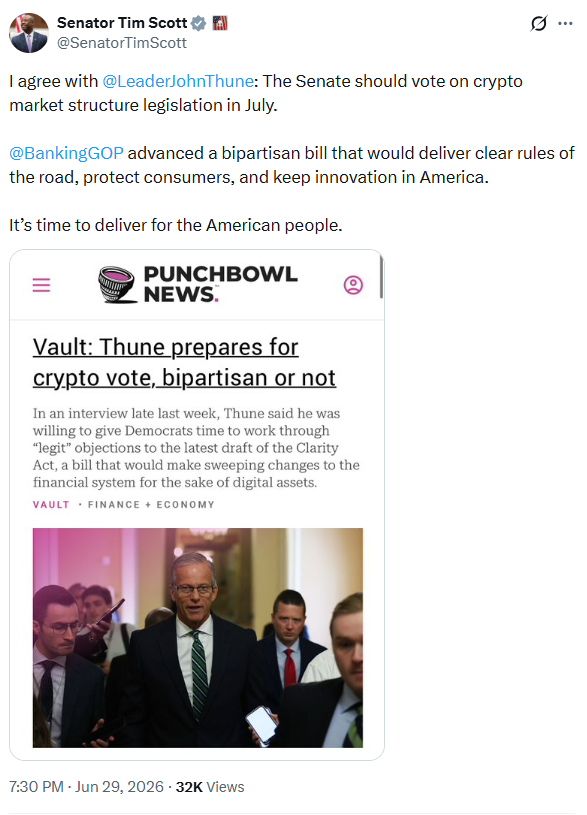
He added that lawmakers should now move forward and deliver the legislation for Americans. However, the market remains cautious as Galaxy Digital has also lowered the odds of CLARITY Act approval in 2026 to 50%.
Instant Currency Exchange at BestChange with Ease
- Compare Rates Across 1000+ Exchanges
- Access 250+ Cryptocurrencies & Pairs
- Save Time with Real-Time Price Tracking
- Trusted & Verified Exchange Listings

Why Trust CoinGape
CoinGape has covered the cryptocurrency industry since 2017, aiming to provide informative insights Read more… to our readers. Our journal analysts bring years of experience in market analysis and blockchain technology to ensure factual accuracy and balanced reporting. By following our Editorial Policy, our writers verify every source, fact-check each story, rely on reputable sources, and attribute quotes and media correctly. We also follow a rigorous Review Methodology when evaluating exchanges and tools. From emerging blockchain projects and coin launches to industry events and technical developments, we cover all facets of the digital asset space with unwavering commitment to timely, relevant information.



Delivered every day.
- Insights that move markets
- 100,000 active subscribers

Global ONCHAIN AWARDS 2026