

An Early Look Into Binance’s TradFi Stack: The Future of Finance is Tokenized


Binance has ventured beyond crypto, and in recent months has been offering an entire ecosystem of TradFi-linked products. There are TradFi perpetual futures contracts giving users pre-IPO exposure, and then there is access to U.S. listed stocks, and bStocks, on-chain tokenized securities.
But when we look at how these are used in practice, two things emerge. One, users are not limiting themselves to one format. They are moving freely between all three. And two, the on-chain layer is scaling faster than many expected. While veteran TradFi traders have started to use these new options more, for 4 in 10 bStock users, it is the first exposure to Binance’s TradFi products.
bStocks are Becoming the Front Door
For 41.5% of bStocks users, the TradFi journey on Binance started with our tokenized security offering. As such, bStocks could very well be considered the way in towards equities for an entirely new generation.

Figure 1: 41.5% of bStocks users came in through bStocks alone. Source: Binance Research, as of July 8, 2026
Newcomers are young and restless. To meet their demands, Binance has also ramped up its bStock listings, which have gone from 5 to 36 in less than a month. And during the same period, the product’s market cap has blown past the $300M mark. Binance has said that as more people demand tokenized securities, it will make more assets available.
Why bStocks is Growing
Binance states that one of the primary reasons bStocks are growing is because they can be traded throughout the day. This is not the norm within the traditional U.S. equity markets space, which operates on a 24/5 schedule. As Binance’s services are open outside these hours, users get the opportunity to capitalize on any news, earnings, and macro events.

Figure 2: bStocks trading volume during trading hours and off-hours. Source: Binance Research, as of July 8, 2026
Another reason is extended accessibility during weekday hours. During those extended hours, graphs show that users are focusing more on bStocks trading. On the other hand, bStocks and direct stocks run close to even during regular sessions. Evidence shows that 48% of equity-linked volume is for bStocks. And once the trading day ends, bStock traders lock in during the extended hours, upping the volume to 58%.
bStocks Utility Runs Deeper Than 24/7 Trading
Beyond 24/7 trading, there are other reasons why investors have grown fond of the bStocks market.
- First, each bStock is backed 1:1 by a share held in a regulated custodian account. This account, according to the website, is publicly verifiable through Binance’s Proof of Collateral page.
- Second, dividends from the bStocks are reinvested automatically through a token rebasing mechanism called the Multiplier.
- Third, bStocks already have their use in various on-chain applications. One example is users getting the ability to supply their bStocks to liquidity pools to either use them as collateral, or deploy across DeFi strategies in return for extra yield. Numbers reveal APY from PancakeSwap LPs growing from roughly 32% to 228%. At the same time, native credit pools were in the 5% to 10% range.
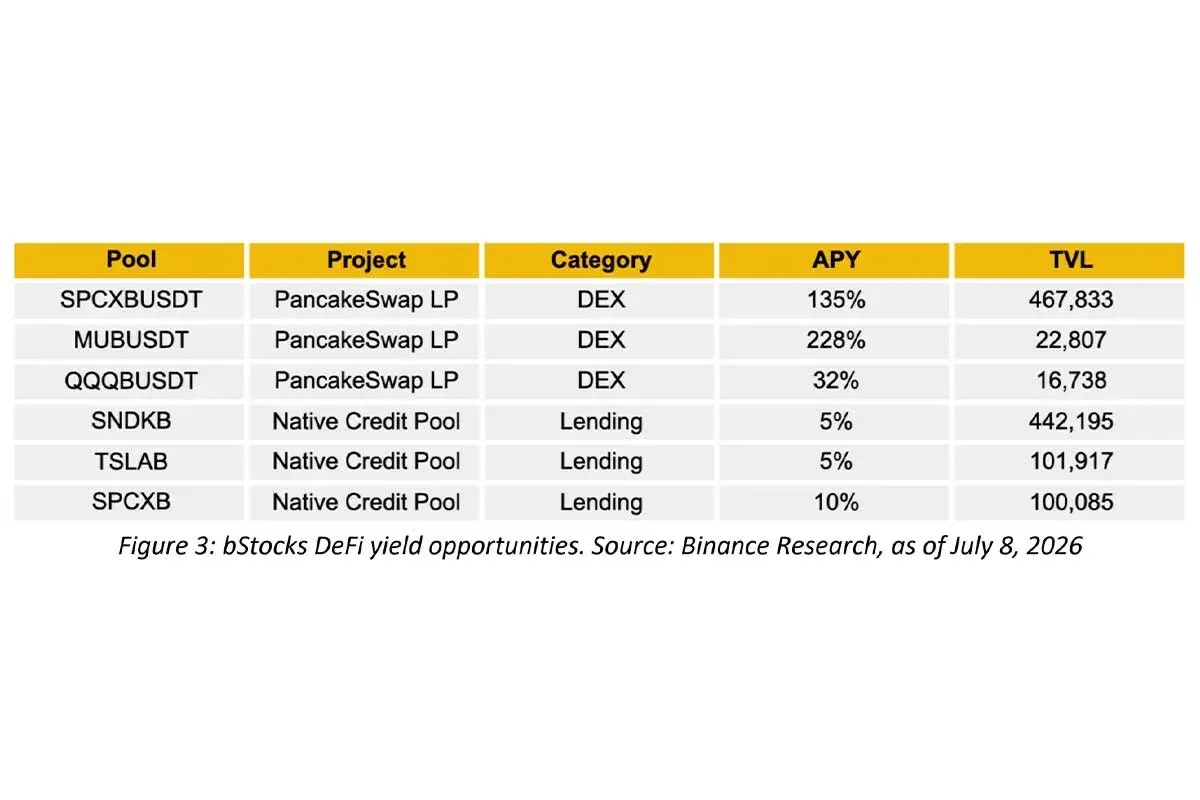
Figure 3: bStocks DeFi yield opportunities. Source: Binance Research, as of July 8, 2026
- The fourth reason is flexibility. Binance users can freely move between a bStock and its underlying stock 1:1 instantly and without paying any conversion fees.
With this frictionless loop in place, price remains tightly pegged. And the gap left by TradFi markets not operating 24/7 creates temporary price differences between a bStock and its underlying stock, giving users primary-market arbitrage opportunities.
According to the data, a sample of users generated $216M in rapid back-to-back trades across bStocks and the matching equities from June 11 to July 8.
Among them, most of the volume belonged to a small group of systematic traders. However, a vast number of retail participants were also present, with some showing up only to gain the advantage of arbitrage opportunities.
Binance Users are Moving Across Products
bStocks, however, doesn’t sit in its own silo, and neither does any product on Binance. Putting perps, stocks, and tokenized securities under one roof allows our users to diversify and build integrated portfolios instead of managing scattered positions across separate apps. The data so far shows that’s already happening: 58.5% of bStock users also traded perps or equities: 25% across perps and bStocks, 20.7% across all three, 12.7% across equities and bStocks.
Let’s look at SPCX’s recent listing as an example. 8.6% of users who traded its pre-IPO perps went on to trade the bStock, against just 0.6% who moved into the direct stock, nearly a 14x edge for the tokenized format as an on-ramp.
A likely explanation for the dramatic difference is familiarity. A token that trades on-chain and sits in the same wallet feels natural to a user who already trades pre-IPO perps. The direct stock, with its separate infrastructure and market hours, is the unfamiliar option.


- Compounding vs Drawdown: The Math Active Traders Often Underestimate
- A 1960s-Style Evening Is Coming to TOKEN2049 Singapore, Courtesy of ChangeNOW
- Smart Money Signals vs Whale Tracking: What Solana Traders Should Actually Follow in 2026
- Bybit Users Can Now Fund Accounts in USD via OpenPayd
- 3 Meme Coin Launchpads Making it up with AI Trends in 2026