Buy
Most fee comparisons stop at the headline percentage. That number tells you very little, because the rate you pay depends on which screen you trade from, where you live, and whether you hold the exchange’s token.
So we priced the same trade everywhere. One $1,000 market buy, at the rate a brand new account pays, taken from each exchange’s published schedule.
MEXC is the cheapest at $0.50. Binance, OKX, Bybit, Bitget and LBank all land around $1.00. Kraken Pro charges $8.00. And Coinbase changed its pricing on 16 September 2026, so the same trade now costs $1.00, $5.00 or $9.00 depending on which country you are in.
Each exchange also carries a low-fee rating out of 5. It is built from four cost measures and nothing else, so a high rating means cheap, not safe. The working is further down the page.
Here is the whole table.
 Feature your project
| Exchange | Spot maker / taker (entry tier) | $1,000 market buy | With token or subscription discount | Fee schedule public without login? | Crypto deposit | Where you can use it | Best for |
|---|---|---|---|---|---|---|---|
| 0.09% / 0.10% | $1.00 | — | No — tiers shown only after sign-in | Free | Brazil, India and other international markets | Cheapest regulated option outside the US and EU | |
| 0.00% / 0.05% | $0.50 | MX deduction (rate varies by account) | Yes — rates vary by region and pair | Free | Not US · No EU/EEA licence — not on the ESMA register, and the Dutch AFM warned in Sep 2025 that it served the Netherlands unlicensed | The cheapest headline spot fee | |
| 0.10% / 0.10% | $1.00 | $0.75 — 25% off paying in BNB | Yes | Free | Not US · Stopped serving EU/EEA residents on 1 July 2026 (no MiCA licence) | Deepest liquidity and coin range | |
| 0.08% / 0.10% | $1.00 | 0.06% / 0.08% holding 2,000+ OKB | Yes | Free | MiCA CASP via MFSA Malta · OKX US is a separate service at 0.20% / 0.35% and excludes NY and TX | Lowest maker fee among the majors | |
| 0.20% / 0.35% | $3.50 | VIP 1 at $100K: 0.10% / 0.20% | Yes | Free | US only, excludes New York and Texas | US traders wanting an order book | |
| 0.10% / 0.10% | $1.00 | $0.80 — 20% off paying in BGB | Yes | Free | Not US · Restricted Austria, France and Germany from 1 July 2026 · Live ASIC investor alert against a Bitget entity | Copy trading and futures | |
| 0.10% / 0.10% | $1.00 | VIP tiers only | Yes | Free | Not US · EU via Bybit EU GmbH (FMA Austria) | Derivatives alongside spot | |
| 0.10% / 0.10% | $1.00 | 0.08% / 0.08% at the next VIP tier | Yes | Free | Not US · No EU licence found on the ESMA register | Early access to new tokens | |
| 0.25% / 0.50% | $5.00 | — | No — sign-in required | Free | EU and UK | Regulated EU and UK trading | |
| 0.50% / 0.90% | $9.00 | Coinbase One subscription | No — sign-in required | Free (ACH) | All US states | US beginners moving to an order book | |
| 0.25% flat (both sides) | $2.50 | 0.10% above $20M monthly volume | Yes | Free (cards 0.49%–4.99%) | US in licensed states · EU licence status | Fiat deposits and withdrawals | |
| 0.40% / 0.80% (Tier 1, $0+) | $8.00 | Tier 3 at $10K volume or $20K held: 0.20% / 0.38% | Yes | Free | US (some state limits) · EU under MiCA via the Central Bank of Ireland | Regulated trading with published tiers | |
| 1.00% per position + spread | $10.00 + spread | 0.85%–0.95% at Platinum and above | Yes | Free | US, UK, EU and others | Social and copy trading |
The cost column is the entry-tier taker fee multiplied by $1,000. Place a limit order that sits on the book and you pay the maker fee instead, which is lower everywhere except CEX.IO and eToro, where both sides cost the same.
Two things jump out of that table. Kraken Pro, the most transparent exchange in the list, is now sixteen times more expensive than MEXC for a new account. And the gap between Coinbase’s cheapest and dearest customers is bigger than the gap between most exchanges.
On 16 September 2026, Coinbase rebuilt its Advanced fee structure. Volume tiers start at $10,000 instead of $25,000, spot and derivatives volume now count together, and the entry rate splits three ways by region.
| Where you live | Maker / taker | $1,000 market buy |
|---|---|---|
| Brazil, India and other international markets | 0.09% / 0.10% | $1.00 |
| EU and UK | 0.25% / 0.50% | $5.00 |
| United States | 0.50% / 0.90% | $9.00 |
Same app, same order, nine times the price in the US that it costs in India. If you are American and you trade often, that single fact is worth more than any other comparison on this page.
One more thing about Coinbase. It is the only exchange here that will not show you its fee schedule unless you sign in. Everyone else publishes theirs openly.
Nearly every exchange runs two products. There is the simple Buy button, which is what most people use, and there is the order book, which is where the rates in the table above apply. The difference is not small.
| Exchange | Simple or instant buy | Card purchase | Cost of a $1,000 instant buy |
|---|---|---|---|
| Kraken | 1% instant and recurring buys, 1.5% custom orders, plus a spread in the quote | 3.75% + $0.25 on USD card deposits | $10.00 funded by bank, $47.75 funded by card |
| Coinbase | About 0.5% spread plus a fee: $0.99 to $2.99 under $200, then 1.49% by bank or 3.99% by card | 3.99% above $200 | $19.90 by bank, $44.90 by card |
| eToro | 1% per position, plus the market spread | No deposit fee | $10.00 plus spread |
| Binance, Bybit, MEXC, LBank, Bitget | Card purchases run through third-party providers, which set their own rates | Varies by provider and country | Shown on the order screen before you confirm |
Read the Kraken row twice. A card-funded $1,000 instant buy costs about $47.75. The same $1,000 on Kraken Pro costs $8.00. Kraken’s own fee page also says instant-buy volume does not count towards the volume discounts, so the expensive route never earns you the cheaper one.
Kraken does sell a way out. Kraken+ costs $4.99 a month and waives fees on up to $10,000 of monthly buying, selling and converting. It does not cover spreads, card charges or anything on Kraken Pro.
Partly. There are genuinely free trades available, but almost always on selected pairs, and usually with a condition attached.
Binance runs the clearest example. FDUSD/USDT trades at 0% on both sides for everyone. Several pairs against USD1, including BTC, ETH, BNB, ADA and DOGE, are 0% for makers and free on both sides for VIP 2 to 9. A longer list of FDUSD pairs is free for makers only. Two catches, both stated on Binance’s own promotions page: volume on zero-fee pairs does not count towards your VIP tier, and the 25% BNB discount does not apply to them.
MEXC charges 0% to makers as standing policy, not as a promotion. Put a limit order on the book and it costs nothing.
Coinbase One waives trading fees up to a monthly limit for a subscription.
The things that are never free are the blockchain fee when you withdraw, and the spread. An exchange that drops its visible fee can widen the spread instead, and you will not see that on your receipt.
Withdrawal fees change with network conditions, sometimes daily, so any number we print here would be stale within a week. What does not change is where to look and what to watch for.
Binance, Kraken, OKX, Bitget, LBank, MEXC and CEX.IO all publish withdrawal fees per coin and per network without a login. Coinbase does not publish a fixed schedule at all. It shows the network fee when you make the withdrawal.
The thing worth knowing is that the network you pick matters more than the exchange you pick. Moving USDT costs a few cents on some networks and a couple of dollars on others, on the same exchange, in the same minute. Check the fee on the withdrawal screen before you confirm, and if your destination supports more than one network, take the cheap one.

MEXC charges 0% to makers and 0.05% to takers, which is the lowest published spot rate of any large exchange. A $1,000 market buy costs 50 cents. A limit order costs nothing at all.
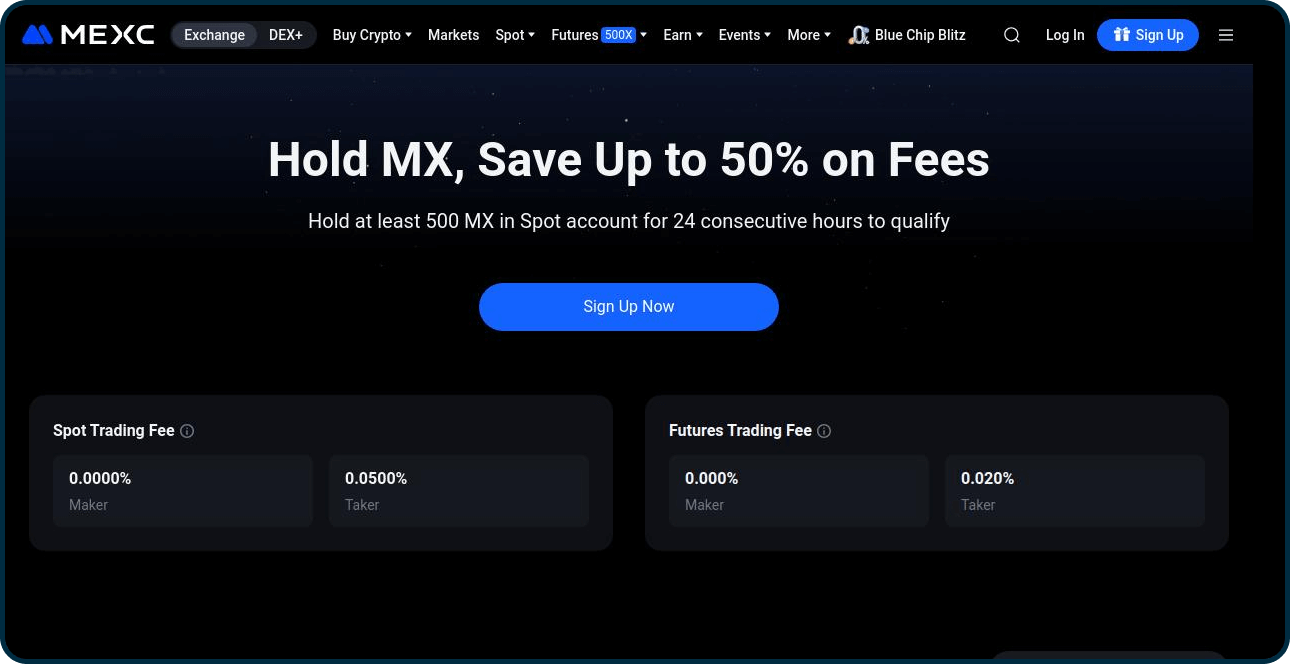
The catch is not the fee. MEXC has no MiCA licence and does not appear on the EU register, and three regulators have acted: the Dutch AFM warned consumers about it on 24 September 2025, Belgium’s FSMA ordered it to stop serving Belgian clients in July 2024, and it sits on the FCA’s warning list in the UK. It does not serve US residents. Rates also vary by region and pair, and orders placed through the API cost 0.06% and 0.08% instead of the advertised rates.

Binance charges 0.10% both ways, dropping to 0.075% if you pay fees in BNB. That discount applies from your very first trade, with no volume requirement, which is rare. Futures cost 0.02% and 0.05%.
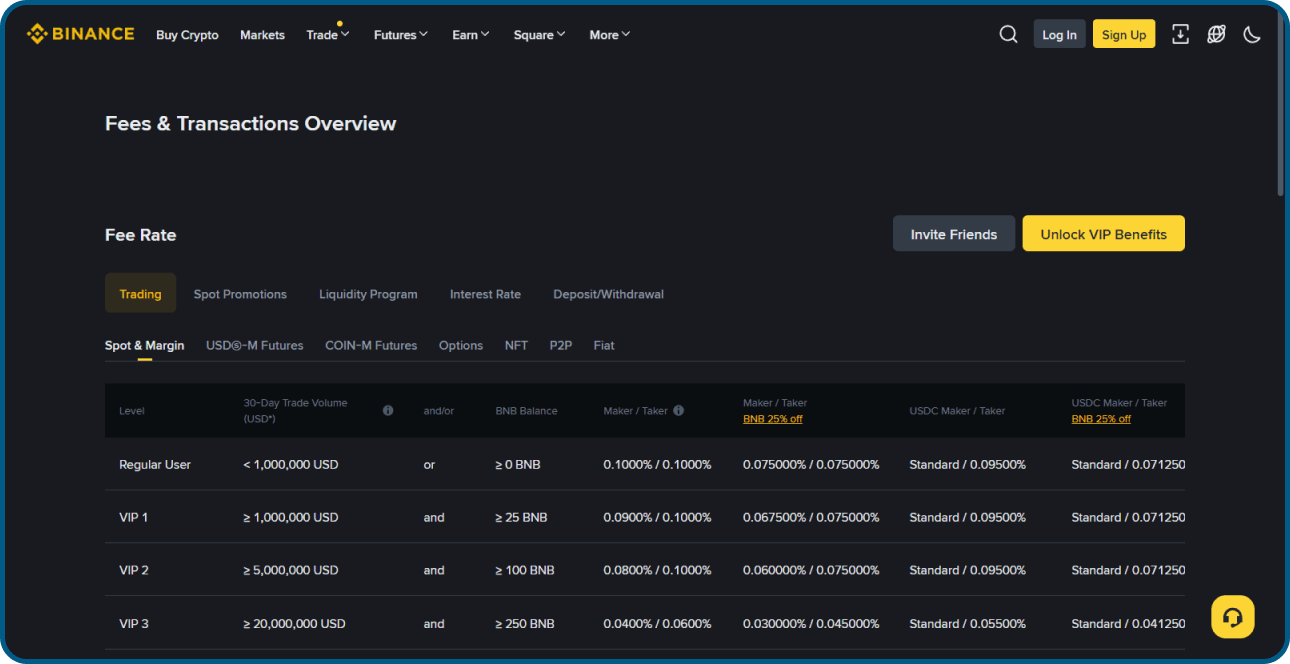
What you are really buying is liquidity. On major pairs the spread you pay on top of the fee is usually the tightest anywhere, and that often matters more than a basis point of commission. Binance stopped serving EU and EEA residents on 1 July 2026 after it failed to obtain a MiCA licence, and it has never served US residents.

OKX charges 0.08% to makers and 0.10% to takers, and holding 2,000 OKB or more brings that down to roughly 0.06% and 0.08%. Futures sit on a cheaper schedule again, at 0.02% and 0.05%.

Watch which OKX you are using. OKX US is a different service with different prices, 0.20% and 0.35%, and it does not operate in New York or Texas. In Europe, OKX holds a MiCA licence through Malta, which makes it one of the cheaper venues Europeans can still legally use. Tiers qualify on assets held or volume traded, whichever suits you better.

Bitget charges 0.10% on spot, or 0.08% if you pay in BGB, and 0.02% / 0.06% on futures. It publishes proof of reserves every month and has done for 46 consecutive months, most recently at a 135% reserve ratio across 19 assets.

September was rough. On 24 September 2026 attackers moved about $387.5m out of Bitget’s hot and warm wallets, using flaws in two third-party security tools rather than stealing any keys, and withdrawals were suspended. Bitget covered the loss from its own Protection Fund, customer balances were untouched, and all withdrawals, fiat services and P2P trading were restored on 2 October. It also carries a live ASIC investor alert over unlicensed crypto futures, holds no EU licence, and has restricted Austria, France and Germany since July 2026.

Bybit charges a flat 0.10% on both sides of a spot trade and 0.02% / 0.055% on perpetual futures. There is no token discount on spot, so a casual spot trader does better at Binance or Bitget.

European users trade through Bybit EU GmbH, licensed in Austria, which is unusual among the offshore-founded exchanges. US residents are excluded. Bybit also lost about $1.46bn to an attack in February 2025, the largest exchange hack on record, and says customer assets stayed fully backed throughout.

LBank charges 0.10% on both sides, with 0.08% at the next tier up, and 0.02% / 0.06% on futures. Small-cap and newly launched tokens often appear here before the bigger venues.
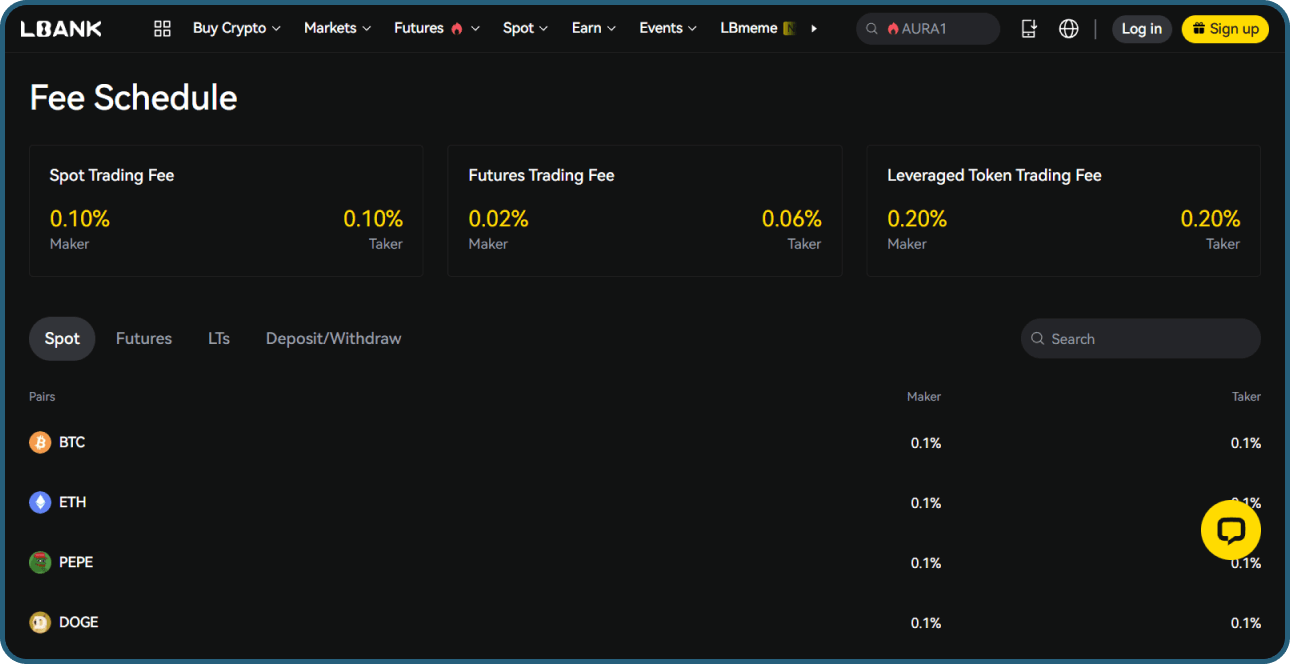
That is also the risk. On a thin order book, the slippage on a market order can cost more than any fee you saved. LBank has no MiCA licence, so it cannot take on new EU customers, and it discloses less about its corporate structure than the others here.

Coinbase is the only publicly listed company here, and it files audited accounts. Since 16 September 2026 its Advanced rates depend on where you live: 0.09% and 0.10% internationally, 0.25% and 0.50% in the EU and UK, 0.50% and 0.90% in the US.

Volume tiers now start at $10,000 and combine spot with derivatives. The Buy button is a separate and far more expensive product. Worth repeating: Coinbase only shows the full schedule to signed-in users.

CEX.IO charges a flat 0.25% to both sides under $10,000 of monthly volume, falling to 0.10% above $20m. That is five times MEXC’s rate, and the reason to pay it is fiat: direct USD, EUR and GBP deposits and withdrawals, US customers served in licensed states, and pricing you can work out in your head.
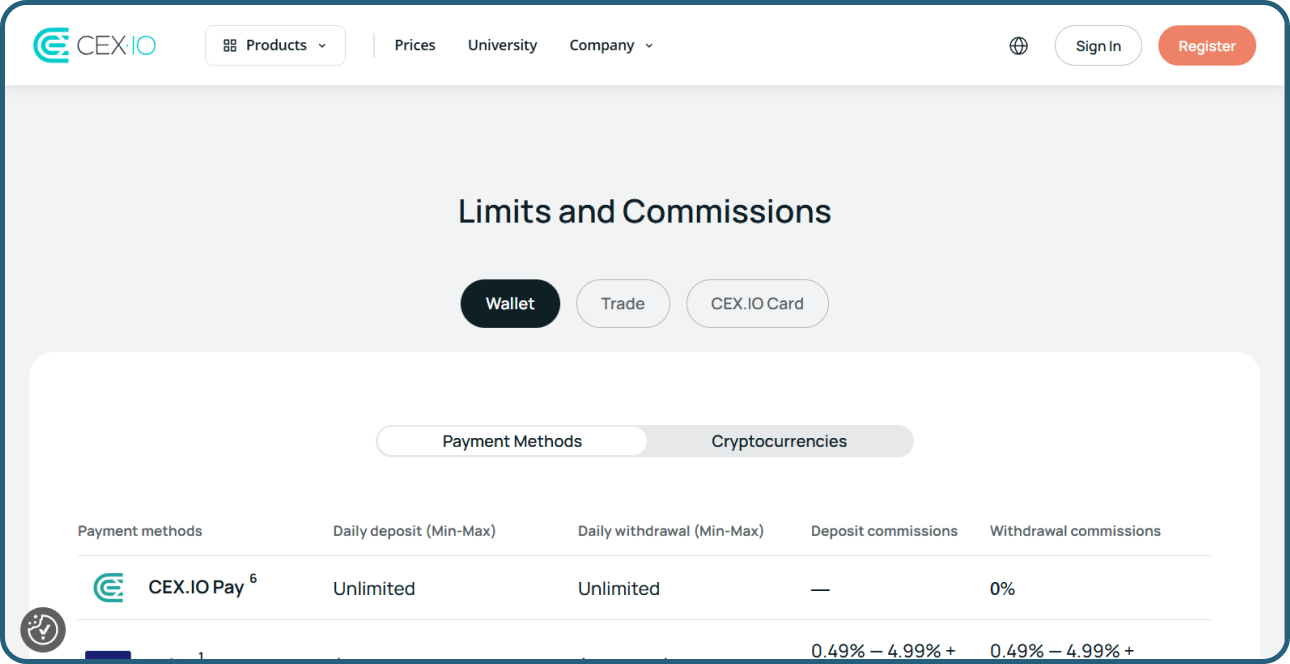
Cards are the expensive route, at 0.49% to 4.99% depending on method and country. CEX.IO has no MiCA licence, so it is closed to new EU customers.

Kraken publishes every tier, and assets you hold on the platform count towards your tier as well as volume traded. It is also the most expensive entry tier of any major exchange here: 0.40% maker and 0.80% taker, so $8.00 on a $1,000 buy.
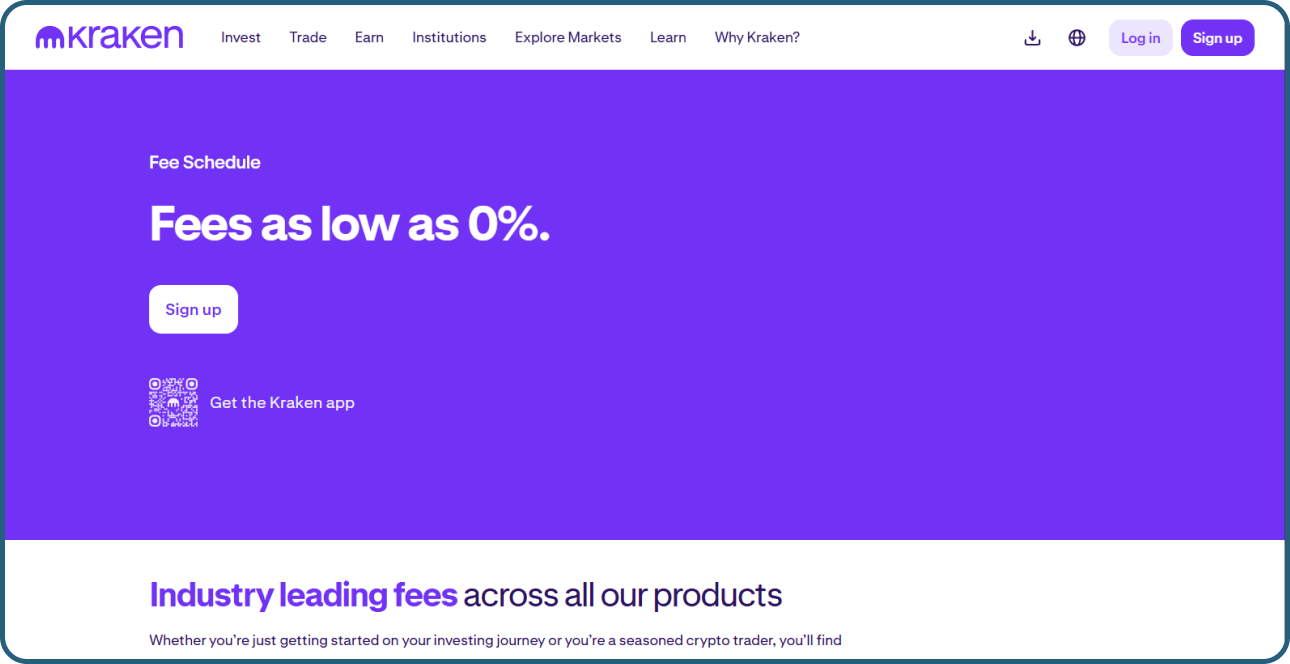
Rates fall fast with activity. Trade $10,000 in 30 days, or hold $20,000, and you are at 0.20% and 0.38%. The simple Kraken app charges 1% on instant buys and a USD card adds 3.75% plus 25 cents on top. In Europe, Kraken operates under a MiCA licence held by Payward Global Solutions Limited, authorised by the Central Bank of Ireland.

eToro charges 1% of the position when you open a crypto trade and 1% again when you close it, plus the market spread. Platinum members and above pay 0.85% to 0.95%. That makes it the most expensive way to buy crypto on this page.

Two non-trading fees matter as much as the rate: $5 to withdraw from a USD account, with a $30 minimum, and $10 a month if you do not log in for a year. What the price buys you is copy trading and one account covering crypto, stocks and ETFs. eToro (Europe) Ltd has held a MiCA licence from CySEC since January 2025, and eToro (UK) Ltd is authorised by the FCA.
We priced one $1,000 market buy at the entry fee tier on each exchange, using the rate a brand new account pays, taken from the exchange’s own published schedule. That figure is the cost column, and the order of the table is the order of that column. Nothing else moves a platform up or down.
Where an exchange runs separate services by region, we priced them separately, which is why Coinbase and OKX appear more than once. We also recorded whether the schedule is public without a login, what the simple Buy button costs, and which licence covers the entity serving each market, checked against the regulator’s own register.
The rating out of 5 comes from four measures, all of them about cost. Nothing else feeds into it. We do not score security, product range or customer support here, because this page answers one question.
| What we score | Weight | What a 5 looks like |
|---|---|---|
| What a $1,000 market buy costs at the entry tier | 50% | 50 cents or less |
| The cheapest route open to a brand new account: the maker fee, plus any token or subscription discount available on day one | 20% | Free, with no volume requirement |
| What the easy route costs: the simple Buy button, instant buy, or card funding, per $1,000 | 20% | Under $5 |
| Fee transparency: the full schedule published without a login, withdrawal fees published per coin and network, and no contradictions between the two | 10% | Everything published, nothing behind a sign-in |
Each measure is scored out of 5, multiplied by its weight, added up, and rounded to one decimal place. Two worked examples, so you can check us.
MEXC scores 5 on the first measure, because $1,000 costs 50 cents. It scores 5 on the second, because its maker fee is zero for everyone with no conditions attached. It gets 4 on the easy route, since card purchases run through outside providers but the order book is the default screen. Transparency gets 3.5: the schedule is public, but rates vary by region and the MX discount currently shows as 0% on MEXC’s own page. That works out at 4.65, which we publish as 4.7.
Kraken Pro scores 2 on the first measure at $8.00. The maker fee of 0.40% puts the second at 2.5. The easy route scores 2, because instant buys cost 1% and a card adds 3.75% plus 25 cents. Transparency scores a full 5, since Kraken publishes every tier and every withdrawal fee openly. Total: 2.4.
The table runs in order of what a $1,000 trade costs, cheapest first. Where two exchanges cost the same, the higher rating goes first, and where those tie as well, the lower maker fee wins. That is why Binance sits above OKX and Coinbase’s international service sits at the bottom of the $1.00 group: same trade cost, but Binance has free pairs and a 25% token discount from day one, while Coinbase hides its schedule behind a login.
You will see one place where a dearer exchange scores higher than a cheaper one. Kraken Pro costs more than Coinbase in the EU and UK, and they both land on 2.4, because Kraken publishes everything and Coinbase does not. That is the rating doing its job.
Fees last checked on 9 October 2026. Rates move without notice, so confirm on the exchange’s own page before you trade.
One thing this table does not tell you. It ranks exchanges by cost, not by safety. A low fee says nothing about how well a venue protects your money, and several of the cheapest here hold no licence in the EU or the US. Of the exchanges on this page, only OKX, Coinbase, Kraken, Bybit and eToro hold a MiCA licence. Binance, MEXC, LBank, CEX.IO and Bitget do not, and since 1 July 2026 an unlicensed platform cannot take on new customers in the EU or EEA.
MEXC, at 0% for makers and 0.05% for takers, which works out at 50 cents on a $1,000 trade. Binance, OKX, Bybit, Bitget and LBank all charge about $1.00 for the same trade. Kraken Pro charges $8.00 at its entry tier.
Between 50 cents and $10, depending on the exchange, and far more if you use the simple Buy button. On Kraken the same $1,000 costs $8.00 on Kraken Pro and about $47.75 if you fund it with a card.
Since 16 September 2026 Coinbase Advanced prices by region. US customers start at 0.50% maker and 0.90% taker, EU and UK customers at 0.25% and 0.50%, and international customers at 0.09% and 0.10%.
On some pairs, yes. Binance’s FDUSD/USDT pair trades free on both sides, and MEXC charges makers nothing at all. But the blockchain fee on withdrawal always applies, spreads can widen while a promotion runs, and on Binance the volume you trade on zero-fee pairs does not count towards your VIP tier.
Whichever one you already use, traded from its order book rather than its Buy button. That single switch saves more than changing exchanges. If you are starting from scratch and want a licence behind you, Kraken and Coinbase both publish their rates and hold EU authorisation, though neither is cheap at the entry tier.
No. Binance stopped serving EU and EEA residents on 1 July 2026 because it does not hold a MiCA licence. Kraken, OKX, Bybit, Coinbase and eToro all do.









 2M+ Monthly Readers
 50k+ Articles