Buy

List your Card on CoinGape
RoboSats takes the top spot in our no-KYC crypto exchanges review with a score of 8.1/10, followed by Uniswap at 8/10 and SimpleSwap at 7.80/10. The scores reflect how each exchange performed across our six weighted criteria: KYC-freedom depth, trust and track record, custody and security, privacy, costs, and usability and asset coverage.
For this comparison, we define a no-KYC exchange as a platform that lets users access its core crypto trading or swapping services without submitting government-issued identification for routine use. Geographic restrictions apply; several no-KYC exchanges exclude U.S. residents per their terms of service.
Note that no-KYC exchanges carry no deposit insurance; many are unlicensed and offer no regulatory protections; funds on any exchange are at risk. All facts and rankings in this article are up to date as of September 2026.
No-KYC means different things across crypto exchanges. Some let users trade without creating an account; others allow unverified trading up to specific limits. The table below compares these differences alongside custody model, privacy stack, trading fees, restrictions, and track record.
Table order is based on score ranking, sorted in descending order; placement cannot be bought.
| Exchange | Our Score | No-KYC Tier (as published in official docs) | No-KYC Withdrawal Limit 24h | KYC Trigger Points | Custody Model | Geo-Restrictions | Privacy Stack | Trading Fees | XMR & Privacy-Coin Support | Track Record | Best For |
|---|---|---|---|---|---|---|---|---|---|---|---|
| 8.1 ⭐ | Full | None published - non-custodial | Not published | Non-custodial | No geographic restriction | Tor/Onion access. No registration. Email-free signup. Disposable robot identities. PGP-encrypted chat. Open source | 0.025% maker / 0.175% taker | None | Checked, none found | Private fiat-to-Bitcoin trading | |
| 8.0 ⭐ | Full | None published - non-custodial | Fiat on-ramps | Self-custodial | Not published | Wallet-based access. Permissionless protocol. No account | V2: 0.30%. V3: 0.05%, 0.30%, 1% V4: custom fees. | ZEC only as wrapped tokens | Checked, none found | Permissionless on-chain token markets | |
| 7.2 ⭐ | Full | None published - non-custodial | Flagged/high-risk swaps | Non-custodial | Not published | Tor/Onion. No account or email | 2% flat service fee + network fees | XMR only | Checked, none found | Cross-chain swaps across a broad pair coverage | |
| 7.3 ⭐ | Full | None published - non-custodial | AML/fraud/flagged transactions | Non-custodial | Not published | Tor. No account or email. JavaScript optional. Open-source tools | Variable fees. USDT, network fees range from $0.00048 to $2.29 | XMR and ZEC | Checked, none found | Fixed rate pricing and floating swaps |
|
| 7.8 ⭐ | Full | None published - non-custodial | Source of funds. Enhanced due diligence | Self-custodial | Afghanistan, Burundi, Central African Republic, China, Colombia, Côte d'Ivoire, Cuba, DRC, Eritrea, Austria, Belgium, Bulgaria, Croatia, Cyprus, Czechia, Denmark, Estonia, Finland, France, Germany, Greece, Hungary, Ireland, Italy, Latvia, Lithuania, Luxembourg, Malta, Netherlands, Poland, Portugal, Romania, Slovakia, Slovenia, Spain, Sweden, Guinea, Iran, Iraq, Japan, Liberia, Libya, Mali, Nicaragua, North Korea, Myanmar, Guinea-Bissau, Somalia, South Sudan, Sudan, Syria, US, UK, Venezuela, Yemen and Zimbabwe | No-account | Not published | XMR, ZEC & DASH | Checked, none found | Swapping between obscure or hard-to-find cryptocurrencies | |
| 7.5 ⭐ | Full | None published - non-custodial | Dispute documentation | Self-custodial; Escrow-multisig | No geographic restriction | Tor hidden services. Encrypted P2P. Open source | 0.15% maker / 1.15% taker when paid in BTC 0.075% maker / 0.575% taker when paid in BSQ | XMR only | May 2026 exploit. 10 users lost 11.59104 BTC | Private, decentralized P2P trading | |
| 7.5 ⭐ | Full | None published - non-custodial | Geographic access | Self-custodial | US, Canada, UK, Iran and North Korea | Wallet-based access | 0.010% maker / 0.050% taker | None | Checked, none found | Self-custodial perpetuals | |
| 7.2 ⭐ | Tiered | $10,000/day | Account security, suspicious activity, regulatory requirements, high-value and high-frequency transactions | Custodial CEX | US, China, Hong Kong, Canada, EEA, UK, Switzerland, Kazakhstan, Iran | Spot: 0.20% maker / 0.20% taker | XMR & ZEC | Checked, none found | Trading both spot and futures without completing KYC | ||
| 7.0 ⭐ | Full | None published - non-custodial | Internal policy. Dispute documentation. | Non-custodial; Escrow-multisig | Russia, Belarus, United States, Cuba, North Korea, Iran, Iraq, Syria, Sudan, Somalia and UN-embargoed jurisdictions | Email signup. Multisig escrow. Direct user-to-user settlement | Spot: 0.75% standard; 0.50% for referred/referrer users | None | Checked, none found | P2P Bitcoin trading with multisig escrow | |
| 5.7 ⭐ | Tiered | $20,000 per 24h | Fiat services. Enhanced due diligence. | Custodial CEX | US, Canada, Iran, North Korea, Russia | Email-based account | Futures: Spot: 0.01% maker / 0.045% taker | None | Checked, none found | Leveraged crypto trading with adjustable exposure | |
| 5.4 ⭐ | Tiered | None; requires KYC for deposits, withdrawals, and trading | Platform funding/trading | Custodial CEX | North Korea, Canada, Cuba, Sudan, Iran, Mainland China, Singapore, US, UK, Hong Kong | Spot: Spot: 0% maker / 0.05% taker | XMR & ZEC | Checked, none found | Low-cost trading across altcoins | ||
| 4.2 ⭐ | Tiered | ≤20,000 USDT/day | Standard platform access. High-risk withdrawal | Custodial CEX | US, China, Hong Kong, Singapore, Canada, North Korea, Cuba | Email-based account | Spot: Spot: 0.10% maker / 0.10% taker | ZEC only | February 2025 - $1.46B hack | Futures copy trading |
We reviewed each crypto exchange’s KYC requirements, withdrawal limits, custody model, privacy protections, fees, security record, and overall accessibility without identity verification. We then scored each platform against the same criteria across six weighted pillars, with the strongest emphasis on what users can actually do without completing KYC.
The table below sets out the scoring scheme used for the comparison. It also shows how we awarded points or deducted points across the pillars.
| Pillars | |||||
| Verified KYC-Freedom Depth (30%) | Trust & Track Record (25%) | Custody & Security (15%) | Privacy Stack (10%) | Costs (10%) | Usability & Asset Coverage (10%) |
|
Total score starts at 10
|
|
|
|
|
Each exchange is scored from 0 to 10, multiplied by the pillar’s weight, and then summed to produce the final score out of 10. The breakdown is as follows:
|
Pillars |
||||||||
| Position | Exchanges | Verified KYC-Freedom Depth (30%) | Trust & Track Record (25%) | Custody & Security (15%) | Privacy Stack (10%) | Costs (10%) | Usability & Asset Coverage (10%) | Final Score (Over 10) |
| 1 | RoboSats | 9 | 9 | 8 | 6 | 8 | 5 | 8.1 |
| 2 | Uniswap | 9 | 10 | 8 | 3 | 4 | 9 | 8.0 |
| 3 | SimpleSwap | 9 | 10 | 6 | 4 | 6 | 7 | 7.8 |
| 4 | Bisq | 9 | 6 | 10 | 8 | 6 | 4 | 7.5 |
| 5 | dYdX | 9 | 9 | 8 | 3 | 3 | 7 | 7.5 |
| 6 | HiddenSwap | 7 | 10 | 8 | 9 | 1 | 5 | 7.3 |
| 7 | CoinEx | 7 | 10 | 4 | 2 | 8 | 10 | 7.2 |
| 8 | GhostSwap | 9 | 9 | 6 | 7 | 1 | 5 | 7.2 |
| 9 | Hodl Hodl | 6 | 10 | 8 | 0 | 5 | 5 | 6.5 |
| 10 | PrimeXBT | 6 | 10 | 0 | 0 | 5 | 9 | 5.7 |
| 11 | MEXC | 0 | 10 | 5 | 2 | 9 | 10 | 5.4 |
| 12 | Bybit | 0 | 6 | 5 | 0 | 9 | 10 | 4.2 |

RoboSats is a peer-to-peer Bitcoin exchange designed around Tor. It uses the Lightning Network for its trading infrastructure and gives each trade a randomly generated robot identity. Users generate a new identity for every trade, while Tor prevents the RoboSats node and trading peer from learning the user’s IP address or location.

| Trading fees | 0.025% maker / 0.175% taker (Source) |
| BTC withdrawal fee | None published |
| No-KYC tier & 24h limit | None published |
| Deposit methods | Instant SEPA, Amazon eGift Cards, Interac e-Transfer, Wise, Revolut, PayPal (Source) |
| Custody / security model | Non-custodial |
| Licenses | No licenses found in NYDFS/FCA/MiCA registers, checked September 2026 |
| Incidents (last 24 months) | None published |
The catch

On Uniswap, you connect your wallet, choose the tokens you want to exchange, and approve the transaction on-chain. You don’t need to create an account or complete KYC for crypto-to-crypto swaps. However, KYC comes into play when you use Uniswap’s fiat on-ramp to buy crypto, as the third-party payment providers handling those purchases require identity verification.

| Trading fees | v2: 0.30% swap fee
v3: 0.05%, 0.30%, and 1% v4: from 0% to 100%, depending on pool creators (Source) |
| BTC withdrawal fee | Not applicable (wallet-to-wallet, not a custodial exchange) |
| No-KYC tier & 24h limit | Buying crypto through third-party fiat providers |
| Deposit methods | Wallet transfers, fiat on-ramps (debit/credit cards and bank transfers) (Source) |
| Custody / security model | Self-custodial |
| Licenses | No licenses found in NYDFS/FCA/MiCA registers, checked September 2026 |
| Incidents (last 24 months) | None published |
The catch

GhostSwap is a non-custodial crypto swap platform that supports 1,600+ cryptocurrency pairs without requiring an account or routine KYC. You send crypto from your wallet, and GhostSwap routes the swap through third-party processing partners before sending the coins to your destination address.
The tradeoff is that no-KYC is not guaranteed for every transaction. As part of its AML compliance, GhostSwap says that every swap is automatically screened by its processing partners, and a flagged deposit can be held until identity verification or source-of-funds information is provided.

| Trading fees | 2% flat service fee + network fees (source) |
| BTC withdrawal fee | Not applicable |
| No-KYC tier & 24h limit | No tier or fixed limit |
| Deposit methods | Crypto wallet (source) |
| Custody / security model | Non-custodial |
| Licenses | No licenses found in NYDFS/FCA/MiCA registers, checked September 2026 |
| Incidents (last 24 months) | None published |
The catch

HiddenSwap supports more than 1,100 coins and networks, with no account, email, or ID required for normal swaps. It lets users choose between a floating rate that changes with the market or a fixed rate that locks the quoted amount for the order’s validity period (usually about 2 minutes).
HiddenSwap’s trade-off is that no-KYC does not mean every swap is guaranteed to complete without review. It monitors swaps and can pause a transaction, request more information, or refuse it if fraud or other illegal activity is suspected.

| Trading fees | Not published for other crypto-to-crypto swaps (variable)
For USDT, network fees range from $0.00048 on Avalanche C-Chain to $2.29 on Tron (source) |
| BTC withdrawal fee | Not applicable |
| No-KYC tier & 24h limit | No account, email, or ID required, and no 24-hour limit published |
| Deposit methods | Crypto wallet (source) |
| Custody / security model | Non-custodial |
| Licenses | No licenses found in NYDFS/FCA/MiCA registers, checked September 2026 |
| Incidents (last 24 months) | None published |
The catch

SimpleSwap is a multi-source crypto swap aggregator built for instant wallet-to-wallet exchanges. You choose the assets, enter your receiving wallet address, send crypto from your own wallet, and receive the swapped asset directly without creating an account or keeping a balance on SimpleSwap.
However, SimpleSwap does not publish a transaction or withdrawal limit for its no-KYC tier, which means KYC can be triggered at any time. If triggered, SimpleSwap can request identity and source-of-funds information and temporarily freeze the transaction while it reviews the request.

| Trading fees | Not published (variable) |
| BTC withdrawal fee | Not applicable (wallet-to-wallet, not a custodial exchange) |
| No-KYC tier & 24h limit | Not published |
| Deposit methods | Crypto wallet for swap, credit or debit card for fiat purchase (Source) |
| Custody / security model | Self-custodial |
| Licenses | No licenses found in NYDFS/FCA/MiCA registers, checked September 2026 |
| Incidents (last 24 months) | None published |
The catch

Bisq is open-source software and a peer-to-peer trading network in which users run the Bisq application on their own computers, connect directly with other traders over Bisq’s P2P network, and settle fiat payments directly with one another.
The first generation, Bisq 1, uses a 2-of-2 multisig escrow controlled by the buyer and seller. Its successor, Bisq 2, relies on seller reputation and was built to support multiple trading protocols and privacy networks.

| Trading fees | 0.15% maker / 1.15% taker when paid in BTC
0.075% maker / 0.575% taker when paid in BSQ (Source) |
| BTC withdrawal fee | Not yet tested |
| No-KYC tier & 24h limit | None (Source) |
| Deposit methods | SEPA, SEPA Instant, Faster Payments, ACH, Zelle, Revolut, Wise, Pix (Source) |
| Custody / security model | Self-custodial |
| Licenses | No licenses found in NYDFS/FCA/MiCA registers, checked September 2026 |
| Incidents (last 24 months) | Bisq v1 exploit resulted in 11.59104 BTC loss (May 1, 2026) |
The catch
You don’t need to complete an ID verification process to start trading perpetuals on the dYdX exchange. Simply connect a crypto wallet, deposit funds, and trade perpetual markets such as BTC-USD and ETH-USD. The platform supports a range of order types, including market, limit, stop, and take-profit.

| Trading fees | 0.010% maker / 0.050% taker (Source) |
| BTC withdrawal fee | Not published |
| No-KYC tier & 24h limit | No KYC tier |
| Deposit methods | Crypto deposits |
| Custody / security model | Self-custodial (wallet-controlled) |
| Licenses | No licenses found in NYDFS/FCA/MiCA registers, checked September 2026 |
| Incidents (last 24 months) | October 2025 chain halt (Source) |
The catch

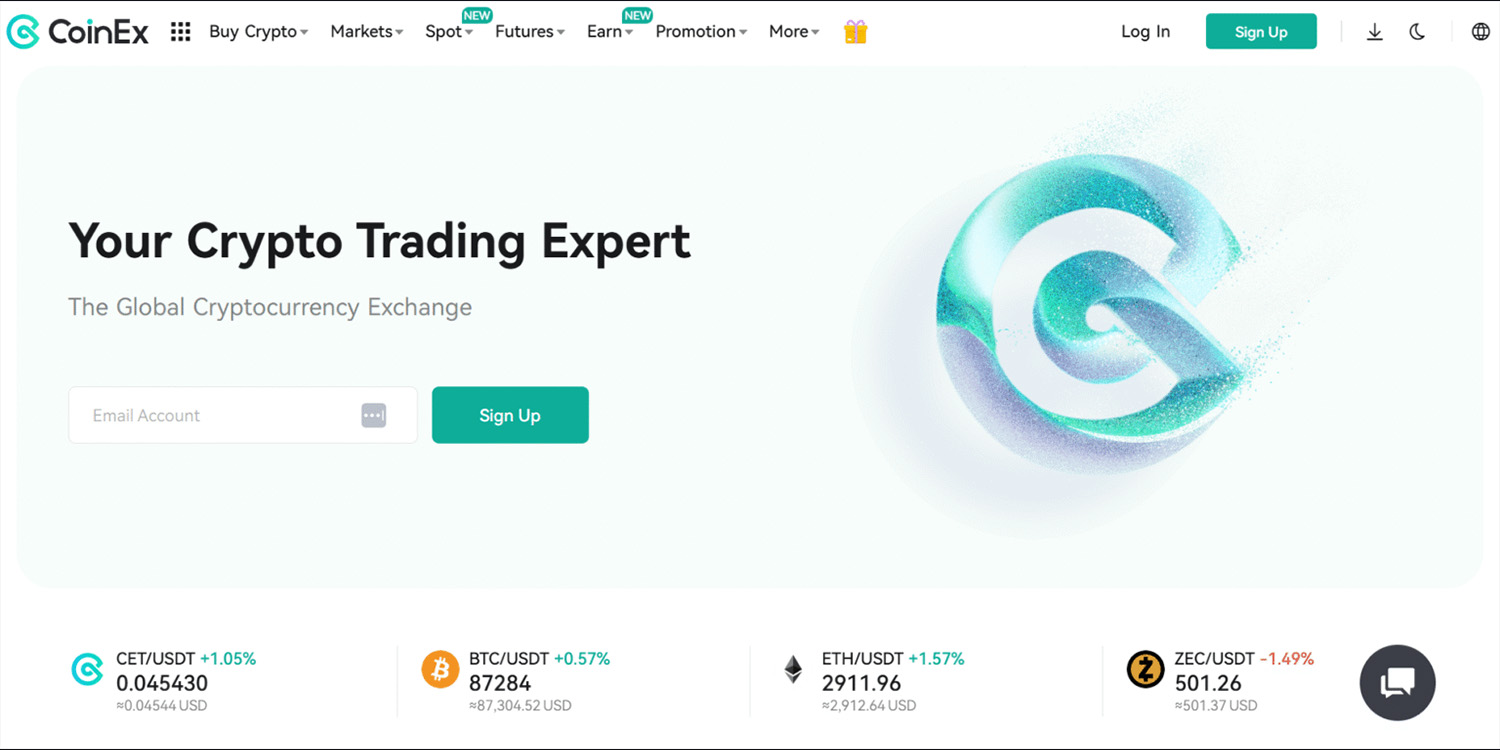
CoinEx actually permits crypto trading before KYC. You can trade spot, margin, and futures without completing identity verification. However, withdrawals are capped at $10,000 per day and $50,000 over a 30-day period.
CoinEx’s AML/KYC policy gives the exchange broad discretion to request identity verification, including in response to suspicious activity, security incidents, or regulatory requirements.
| Trading fees | 0.20% maker / taker; 20% discount when paying fees with CET (Source) |
| BTC withdrawal fee | 0.0001 BTC |
| No-KYC tier & 24h limit | Spot, margin, and futures trading allowed; withdrawal is $10,000/24hours (Source) |
| Deposit methods | Crypto deposits |
| Custody / security model | Custodial |
| Licenses | No licenses found in NYDFS/FCA/MiCA registers, checked September 2026 |
| Incidents (last 24 months) | Not published |
The catch

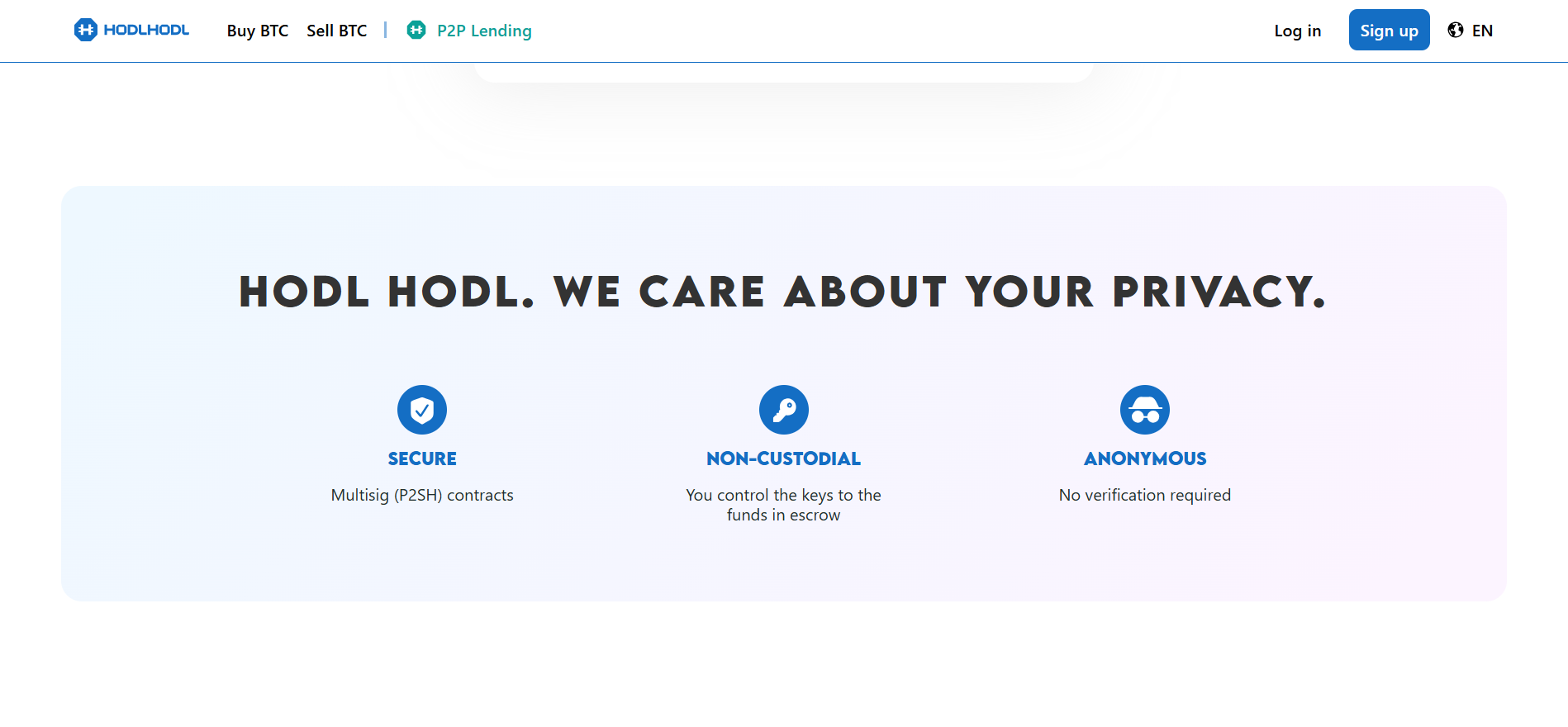
Hodl Hodl is best for buying or selling Bitcoin without going through identity verification. It’s a P2P Bitcoin marketplace where you trade directly with another user, with the BTC locked in a 2-of-3 multisig escrow rather than deposited into a custodial exchange wallet. You sign up with an email address and password, connect your own Bitcoin wallet, and settle the payment directly with your counterparty.
| Trading fees | Fixed 0.75% service fee + variable swap fee (Source) |
| BTC withdrawal fee | Not published |
| No-KYC tier & 24h limit | No KYC required for normal trading |
| Deposit methods | Bitcoin Lightning Network, USDT, BUSD, USDC, SWIFT, Wise, N26, Google Pay, Apple Pay, Zelle, Venmo (Source) |
| Custody / security model | Non-custodial (2-of-3 multisig escrow) (Source) |
| Licenses | No licenses found in NYDFS/FCA/MiCA registers, checked September 2026 |
| Incidents (last 24 months) | None published |
The catch

PrimeXBT offers a usable unverified account. You can deposit crypto and trade on PrimeXBT without completing identity verification. Crypto withdrawals are capped at $20,000 per 24 hours, while money deposits are limited to $2,000.

| Trading fees | 0.01% maker / 0.045% taker for Crypto Futures (Source) |
| BTC withdrawal fee | None published |
| No-KYC tier & 24h limit | Withdrawals capped at $20,000 per 24 hours |
| Deposit methods | Crypto deposit, bank cards, local banks |
| Custody / security model | Custodial |
| Licenses | South Africa FSCA
El Salvador’s DASP license & BSP license (Source) |
| Incidents (last 24 months) | None published |
The catch

In February 2026, MEXC updated its AML/CFT compliance framework to restrict unverified users from depositing, withdrawing, and trading. That means there is no longer a meaningful no-KYC trading tier. Users must complete at least Primary KYC to access funding and trading, with an 80 BTC daily withdrawal limit, while Advanced KYC raises the limit to 200 BTC.

| Trading fees | 0% maker / 0.05% taker (Source) |
| BTC withdrawal fee | 0.00002 BTC (Source) |
| No-KYC tier & 24h limit | No usable unverified trading/withdrawal tier |
| Deposit methods | Online bank transfer, SEPA, Debit/Credit card, Apple Pay, Google Pay, MoonPay, AlchemyPay Legend (Source) |
| Custody / security model | Custodial |
| Licenses | No licenses found in NYDFS/FCA/MiCA registers, checked September 2026 |
| Incidents (last 24 months) | None published |
The catch

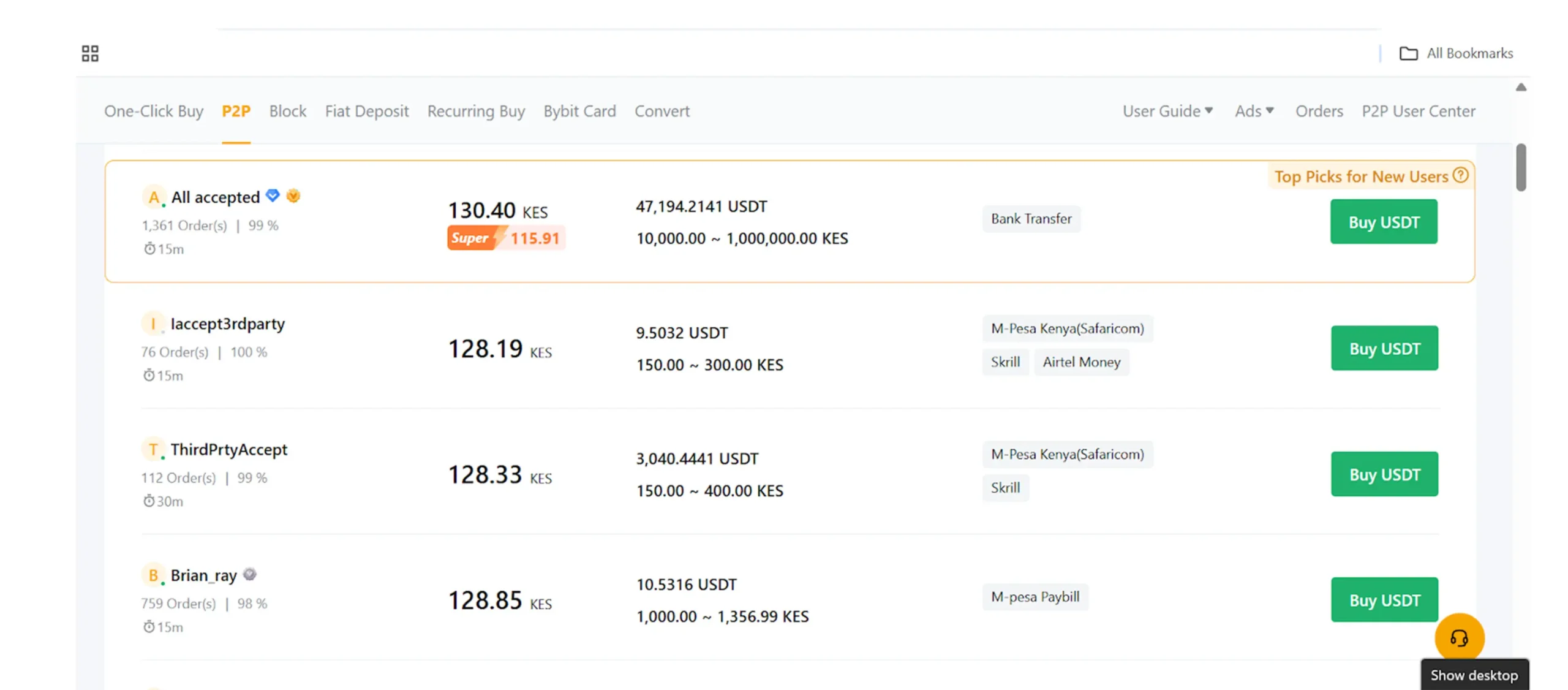
Bybit is a centralized exchange with a tiered verification system, but its no-KYC access is extremely limited. It doesn’t require verification for withdrawals up to 20,000 USDT daily / 100,000 USDT monthly, but users cannot deposit, trade, use P2P, buy crypto, or access other exchange services until they complete at least Standard Identity Verification.
| Trading fees | 0.10% maker / taker (Source) |
| BTC withdrawal fee | Varies. Not yet tested |
| No-KYC tier & 24h limit | Withdrawals only (≤ 20K USDT daily) |
| Deposit methods | Crypto deposit, one-click buy, fiat deposit (SEPA, PIX, SWIFT, bank card), and p2p. |
| Custody / security model | Custodial |
| Licenses | Bybit EU -MiCAR |
| Incidents (last 24 months) | Feb 2025 hack, resulting in $1.5 billion in losses. |
The catch
Sometimes, an exchange lets you use its services without KYC, but then suddenly asks you to verify your identity when you try to withdraw or complete a transaction. This is informally known as Shotgun KYC.
The problem is that the exchange does not clearly state when KYC can be triggered. For instance, SimpleSwap doesn’t publish a no-KYC transaction or withdrawal threshold. However, its AML/KYC policy allows it to require KYC on any transaction based on its risk assessment. Its Terms of Service also allow it to freeze funds, request information such as source of funds and proof of ownership, and refuse to return the funds if it is not satisfied with the documentation provided.
Using a no-KYC exchange is not, by itself, illegal for someone who buys, sells, or holds cryptocurrency. Instead, KYC and AML requirements place compliance obligations on exchanges and crypto service providers. For users, no KYC does not mean “no laws.” You are still responsible for complying with the laws that apply to your transactions, including tax obligations.
Buying crypto without KYC is much harder when starting with fiat. As such, most no-KYC platforms support crypto-to-crypto swaps because card and bank payment providers typically require identity verification before processing a purchase.
Platforms that use escrow let you buy directly from another person. Instead of giving your ID to a card or payment provider, you trade directly with another person, using an escrow system that holds the crypto until the payment is completed. This reduces the need for identity verification.
Among the 10 exchanges we reviewed in this article, four support Monero (XMR): Bisq, CoinEx, MEXC, and SimpleSwap. But support does not necessarily mean no-KYC access.
For instance, CoinEx requires ID verification for XMR deposits and withdrawals, while MEXC requires KYC for platform access. SimpleSwap supports XMR swaps without an account, and Bisq supports XMR through its decentralized P2P market.
For users specifically looking for no-KYC XMR, there is also a separate XMR-native ecosystem built around Haveno-based P2P trading and atomic swaps. These routes are designed specifically for exchanging Monero without relying on a conventional centralized exchange.
Centralized exchanges are tightening KYC requirements to comply with AML/CFT regulations. MEXC now requires KYC for deposits, withdrawals, and trading, while Bybit requires Standard KYC for spot trading, deposits, and P2P, despite publishing a 20,000 USDT daily non-KYC withdrawal allowance.
As a result, users who want genuine no-KYC activity are shifting toward P2P marketplaces and non-custodial DEXs such as RoboSats, Bisq, Uniswap, and dYdX.
Note that no-KYC exchanges carry additional risks and fewer regulatory protections. Crypto assets are generally not covered by FDIC deposit insurance or SIPC protection. Only trade with funds you can afford to lose, and consider moving assets not needed for active trading to a cold or DeFi wallet.
All facts and rankings are up to date as of September 2026. We regularly review and update this article as new information becomes available.
Disclosure: CoinGape earns commissions from some of the companies listed, but this does not affect our scores or rankings.
Generally, yes. For the user, using a no-KYC crypto exchange is not illegal, as KYC and AML compliance is primarily the platform’s responsibility. However, taxes still apply, and some exchanges restrict users from certain countries.
Yes, you can buy crypto without KYC using crypto you already own (crypto-to-crypto swap). The constraint is fiat, as card and bank on-ramps require ID. P2P is an alternative, with Bisq and Hodl Hodl using escrow or multisig.
CoinEx allows $10,000 per 24 hours, while MEXC currently requires KYC for withdrawals, so there is no no-KYC withdrawal limit. These figures are dated and detailed in our comparison table above.
Shotgun KYC is when an exchange requests identity verification after you’ve already deposited funds or initiated a transaction. It can be triggered by suspicious activity, source-of-funds checks, flagged withdrawals, or regulatory requirements.
No-KYC exchanges span the full risk spectrum, from non-custodial, open-source platforms to custodial exchanges with limited regulatory oversight. Check the Track Record column in our comparison table above for known incidents, and see our guide to the safest crypto exchanges.
From our review, PrimeXBT offers futures trading without requiring full verification. It also allows up to $20,000 in crypto withdrawals per 24 hours before verification. However, availability varies by jurisdiction.











 2M+ Monthly Readers
 50k+ Articles