
Atlas System Introduces Smart Cycle Platform: From Community Mutual Aid to Smart Contracts



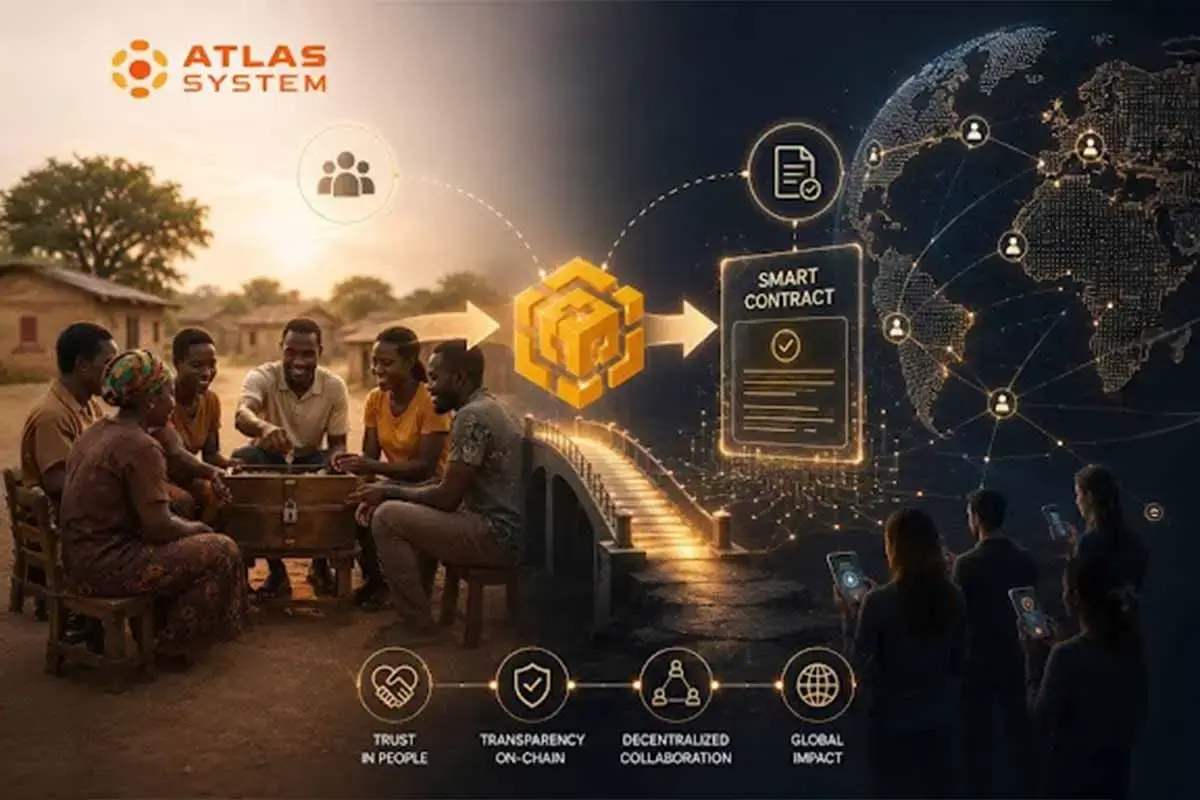
Atlas System today announced the launch of its digital mutual financing platform built on Web3 infrastructure and Hybrid DAO mechanics. The project’s first product, Smart Cycle, enables participants to contribute USDT through predefined cycles and later submit assistance requests according to selected parameters and available liquidity — an attempt to translate long-standing community mutual-aid practices into a programmable, borderless system.
Long before blockchains, communities developed ways to pool resources and support members during periods of need. Families, neighbors, colleagues and local associations contributed to common funds governed by rules understood within the group. These systems often worked because participants knew one another. Reputation mattered, organizers were visible and social pressure encouraged people to respect their commitments.
But the same characteristics that supported trust also limited scale. Manual accounting becomes difficult as a group grows. Participants in different countries may not know one another. Rules can be interpreted differently, records can be altered and control may become concentrated in the hands of a few organizers.
Web3 offers a possible technical response. Smart contracts can record contributions, apply predefined conditions and create a transaction history that participants can examine independently. The harder question is whether technology can scale mutual aid without turning it into something economically and socially different.
Atlas System Unveils Smart Cycle Mechanics
Atlas System describes itself as a digital mutual financing platform built around Web3 infrastructure and Hybrid DAO mechanics. Its first product, Smart Cycle, allows participants to contribute USDT through predefined cycles and later submit a request for assistance according to the selected parameters and available liquidity.
The project does not describe participation as a bank deposit or conventional investment. Its materials state that funds remain inside the system’s redistribution mechanics rather than being sent to an undisclosed external business, trading strategy or investment pool.
The Architect, the digital public persona representing the human founder behind the platform, describes the model in direct terms: “Atlas is not a bank, a deposit, an investment fund or guaranteed income. It is a voluntary digital mutual-aid system.”
The Founder’s Mutual-Aid Narrative
According to a biography supplied by the project, the founder’s interest in mutual financing was influenced partly by time spent in African countries. The project says he observed communities using informal mutual-aid funds where families, neighbors and colleagues combined resources because access to conventional financial services was limited or insufficient.
The idea that Atlas draws from those experiences is still useful for understanding its positioning. Traditional mutual-aid systems rely on human relationships and manual coordination. The project attempts to transfer parts of that logic into a programmable environment where participants may live in different countries and have no direct personal relationship.
What Smart Contracts Can Scale
Smart contracts can make several parts of mutual financing easier to scale. First, they can create a consistent record. A participant’s wallet interaction, USDT transfer and claim transaction can be recorded on BNB Smart Chain and reviewed through BscScan.
Second, they can apply the same programmed conditions to users without requiring an administrator to approve each standard action manually.
Third, public contracts can reduce some information asymmetry. Participants can review addresses, transaction histories and published source code instead of relying entirely on an internal dashboard.
Atlas System separates its architecture into contracts with different roles. Lockup Flow supports fixed-term Smart Cycles, while Daily Flow tracks cycles with daily calculated amounts. Transport and Distribute support routing and partner-related payments. This structure can support a larger and more geographically dispersed community than a manually managed local fund.
What Blockchain Cannot Scale Automatically
The social and economic limits remain. Traditional mutual aid often works because participants understand when support is needed and accept that outcomes may not be identical for everyone. A smart contract cannot interpret personal circumstances unless those circumstances are translated into data and rules.
It also cannot create liquidity. Atlas System’s documentation states that the ability to execute a request depends on available liquidity within the relevant Smart Cycle. A calculated amount shown by the system is therefore not the same as a guaranteed payment.
That difference becomes more important as the system grows. At a small scale, participants may understand the reciprocal nature of the model. At a global scale, some users may view the same mechanism primarily as an earning opportunity, especially when fixed deltas, referral rewards and cycle terms are emphasized.
From Personal Trust to System Trust
Local mutual-aid groups depend heavily on trust between people. Atlas tries to replace part of that relationship with trust in code, documentation and public records. But system trust has its own dependencies. Users still need to trust that the published interface points to the correct contracts. They need to understand administrative permissions, liquidity conditions and the difference between on-chain visibility and economic sustainability. They may also rely on community leaders to explain a model that is more complex than a simple token transfer.
The project uses a referral and partner structure to support that education and growth. The quality of the model will therefore depend partly on how accurately community leaders present it.
Final Thoughts
Blockchain can help mutual-aid systems operate across borders, automate records and make financial movements more visible. Those are meaningful improvements. It cannot guarantee liquidity, eliminate governance risk or ensure that every participant understands the same economic reality.
Atlas System illustrates both sides of the experiment. It uses smart contracts to make a community financing model more programmable and inspectable. At the same time, its long-term viability still depends on participant behavior, available liquidity, operational controls and honest communication.
Web3 may be able to scale the infrastructure of mutual aid. Whether it can scale the trust, responsibility and shared understanding behind that model remains the more difficult question.
About the Project
- Platform: https://atlas-system.io/
- X: https://x.com/AtlasSystemWeb3
- Facebook: https://www.facebook.com/profile.php?id=61590728242235
- TikTok: https://www.tiktok.com/@atlas_system_official
- Telegram Channel: https://t.me/atlas_system_official
- Youtube: https://www.youtube.com/@Atlas_system_official
- GitHub: https://github.com/atlas-system-dev/atlas-smart-cycle-v1


- ChangeNOW Announces NOW AI After Resolving Website Integration Vulnerability
- How AgentBNB Is Building an AI-Driven Ecosystem on BNB Chain as Its Presale Runs
- Sectora Foundation Announces Final Testing of Four Products and $SECT Token Availability on Uniswap
- Bitroot Brings the Parallel AI Blockchain to TOKEN2049 Singapore
- Bitunix Throws a Rooftop Party in Singapore and Showcases Its New Products
For PR & Sponsored Content Reach us :
 @Coingapeofficials