Buy
With every SPL token, there is an Associated Token Account in which it resides. On top of that, there are different DeFi custom account structures. This creates a dual layer of complexity for builders, which means they cannot just use any Solana API when building Solana-based applications.
This guide will explore the best Solana APIs of 2026, uncovering their features and their pros and cons, after answering a major question: what qualifies a good Solana API?
Versatility with speed and reliability that fits developers’ needs: this is one sentence that covers the attributes that a good Solana API should have. The bottom line is that a good API features elements that address Solana-specific technical challenges directly.
Since every SPL token lives in its own Associated Token Account, the mapping is more complex. A good Solana API is able to properly manage this abstraction, ensuring that the account model complexity does not burden the builder with technical complexity.
Considering Solana finalizes one block in roughly 400ms, handling over 80 million transactions daily, it is important that APIs keep up. If they don’t, data transaction rate drops, limiting builders’ capacity to develop the application.
DeFi protocols on Solana, such as Raydium, Jupiter, Meteora, etc., use custom account layouts. The raw RPC responses that come from them are dense, and for many, incoherent. With a good API, the program calls are transformed into comprehensible structured JSON.
Some APIs are capable of submitting transactions and streaming raw chain data. Other APIs can only read data. While many builders need both, there are some who require only one kind. A good Solana API could be any of the three.
With Solana’s NFT standard and newer state compression comes parsing complexity that non-Solana-native APIs cannot handle properly. A good Solana API, however, can.
This is a new requirement made prominent in 2026. The best Solana APIs are able to expose an MCP server so that agents like Claude or Cursor can query wallet or market data directly.

CoinStats Solana API is an all-in-one Solana data API, showing SPL balances, SOL, transactions, DeFi positions, and prices from one endpoint. How it works is simple. Once a user passes any Solana address, the API surfaces a JSON, which is fully priced in USD.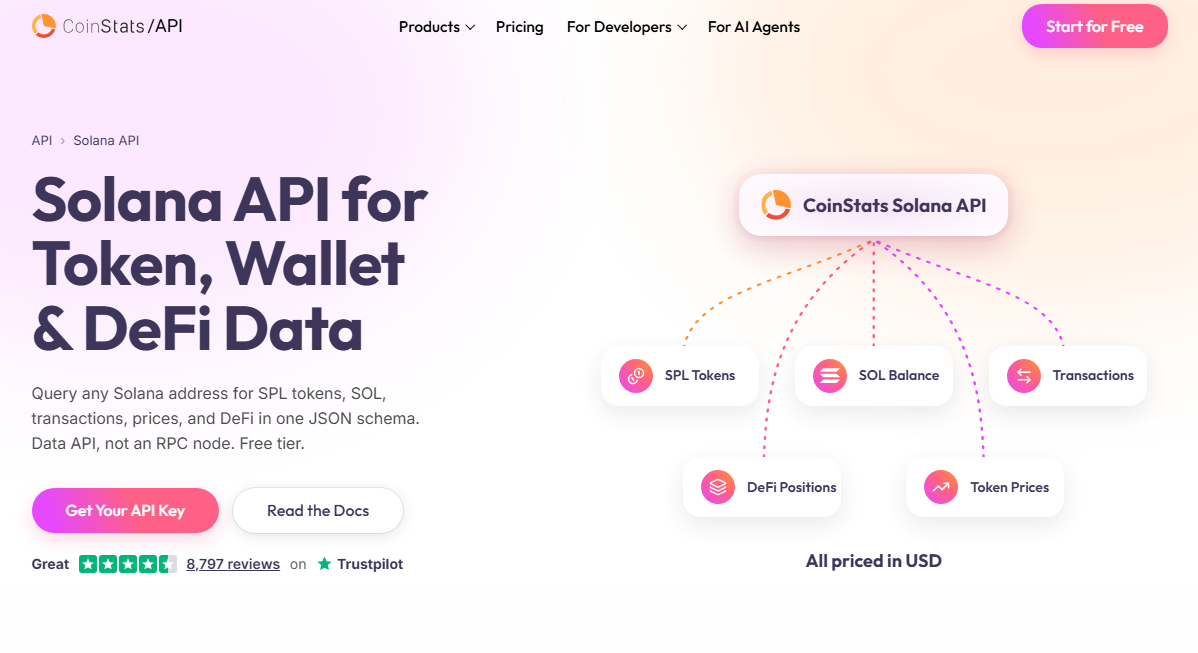
CoinStats API also addresses the biggest complexity of Solana, that stems from every SPL token sitting in its own Associated Token Account and DeFi protocols using custom account layouts. CoinStats addresses the issue by parsing upstream.
The platform auto-detects DeFi positions across 10,000+ protocols, which means it can detect the movement across staking, lending, liquidity, yield, etc., making it more versatile than a standard, Solana-only API.
Those who want to limit themselves to only Solana can find CoinStats API helpful since it covers over 120 blockchains. It has over 100,000 coins, and scrounges data from over 200 exchanges. The end user sees multiple details, including profit and loss, both realized and unrealized. With an MCP Server with 20 tools for AI agents, users can also leverage agents such as Claude and Cursor.
That said, CoinStats only offers a read-only layer. Not being an RPC node, it does not send any transactions or run any node. Those who want to send transactions should pair it with Helius or QuickNode.
The platform’s fee structure is unique. It boasts a free tier that gives 20,000 credits/month. Developers can use this tier for commercial purposes without needing to provide their credit card details.
To learn more about CoinStats’ API perks, users can check out this Solana API guide.

Helius’ addition to this best Solana API list is justified by the fact that it is a good fit for Solana-native developers. While it started as an RPC provider, the platform now acts as a complete Solana infrastructure platform, featuring everything from RPC, APIs, and webhooks to streaming and transaction landing.
Helius’ suite of core products includes a Digital Asset Standard API for NFT/token metadata and compressed NFTs. It features enhanced transactions with over 100 decoders for parsed activity.
The webhooks of the platform can watch up to 100,000 addresses per hook. For real-time data streaming, it features LaserStream, and for reliable transactions during congestion, it features staked connections.
Helius also operates Solana’s largest validator that has secured over $2.5 billion in value.
When it comes to Helius’ price structure, builders do get a large free tier with 1M credits per month that features 10 requests/sec. Higher tiers increase the number of requests per second.
At the largest tier, users get 200 million credits. It is $999 a month, and users also get access to customer support through Telegram.
Given the price structure and the Solana-native nature, Helius is only suitable for teams working exclusively on Solana. Due to no multi-chain support, teams who want to branch out would need a secondary provider.

QuickNode is popularly referred to as a multi-chain generalist API. One of the oldest RPC vendors, QuickNode supports Solana, alongside 65 other chains.
What makes QuickNode different is that despite being multi-chain, it does offer tools specific to Solana, such as DAS APIs, priority fee estimation, and QuickAlerts webhook notifications. Solana Kit plugin support is also available with QuickNode.
With the addition of NFT data, token price feeds, MEV protection, and transaction simulation, QuickNode stands out even more. It also lets users integrate with Jupiter API without needing any middleware.
The platform’s pricing structure is also similar to the above two Solana APIs. There is a free tier, valid for a trial period of one month, which gives builders 10 million credits. With the largest tier only costing $499 a month, Quicknode could be considered one of the more affordable options available.
Being a multi-chain API, QuickNode is suitable for teams seeking vendors that can deliver one bill across multiple networks. There is a trade-off though. Since the platform is not Solana-exclusive, the costs can rise up when more features are stacked to pre-made plans.
The free trial account also leaves much to be desired, as builders will only have access to community support, and the requests allowed per second are fewer.

What makes Shyft different is the fact that it is built around indexing, and not raw RPC. Its flagship feature is a GraphQL API, which is accessible via its SuperIndexer. This API can map any Anchor IDL to a queryable database schema.
That gives the indexer a more precise approach, as the queries don’t waste data pulling more information than needed.
Shyft shows its biggest strengths on two fronts. One is NFTs, for which the API delivers all the info, such as metadata, collections, mint history, transfers, and royalties, through one endpoint. And the other one is transaction parsing, which decodes program calls for major Solana DEXs and launchpads, and then structures them into a JSON file.
The platform also offers multiple infra products, such as staked RPCs across 7 global regions. It also offers Yellowstone gRPC streaming and RabbitStream.
Shyft’s pricing model also stands out. It does not have a credit metering system. At the free tier, users get access to “unlimited credits” at 10 requests per second.
Paid members get a “Build” tier. Costing $199/month, it gives builders access to gRPC and higher throughput.
The pricing model and the multi-chain, index-based approach make it fit for developers of NFT-heavy dApps. Builders developing applications that need decoded DEX/launchpad transaction data without building custom parsers would also prefer what Shyft has to offer.
The biggest trade-off of the platform is that it returns raw and parsed chain data. As priced portfolios are not visible through this API, most developers attach Shyft to data APIs like CoinStats API to get a view of the USD pricing.

“Market-data and trading-data specialist for Solana” are the words that best describe Birdeye. This leading Solana API offers real-time prices, charts, trade, and DEX liquidity, and does not act as a wallet or show portfolio data of the user.
On the official website, Birdeye claims to be the leading crypto trading data provider on Solana, with over 4,000+ enterprise data clients under its belt. The core data this API makes visible includes real-time token price with liquidity context, historical OHLCV, holder analytics, pool/token TVL charting, and new-token/launch tracking.
While Birdeye used to be Solana-exclusive, it has now branched out. Through its Data API, it now also covers other chains like Sui and Ethereum. Major EVM chains are also covered.
In terms of pricing, Birdeye does not feature a credit system. What it instead has is CU, or Compute Unit. At the lowest level, free tier, users get 30,000 CUs and a 1 request per second rate limit. At the highest tier, which costs $2,050 a month, users get 500 million CUs at 150 requests per second.
While Birdeye markets itself as a trading-data specialist, it does not resolve per-wallet DeFi positions, or provide an explorer-style wallet API. Its free tier is also more restrictive, offering only 1 request per minute as compared to the other Solana APIs on the list, which offer equal to or more than 10 requests per minute.
When selecting the Solana API for the list, we focused on three factors: the depth of Solana-native data available, the DeFi and market coverage, and price transparency.
Our analysts explored whether the API is capable of handling SPL token complexity, ATAs, and program-level parsing from the very start. We left out Solana APIs that leave developers to handle the heavy lifting.
The second ranking factor was whether the Solana API resolves per-wallet DeFi positions or gives access to real-time token pricing. CoinStats API, for instance, gained the top spot for its auto-detection of DeFi positions. At last we ranked Birdeye, which shows token prices in real time. We excluded those that only provided raw balances to users.
Pricing transparency was the last factor we focused on. We also assessed whether the platform offered a free tier, and even then, how many credits were made available. We also assessed the pricing structure for each, before assessing their fairness.
For overall performance, CoinStats gets our top pick. It is best for DeFi-aware builders who are looking for multi-chain reach. Those who prefer Solana exclusivity could find Helius to be a better option thanks to its deep infrastructure. QuickNode is picked for the comfortable system it gives for multi-chain teams. And Shyft’s addition to the best Solana API list is justified thanks to its features that align with NFT-first builders. Those looking for trade-based APIs would find Birdeye a better option.
Each platform serves builders of a particular niche. However, CoinStats can serve most, for its read-only capability is what most crypto apps need.











 2M+ Monthly Readers
 50k+ Articles