Buy

Crypto compliance and KYC providers are software vendors that help Web3 businesses verify users, screen businesses, monitor crypto transactions, detect wallet risk, meet Travel Rule requirements, and develop audit-ready compliance workflows.
No single platform covers every solution layer. Instead, most crypto compliance companies specialize in identity verification, blockchain analytics, or Travel Rule infrastructure. The best crypto compliance solution depends on your regulatory requirements and risk profile.
| Platform | Rating | Best For | Compliance Support | Core Modules | Crypto Coverage | KYC/KYB Coverage | Stablecoin Support | Security Audit | Vendor Type | Travel Rule |
|---|---|---|---|---|---|---|---|---|---|---|
| 4.4 ⭐ | Exchanges, neobanks, payments | KYC / KYB / AML / Travel Rule | Verification AML Crypto Monitor Travel Rule Cases | Partner (Chainalysis, TRM, Elliptic) | Native (220+ jurisdictions) | Yes (dedicated solution) | SOC 1/2 ISO 27001+ PCI DSS ETSI iBeta | Identity verification vendor. UK-registered data processor | Yes. Native 2,100+ VASPs | |
| 4.0 ⭐ | Exchanges, banks, stablecoin issuers | Blockchain analytics / KYT | Discovery, Lens, Navigator, Investigator, Data Fabric | 60+ blockchains | Pairs with vendor | Yes | SOC 2, ISO 27001, ISO 22301, ISO 9001 | Blockchain analytics software vendor | Yes (Lens + Navigator) | |
| 4.0 ⭐ | On-ramp/off-ramp, payment, sponsor-bank platforms | Fraud prevention / AML | Global KYC/KYB, Transaction Monitoring, Sanctions Screening, Agentic Ops | None (risk layer only) | Native | Indirect | SOC 2, GDPR, CCPA, CPRA, PCI DSS | Fraud and AML software vendor | No | |
| 4.0 ⭐ | EU crypto businesses, TradFi entering digital assets | Blockchain analytics / KYT / Travel Rule | Wallet Screening, Transaction Monitoring, VASP Directory, Travel Rule API | 23+ chains, EU-hosted | None | Yes | ISO/IEC 27001:2022 | Blockchain analytics software vendor. EU-hosted | Yes | |
| 4.0 ⭐ | VASPs, banks, custodians, payment providers | Travel Rule network | SafeTransact, Notabene Flow, TAP, VASP Directory | Multi-protocol Travel Rule + stablecoin payments | None (institutional only) | Yes | SOC 2, ISO 27001 | Travel Rule network operator | Yes | |
| 4.0 ⭐ | Exchanges, custodians, financial institutions | Blockchain analytics / KYT | KYT, Address Screening, VASP Risking, Reactor, Sentinel | Multi-chain, auto-onboarding | Pairs with vendor | Yes (Sentinel) | SOC 2/SOC 3 | Blockchain analytics software vendor | Via partner | |
| 3.8 ⭐ | Law enforcement, national security, financial institutions | Blockchain analytics / KYT | Forensics Screening Monitoring KYV Compliance360 | 184+ chains | Partner only | Yes (Compliance360) | SOC 2 II ISO 27001 ISO 27701 | Blockchain analytics software vendor | Yes |
Crypto compliance and KYC providers are software platforms that crypto businesses use to verify customers and businesses and screen against sanctions and PEP lists.
They also help monitor blockchain transactions, detect risky wallets, investigate suspicious activity, manage Travel Rule data, and generate audit-ready compliance records. KYC identifies individual customers; KYB verifies business customers and beneficial owners. KYT tracks the movement of crypto funds. A solid Web3 compliance program requires all three.

Best for businesses that need one vendor for KYC, KYB, AML screening
Sumsub combines identity verification, business verification, AML screening, and a proprietary Travel Rule network on a single platform. Sumsub relies on integrated partners like Chainalysis and TRM for blockchain analytics.

What to check before using it: Sumsub suffered a 2026 security breach involving customer support data. For an identity verification vendor, that’s an important issue to ignore. Also confirm that Sumsub’s integrated analytics provider supports your target chains, since it relies on third-party partners for analytics capabilities.
| Key Factors | Details |
| Travel Rule network | 2,100+ VASPs (own directory); $10T+ secured transaction volume (2025, self-reported) |
| KYC/KYB speed | Business check: 15 sec; UBO verification: 30 sec; 90-97% pass rate (self-reported) |
| Document coverage | 14,000+ document types; 220+ countries/territories |
| Core features | ID/document verification; biometric & liveness; deepfake detection; non-document verification |
| Crypto-specific fit | Exchanges, stablecoin issuers, and payment firms needing crypto KYC, KYB, and Travel Rule compliance with separate blockchain analytics |
| Supported regions | 220+ jurisdictions (KYC/KYB & Travel Rule) |

Best for exchanges, banks, and payment firms needing real-time screening
Elliptic offers core services like wallet screening, transaction monitoring, and cross-chain investigation tools built for live trading flows. Elliptic’s Travel Rule support covers counterparty identification and audit trails.

What to check before using it: Confirm whether you need a separate Travel Rule compliance provider for IVMS101 data exchange. You also need to verify chain coverage for the specific Elliptic product you’re using.
| Key Factors | Details |
| Screening latency | <500ms synchronous API response |
| Chain/bridge coverage | 60+ blockchains; 250+ bridges (platform-wide); |
| Stablecoin fit | Dedicated stablecoin risk management for issuer and exposure risk |
| KYC gap | No native KYC/KYB; integrates with third-party KYC providers |
| Core features | Wallet & transaction screening (Lens); cross-chain tracing (Navigator, Investigator); continuous monitoring |
| Crypto-specific fit | Exchanges, payment firms, and stablecoin issuers needing real-time and high-volume crypto transaction monitoring |
| Supported countries | 29+ countries |
Author Insight: Elliptic stands out among crypto compliance companies with its sub-500ms screening. This alone makes it the best choice for users who want crypto transaction monitoring in real-time payment flow. Although Elliptic supports Travel Rule risk assessment, VASPs that require originator/beneficiary data exchange will still need a dedicated data Travel Rule compliance provider.
Best for fintechs, on/off-ramp providers, and sponsor-bank programs
Sardine combines crypto KYC, KYB, fraud detection, and AML transaction monitoring for payment platforms. It is not a blockchain analytics provider like Chainalysis, but it offers wallet screening. Sardine is also not a Travel Rule solution, making it best as a fraud and compliance layer for crypto payment flows.
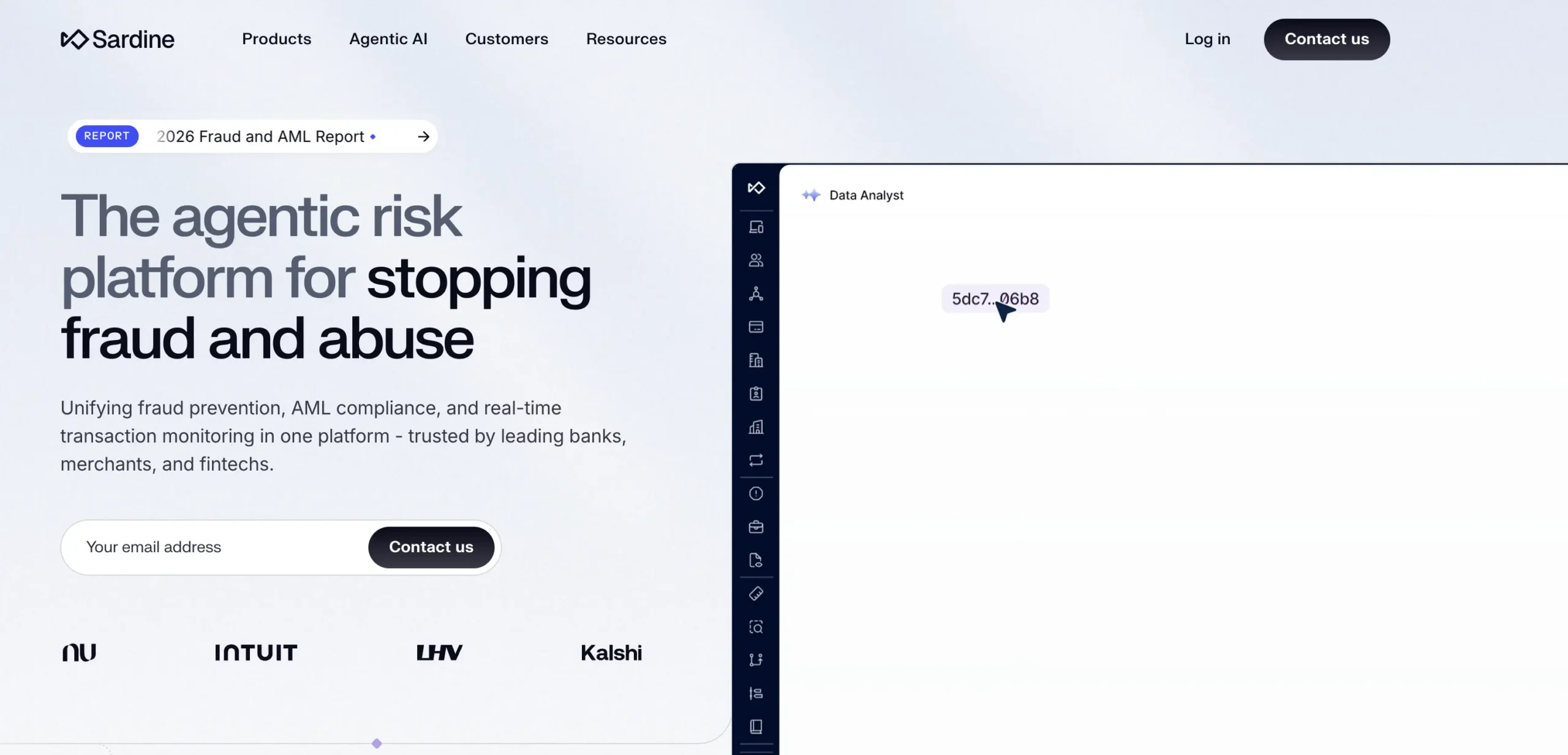
What to check before using it: Sardine does not offer any dedicated Travel Rule compliance or full blockchain analytics. If you need these solutions, Sardine is not the best option. Sardine’s strength is fraud prevention, onboarding risk, and AML around payment flows. Confirm crypto wallet screening depth, supported chains, and entity attributions.
| Key Factors | Details |
| Trust portal | Live trust center with downloadable SOC 2 report and 2025–2026 pentest reports (Dashboard, Network, JS SDK, API, Mobile Apps) |
| Scale | 985M consumers; $1.48T transaction volume; 4.92B transactions monitored (self-reported) |
| G2 rating | 4.9/5 |
| Crypto positioning | Fraud and risk-ops layer for stablecoin and crypto payment flows; not a dedicated crypto compliance solution |
| Core features | Global KYC/KYB; ID, document & bank verification; credit underwriting; fraud detection; bot & ATO detection |
| Crypto-specific fit | Native crypto wallet/transaction risk screening, exposure-based rules |
Author Insight: Sardine isn’t a traditional crypto compliance solution. So, it doesn’t focus on blockchain analytics. Instead, Sardine is a good fit for Web3 brands that want crypto KYC, fraud prevention, and AML for fiat on/off-ramp flows. The best approach to using Sardine is as a complement to blockchain analytics providers.
Also Read – No-KYC vs Travel Rule

Best for EU-based exchanges, tokens, and stablecoin issuers, and financial institutions
ScoreChain combines blockchain analytics, crypto transactions monitoring, and a Travel Rule API on an EU-hosted platform. ScoreChain does not have a native crypto KYC, meaning it needs an integration with a separate identity verification provider. ScoreChain’s Travel Rule API uses partner infrastructure.

What to check before using it: ScoreChain supports 23+ blockchain coverage. Confirm if that meets your needs. Also, compare its native Travel Rule features with dedicated providers. Check API limits and KYC/KYB integrations.
| Key Factors | Details |
| Hosting | EU-hosted private cloud; GDPR-aligned; built for MiCA compliance |
| Chain coverage | 23+ blockchains |
| Stablecoin monitoring | Supports USDT, USDC, EURC, and EURCV with issuer, intermediary, and user-level visibility |
| Core features | Wallet screening; crypto transaction monitoring; exposure tracing; KYA/KYT reports; VASP directory; stablecoin monitoring |
| Crypto-specific fit | EU exchanges, token and stablecoin issuers |
Author’s Insight: ScoreChain is one of the best crypto compliance companies for EU-focused companies. It’s one of the few that combines blockchain analytics and Travel Rule compliance in one workflow. The major limitations are the absence of native KYC/KYB and reliance on partner infrastructure for Travel Rule data exchange
Best for VASPs, banks, custodians, and payment providers
Notabene is designed for Travel Rule and stablecoin cross-border payments networks. It is not a general KYC or blockchain analytics.

What to check before using it: Confirm which blockchain analytics providers and crypto KYC providers integrate with your stack. Confirm supported Travel Rule protocols, blockchain support, and analytics integration.
| Key Factors | Details |
| Network scale | 2,000+ financial institutions; 100+ jurisdictions; $2T+ compliant transaction volume (self-reported) |
| Flow | $1T+ annual TPV; 85% straight-through processing; 500+ average counterparty connections |
| Notable backing | Strategic investment from Ripple |
| Core features | Travel Rule screening & PII exchange (SafeTransact); pre-transaction authorization (Transact); cross-border stablecoin payments (Flow); |
| Crypto-specific fit | VASPs, banks, custodians, fintechs, and payment firms needing Travel Rule compliance and compliant stablecoin payments |
| Supported regions | 95–100+ jurisdictions |
Author’s Insight
Notabene is a good choice for Travel Rule compliance. Users looking for a general crypto compliance solution may find it lacking. The strongest compliance stack usually pairs Notabene with a blockchain analytics or crypto KYC platform, rather than relying on it alone.

Best for: Stablecoin issuers, custodians, exchanges, regulators, and financial institutions
Chainalysis is one of the top blockchain research platforms that provides blockchain transaction monitoring, wallet risk scoring, and investigative tooling used across exchanges, custodians, and law enforcement. Chainalysis has no native identity verification, so KYC.KYB requires a separate integrated vendor.

What to check before using it: Verify false-positive rates for your transaction volume, confirm which Travel Rule compliance provider and crypto KYC provider integrate with your stack, and review API rate limits for your expected throughput.
| Key Factors | Details |
| Investigations | Reactor for blockchain investigations and case building (separate from KYT) |
| Chain coverage | Automatically adds support for new blockchains and tokens |
| False positives | As low as 0.01% (self-reported) |
| KYC gap | No native crypto KYC or identity verification; requires third-party KYC/KYB integration |
| Core features | Wallet & address screening; crypto transaction monitoring (KYT); Reactor investigations |
| Crypto-specific fit | Exchanges, custodians, stablecoin issuers, and financial institutions needing blockchain analytics and investigations |
Author’s insight: Chainalysis is one of the leading blockchain analytics providers, but it is not a complete crypto compliance solution. For a complete Web3 compliance stack, you’ll need to pair Chainalysis with a crypto KYC provider and a Travel Rule compliance provider.

Best for law enforcement, regulators, exchanges, custodians, and financial institutions
TRM Labs combines blockchain analytics, crypto transaction monitoring, wallet screening, and investigations with its Beacon network. TRM has no native crypto KYC or KYB, requiring an integrated identity verification provider.

What to know before using it: Compare Know Your VASP with a dedicated Travel Rule compliance provider, verify false-positive rates and certification scope. Confirm regional coverage for your target markets.
| Key Factors | Details |
| Chain/asset coverage | 184+ blockchains; 1.9B+ assets tracked |
| Collaboration | Beacon Network for real-time fund-freeze alerts across exchanges, law enforcement, DeFi, and stablecoin issuers |
| Cross-chain tracing | 840+ bridges supported |
| Stablecoin fit | Compliance360 for stablecoin and tokenized asset issuers |
| Core features | Entity attribution; wallet screening; dynamic risk scoring; Graph Visualizer; cross-chain tracing |
| Crypto-specific fit | Exchanges, custodians, financial institutions, and stablecoin issuers needing blockchain analytics and investigations |
| Supported regions | 600+ customers across 75 countries |
Author’s Insight: TRM Labs stands out among other blockchain analytics providers with its Beacon and Chainabuse. This way, it enables real-time fund freeze. TRM Labs’ investigative depth could exceed the needs of organizations that are only focused on monitoring transactions.
We scored each platform from 1–5 across seven criteria: crypto compliance, KYC/KYB capabilities, Travel Rule readiness, security and audit posture, API and workflow usability, regulatory fit, and platform maturity.
We based our scores on independently verified information from official product pages, trust centers, security disclosures, and public documentation, and not unverified marketing claims. Our final scores are the simple average across applicable criteria.
Compliance Companies Score Breakdown
| Platform | Compliance Depth | KYC/KYB Depth | Travel Rule Readiness | Security/Audit Posture | API/Workflow Usability | Regulatory Fit | Platform Maturity | Overall Score |
| Sumsub | 5 | 5 | 5 | 3 | 5 | 3 | 5 | 4.4 |
| Elliptic | 3 | N/A | 4 | 5 | 4 | 4 | 4 | 4.0 |
| Sardine | 3 | 4 | N/A | 5 | 4 | 4 | 4 | 4.0 |
| Notabene | 3 | N/A | 5 | 4 | 3 | 5 | 4 | 4.0 |
| Chainalysis | 4 | N/A | 3 | 4 | 4 | 4 | 5 | 4.0 |
| TRM Labs | 3 | N/A | 4 | 4 | 4 | 4 | 4 | 3.8 |
| Scorechain | 4 | N/A | 4 | 4 | 4 | 4 | 4 | 4.0 |
Web3 has evolved in recent years, and modern Web3 compliance has gone beyond collecting ID during onboarding. A complete crypto compliance solution helps businesses verify individual customers (KYC), verify business customers and beneficial owners (KYB), monitor the movement and destination of crypto funds (KYT), and exchange required information under the Travel Rule.
Crypto compliance solutions also screen wallets for transaction and illicit activity and monitor deposits and withdrawals. No single platform excels at every layer; many businesses combine crypto KYC providers, blockchain analytics providers, and Travel Rule compliance providers to build a complete compliance stack.
Fees and pricing are important considerations when using Web3 compliance and KYC platforms. Most platforms do not publish rates, but instead rely on custom enterprise quotes based on transaction volume and chain coverage.
We researched our list, and Sumsub is one of the few providers with a fully public rate card. So, we use the below as a reference point for the fees Web3 enterprises should compare before using a platform.
| Fee Type | Sumsub’s Published Rate (Source) |
| Per KYC check (Basic tier) | $1.35 per verification; $149 min. monthly commitment |
| Per KYC check (Compliance tier) | $1.85 per verification; $299 min. monthly commitment |
| AML screening | $0.08 per initial check, and per each subsequent checked match |
| Proof of Address check | $1.35 per check (Compliance tier) |
| Travel Rule | Enterprise tier only |
| Email verification | $0.04 per applicant |
| Phone verification | $0.04 per successful verification, plus SMS notification fee |
| Face authentication | $0.35 per session |
| Ongoing ID monitoring | +$0.05 per document |
The best crypto compliance solution depends on your business model, regulatory obligations, and risk profile rather than choosing the platform with the most features. Here’s a simple way to choose the best crypto compliance and KYC provider:
Chainalysis, TRM Labs, and Elliptic offer blockchain analytics and KYT, with strong wallet screening and cross-chain tracing. However, the right provider depends on chain coverage, investigation depth, and integration needs.
Sumsub scored highest in this review; it combines native KYC, KYB, AML, and Travel Rule on a single platform. Although Sumsub’s strength is compliance, it lacks native blockchain analytics, so it pairs with an analytics vendor.
A VASP stack should include KYC/KYB for onboarding, KYT for ongoing transaction monitoring, sanctions screening, and Travel Rule infrastructure to exchange counterparty data with other VASPs.
Yes. KYC verifies who a customer is; blockchain analytics tracks the destination of crypto funds. Most compliance programs need both, often from separate, integrated vendors.
Issuers should monitor token circulation, screen counterparty wallets for sanctions exposure, and track secondary-market activity using a dedicated stablecoin monitoring tool.
Look for platforms with SOC 2, ISO 27001, and PCI DSS at minimum. You can confirm this through the vendor’s trust center rather than claims made on marketing pages.
No. These platforms are software vendors, not licensed financial institutions or regulated custodians. They help regulated businesses meet compliance obligations without being regulated entities themselves.
FATF Recommendation 16 requires VASPs to collect and share originator and beneficiary information for qualifying crypto transfers. However, thresholds and enforcement vary by jurisdiction.
Most Web3 businesses use multiple vendors, since few platforms natively cover KYC, KYB, KYT, and Travel Rule together. Sumsub is the closest to a single-vendor option reviewed here.











 2M+ Monthly Readers
 50k+ Articles