Buy

Crypto payroll platforms help businesses pay employees, contractors, and vendors in cryptocurrency, stablecoins, fiat, or a mix of both. Depending on the crypto payroll solution, they may also handle payroll processing, tax documents, fiat-to-crypto conversion, compliance, and cross-border payments.
The right choice depends on how you hire and pay your workforce. Some businesses only need stablecoin payouts, while others need payroll compliance, tax withholding, EOR services, and local employment support. Worker classification and compliance matter far more than the number of supported cryptocurrencies.
| Platform | Ratings | Best For | Platform Type | Supported Stablecoin | Payroll Coverage | Regulation/Licenses | Built-in Compliance | Supported Counties | Fees | Payment Settlement Time | KYC Requirement | Off-Ramp Support | Supported Chains |
|---|---|---|---|---|---|---|---|---|---|---|---|---|---|
| 4.4🌟 | Web3 start-ups | Crypto/hybrid | USDC, USDT | Contractors, EOR | FinCEN MSB | KYC, 1099, W-9 | Spain, UK, and 190+ countries | From $49 | 1 mins - 24 hrs | Yes | Yes | ETH, Poly, Arb, Opt, Avax | |
| 4.3🌟 | Enterprise & global employers | Payroll + EOR | USDC, EURC, USDT | Employees, contractors, EOR | MT license | Fiat calc, crypto payout | Canada, Brazil, Belgium and 150+ countries | From $8/emp | 1-3 minutes | Yes | Yes | ETH, Base, Poly, others | |
| 4.2🌟 | Freelancers & global entrepreneurs | Crypto payroll | USDC, USDT, DAI | Employees, contractors. | Bank partners | W-2, FLSA | US, UK, Brazil and 200 + countries | Free; $7.99+ | 24-72 hrs | Yes | Yes | ETH, Poly, Tron, XLM | |
| 4.2🌟 | Crypto B2B companies | EOR/PEO/API | USDC, USDT | EOR, contractors. | SOC 2 | Tax, filings, FMV | Brazil, Portugal and 100+ countries | $19+; $599+ | 10 sec | Yes | Yes | Sei, Poly | |
| 4.1🌟 | Web3 Treasuries & DAOs | Spend + pay | USDC, USDT, DAI | Contractors, vendors | MSB/MTLs | KYB/KYC | Belgium, Canada and 190+ countries | Free; 0.5% | 1 mins+ | Yes | Yes | ETH, Poly, ARB, others | |
| 4.1🌟 | Enterprise & fintechs | EOR/PEO/payroll | USDC | Employees, cont. | Owned entities | Tax, labor, filings | Australia, Belgium and 90+ countries | $29–699 | 1mins+ | Yes | No | Base |
Crypto payroll softwares are platforms that calculates taxes and distributes workers’ payments in stablecoins like USDC and USDT, fiat currencies, or crypto. Some platforms offer support for all three methods. Crypto payroll is beyond a simple wallet transfer.
It involves real practices like calculating wages, classifying workers, generating payslips, handling tax and compliance requirements, and maintaining payroll records, while using blockchain for settlement.
Recent research by Chainalysis supports that stablecoin are becoming part of the world’s payment systems, and as Deel notes in a separate post, employees want crypto/stablecoin payouts because they offer flexibility. In addition, these digital assets also provide price stability and lower costs for cross-border transactions.

Best for Global contractors & Web3-native Payroll
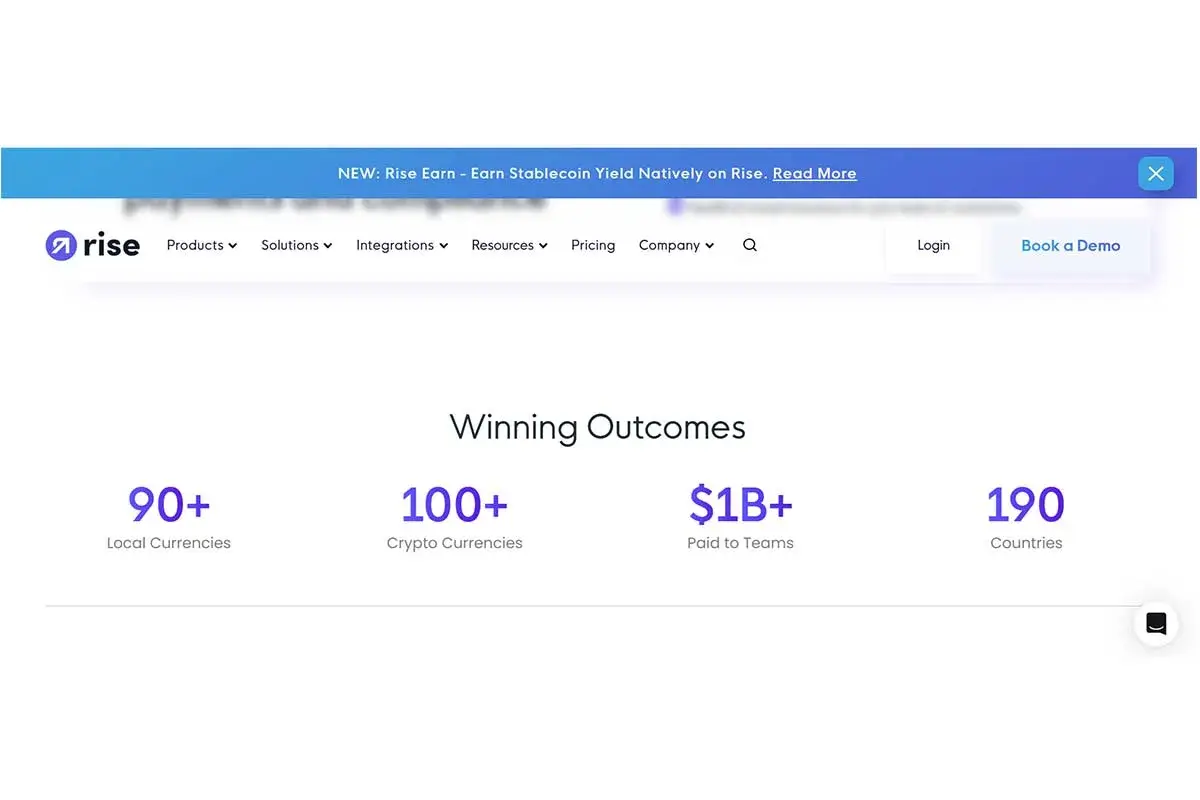
Rise runs hybrid fiat-and-crypto payroll across 190+ countries, according to its homepage, allowing employers to fund payroll in USD or stablecoins while contractors pick their own withdrawal currency every cycle.
What to check before using it: Rise markets three separate products with different prices: Global Contractor Pay ($49/contractor/mo), Agent of Record ($299/contractor/mo), and Employer of Record ($399/employee/mo). The prices are based on how much legal/compliance risk Rise absorbs. So, ensure you match your tier to your worker classification rather than defaulting to the cheapest tier.
Rise at a Glance
| Total paid to teams | $1B+ paid to teams across the platform |
| Crypto asset support | 100+ crypto assets, 90+ local currencies |
| EOR expansion pace | New EOR markets added weekly; targeting 60+ live EOR countries by end of 2026 |
| Yield feature | Rise Earn built on Arbitrum, powered by Aave; 1% commission on interest at withdrawal only |
| Wallet support | MetaMask, Coinbase Wallet, Gnosis Safe, MyEtherWallet |

Best for Global Payroll/EOR with Optional Stablecoin Payout
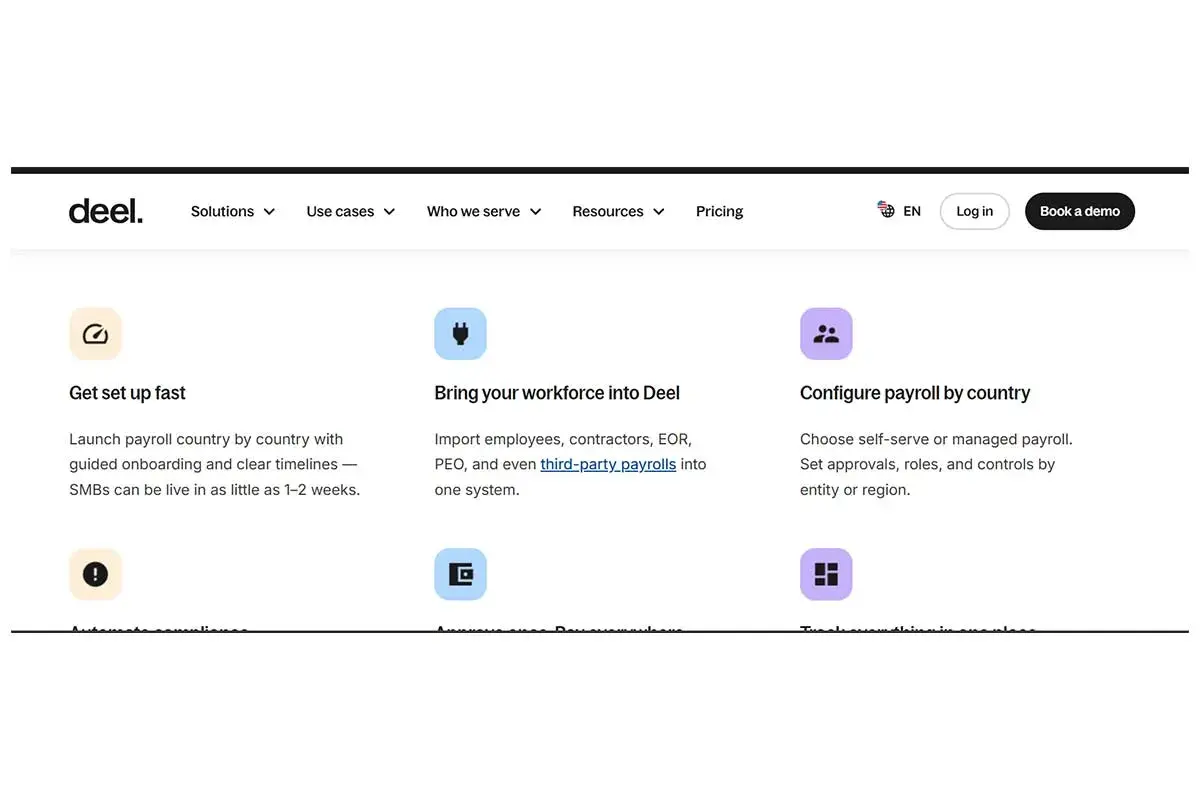
Deel runs fiat payroll and EOR across 150+ countries, according to its homepage, and layers in optional stablecoin payouts (USDC, EURC, and USDT) for eligible employees and contractors.
What to check before using it: Deel has a detailed fee page, but the pricing can feel a bit confusing at first glance. Plus, stablecoin salary payouts are also limited to USD, EUR, and GBP contract currencies, and contractor stablecoin withdrawals are not available in the USA or UK, according to Deel’s blog post.
Deel at a Glance
| Annual payroll volume | $22 billion processed annually, to more than 150 million workers (Deel) |
| Crypto settlement partners | Coinbase, BVNK, and MoonPay |
| Payroll efficiency (Forrester TEI) | 60% less time processing payroll (Forrester TEI study) |
| Regulatory footprint | Operates through licensed money transmitter/payments subsidiaries in multiple jurisdictions (Legal and compliance) |
| Time to launch | SMBs typically live in 1-2 weeks; larger orgs follow a phased rollout |
| Crypto and fiat support | Fiat payroll in 150+ countries; stablecoin payouts (USDC, EURC, USDT) for eligible employees and contractors |

Best for Freelancers & Global Payroll
Bitwage plugs into 15+ existing payroll providers, according to its product update. It allows employees to redirect part of their paycheck into Bitcoin, Ethereum, or stablecoins across nearly 200 countries.

What to check before using it: USDC is not available to US users, according to Bitwage’s pricing FAQ. Stablecoin fees differ by token and network. There’s no flat fee with USDT via Polygon, but there’s a 3% variable fee. Bitwage also excludes OFAC-sanctioned countries. Verify regional support before using the platform.
Bitwage at a Glance
| Payroll processed | $400M+ |
| Payroll system integrations | 15+ platforms, including ADP, Gusto, Workday, Rippling, QuickBooks Payroll |
| Bank payout processing time | 24–72 business hours once funds reach Bitwage, plus up to 24 hours internal processing |
| Supported currencies | USD, EUR, GBP, CAD, AUD, ARS, BRL, MXN, PHP, USDC, USDT, DAI, CUSD, BTC, ETH |
| Minimum deposit | $10 per currency deposit |

Best for Web3-native Companies Needing EOR + Token Compensation
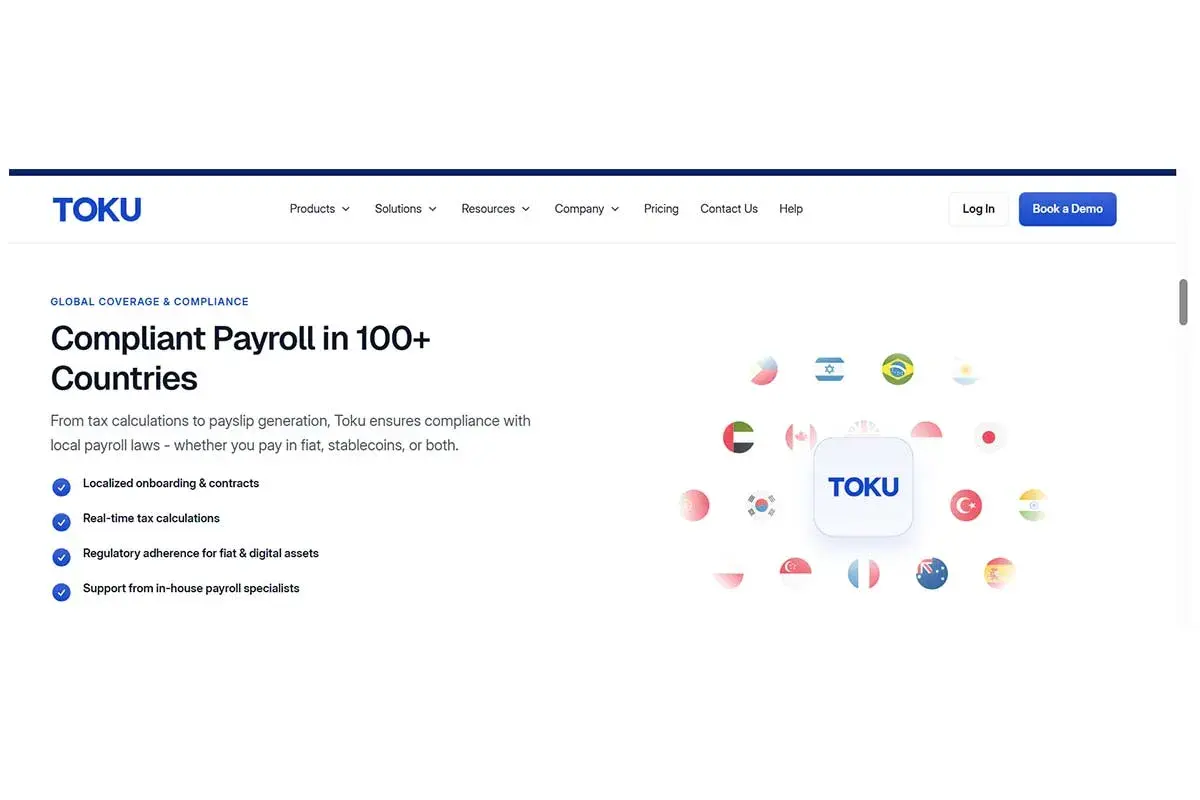
Toku runs EOR, PEO, and contractor payroll across 100+ countries, according to its pricing page, with stablecoin payouts, token grant administration, and tax compliance built into every plan. Toku also offers yield.
What to check before using it: Verify Toku supports the tax, labor, and social contribution rules in your hiring countries. Finally, decide whether each worker will be paid in local currency, USDC, or tokens to avoid changes later.
Toku at a Glance
| Annual payroll volume | $1B |
| Built-in Compliance & Tax Automation | ADP (US); global EOR & tax compliance |
| Payroll coverage | 300+ integrations in over 100 countries |
| Supported card | Rain Card |

Best for Global AP, Contractor & Vendor Stablecoin Payments
Request Finance is designed for Web3 companies managing crypto treasuries. It enables businesses to pay employees from crypto while workers receive local currency in their bank accounts across 190+ countries.

What to check before using it: Request Finance is a payroll and payment platform, not an Employer of Record. If you need help with worker classification, labor law, or tax withholding, you’ll need a separate provider.
Request Finance at a Glance
| Payment volume | $1B |
| Employee salary payout currencies | 15+ fiat currencies, including USD and EUR, to bank accounts in 190+ countries |
| Insurance coverage | Partnered with OpenCover |
| Payroll batch upload capacity | Up to 200 payments per CSV upload for bulk payroll runs |
| Self-custodial wallet support | Works with self-custodial, MPC, and multisig wallets. Supports 200+ wallets in total. |

Best for Global EOR hiring
Remote runs EOR, payroll, and contractor management through owned entities in 90+ countries, according to its EOR pricing page. Remote offers two separate crypto systems: Coinbase for US employees, USDC via Stripe for contractors.

What to check before using it: Remote uses different crypto payroll systems for different worker types. US employees can receive any Coinbase-supported cryptocurrency, while contractors in around 70 countries are currently limited to USDC through Stripe Connect. Also, check which Remote product you’re using, as coverage differs for EOR, payroll, and contractor management.
Remote at a Glance
| Security certification | SOC 2 Type 2 compliant, ISO 27001 certified |
| Crypto payouts | US employees can receive salary in crypto via Coinbase |
| Crypto conversion fees | 0% conversion fees |
| Wallet support | Wallet must support Base, Aptos, or Polygon Network |
We evaluated each platform against its own official documentation such as pricing pages, help centers, and compliance disclosures rather than marketing copy alone. We provided disclosures on what to check before using each platform to give users a holistic view. Our scoring weighed five factors:
Crypto payroll platforms may charge more than subscription fees, and employers must be aware of these fees and compare them across platforms before deciding on the best fit.
Employers evaluating crypto payroll should also factor in per-worker fees, FX spreads, stablecoin conversion charges, funding fees, and withdrawal charges.
Some of these extra fees are not listed in the pricing pages of most platforms. You’ll find them in a separate fee schedule. Here’s an example of the common fees employers evaluating crypto payroll may encounter on a platform. We used Bitwage for this example.
| Fee Type | Fee (Bitwage) |
| Platform subscription | Free (Standard); $7.99/mo per recipient (Premium) (Source: Bitwage) |
| Per-worker fee | $7.99/mo per recipient on Premium plan |
| Stablecoin payout fee | USDT: 3% variable + flat fee (varies by network); USDC: 2% + flat fee; DAI: 2% + $5 flat (Source: Bitwage) |
| Crypto conversion spread | Spread-based for BTC/ETH payouts, no fixed fee |
| FX cost | 1% FX spread applied when payout currency isn’t USD |
| Withdrawal fee | $20 incoming wire fee for individuals (waived on Premium) |
| Payroll funding fee | ACH Debit: 0.50% + $0.50/payroll; Credit Card: 3.50% + $0.30/payroll |
Pricing models vary across platforms. Some platforms may charge a flat monthly fee with unlimited payouts, while others charge per worker or per transaction. Check subscription, payout, FX, and payroll fees before using a platform.
The best option depends on who you’re paying and how much compliance infrastructure you need. A company hiring full-time staff abroad has a different requirement than a DAO paying contributors in tokens. A good way to choose the best crypto payroll platform is to select by need.
Yes, companies can, but it depends on local law. Some jurisdictions require companies to pay salaries in legal tender such as the USD. So, crypto is offered as an optional post-tax conversion, and not a replacement for fiat-based pay, per Deel’s payroll guide.
Stablecoins are pegged to the value of fiat currencies like the USD, making them more stable in price than Bitcoin or Ethereum. Stablecoin payments are more predictable than Bitcoin payroll.
The platform calculates and taxes wages in fiat first. Crypto serves as a payout method once wages are calculated and taxed. The crypto payroll platform only converts already-taxed pay into digital assets.
Yes, most platforms on this list support USDC contractor payouts, including Bitwage, Rise, Toku, and Request Finance. However, availability, fees, and supported countries differ across platforms. Check each platform’s documentation to confirm eligibility.
Request Finance is a good option for DAOs. It supports self-custodial, MPC, and multisig wallets alongside batch payments.
Yes. Every platform in this review requires identity verification before enabling crypto payouts. Identity checks range from basic ID to full business verification (KYB) for company accounts.
Coverage varies by platform and worker type. Some platforms like Remote offer a Coinbase integration for US full-time employees.
Employers should record the fair market value of the crypto asset at the time of transfer, as the IRS and most tax authorities treat it as taxable wages valued at the moment of pay.
Companies record crypto payouts as fiat-equivalent wages at the transfer date. Platforms like Deel and Request Finance generate payslips and receipts to support reconciliation and audit trails.
Stablecoins like USDC are pegged to the dollar. However, for volatile assets like BTC, the taxable value is locked at the transfer date regardless of later price shifts.











 2M+ Monthly Readers
 50k+ Articles