
















Buy

List your Card on CoinGape
Tokenized real-world assets have grown into a $370B+ on-chain market including stablecoins; roughly $36B excluding them – according to CoinGape’s live RWA screener (July 2026). Institutional issuance is scaling fast: BlackRock, Franklin Templeton, and regulated issuers like Paxos now run tokenized treasuries, funds, gold, and real estate on public blockchains.
For investors and institutions, the question is no longer whether tokenization will win, but which platforms will power it, and which one fits your use case. We evaluated 11 leading RWA tokenization platforms and companies against a weighted 7-factor framework. Here’s what we found.
| Logo | Platform | CoinGape Score | Best for | Category | Who can invest | Key regulation | Fees & minimum investment | Chains | Backing & attestations | AUM / key metric (Jul 2026) |
|---|---|---|---|---|---|---|---|---|---|---|
 | 4.3 🌟 | Institutional issuance & BUIDL | Tokenization platform + transfer agent | Institutions; BUIDL = qualified purchasers | SEC-registered transfer agent; broker-dealer subsidiary | BUIDL min $5M; issuance custom | Ethereum, Solana, Avalanche, Polygon+ | BNY custody; monthly NAV; audited | BUIDL $2.01B | |
 | 4.2 🌟 | Regulated issuance, tokenized gold | Regulated issuer & infrastructure | Retail (via exchanges/app) + enterprise | NYDFS trust charter | PAXG: 0.02% on-chain fee; tiered creation; min ~0.01 oz | Ethereum (PAXG); multi-chain (stablecoins) | Monthly third-party attestations; gold at Brink's | PAXG $2.51B | |
 | 4.1 🌟 | Tokenized treasury yield | Issuer / asset manager | OUSG: qualified purchasers; USDY: non-US retail | OUSG Reg D; USDY Reg S | OUSG 0.15% management, $100k min; USDY $500 min | Ethereum, Solana, Polygon, Ondo Chain+ | Custodied treasuries; daily reporting | OUSG $720.7M + USDY $1.32B ≈ $2.0B | |
 | 4.1 🌟 | Retail tokenized money fund | Asset manager - tokenized '40 Act fund | US retail + institutions | SEC-registered '40 Act money fund (FOBXX) | ~0.15% net expense; $20 min | Stellar, Ethereum, Solana, Avalanche, Base, BNB+ | Daily NAV; SEC-regulated fund administration | ≈$2B, fastest-growing tokenized treasury fund 2026 | |
 | 4.0 🌟 | Tokenized stocks & ETFs | Issuer - tokenized equities/ETFs | Non-US retail via exchanges | Swiss DLT Act + EU prospectus | 0% management; issuance/redemption fee + spread | Solana, Ethereum+ | 1:1 share backing; Chainlink PoR | 100+ xStocks; $25B+ cumulative volume (Kraken) | |
 | 3.9 🌟 | Compliant EU issuance (ERC-3643) | Tokenization platform (issuance infra) | Enterprises/issuers (investor rules per issuance) | ERC-3643 permissioned standard; Luxembourg; Apex Group-owned | Enterprise pricing (on request) | Ethereum, Polygon, EVM chains | On-chain identity registry; issuer-level audits | 120+ issuers / $3B+ tokenized (company-reported) | |
 | 3.8 🌟 | Institutional tokenized treasuries (USTB/Invesco) | Registered asset manager | Qualified purchasers / institutions | SEC-registered adviser; USTB managed by Invesco | Mgmt fee + min | Ethereum+ | Daily NAV; on-chain share registry | USTB $1.08B | |
 | 3.7 🌟 | On-chain credit & fund tokenization | Decentralized tokenization protocol | DeFi users + institutions (per-pool KYC) | Legal SPV per pool | Pool-dependent (some ~0.15%) | Centrifuge Chain, Ethereum, Base, Arbitrum | On-chain NAV; pool-level reporting | TVL ≈$1.6B (2026 reports vs DefiLlama) | |
 | 3.7 🌟 | RWA chain + SEC-registered transfer agent | RWA chain + SEC transfer agent | DeFi users & builders | SEC-registered transfer agent (Oct 2025) | Network gas fees | Own EVM chain | Ecosystem/protocol-level | RWA value on-chain $110M+ | |
 | 3.5 🌟 | Tokenized T-bills & gold in Asia | Issuer - T-bills & gold | STBT: accredited; XAUm: retail via exchanges | Singapore (Matrixport group) | STBT min; XAUm exchange spread | Ethereum, BNB+ | Chainlink proof-of-reserves | STBT + XAUm figures | |
 | 3.4 🌟 | Fractional US real estate | Real-estate tokenization platform | Non-US retail (Reg S); US accredited (Reg D) | Per-property LLC; Reg D/S offerings | From ~$50/token; fees embedded in rent mgmt | Gnosis, Ethereum | Property deeds per LLC; rent reporting | 700+ properties tokenized |
Quick Answer
Best by use case:
Real-world asset tokenization is the process of taking physical or traditional financial assets, like real estate, bonds, or treasury notes, and turning them into digital tokens on a blockchain. These tokens represent ownership or a claim on the actual asset, so you can buy, sell, or trade them just like cryptocurrency. This makes it easier to access, move, and use assets without dealing with banks or paperwork.
In 2026, the main assets being tokenized include treasuries and bonds, real estate, private loans, invoices and receivables, and commodities. The process usually starts with a legal wrapper, which makes sure everything is compliant and safe.
Next, an issuance vehicle, often called an SPV, holds the asset and prepares it for tokenization. After that, the on-chain token is created. It could be an ERC-20, ERC-3643, SPL token, or a custom standard depending on the platform. Once the token exists, it goes into custody and is distributed to investors through a primary market.
From there, it can trade on secondary markets just like stocks or bonds. Behind the scenes, important technology makes all this possible. This includes the token standard and smart contracts that handle rules and transactions. Others include institutional custody solutions for tokenized assets, oracles or proof-of-reserves to verify the asset, and layers for AML, KYC, and compliance.
To help you find the best RWA tokenization platforms, we did in-depth research and reviewed 25 crypto tokenization platforms. Using a comprehensive review methodology that weighted factors such as regulatory compliance, asset custody, secondary market liquidity, and investor experience, we have narrowed the field and selected the Top 10 most trusted and active platforms for 2026.
Here, we take a close look at the top tokenization platforms, showing how you can issue, invest, or build on real-world assets with crypto.
Institutional issuance & BUIDL
Securitize Markets is a broker-dealer and ATS (alternative trading system) under the broader Securitize tokenization platform. It sits at the nexus of traditional finance and on-chain securities.
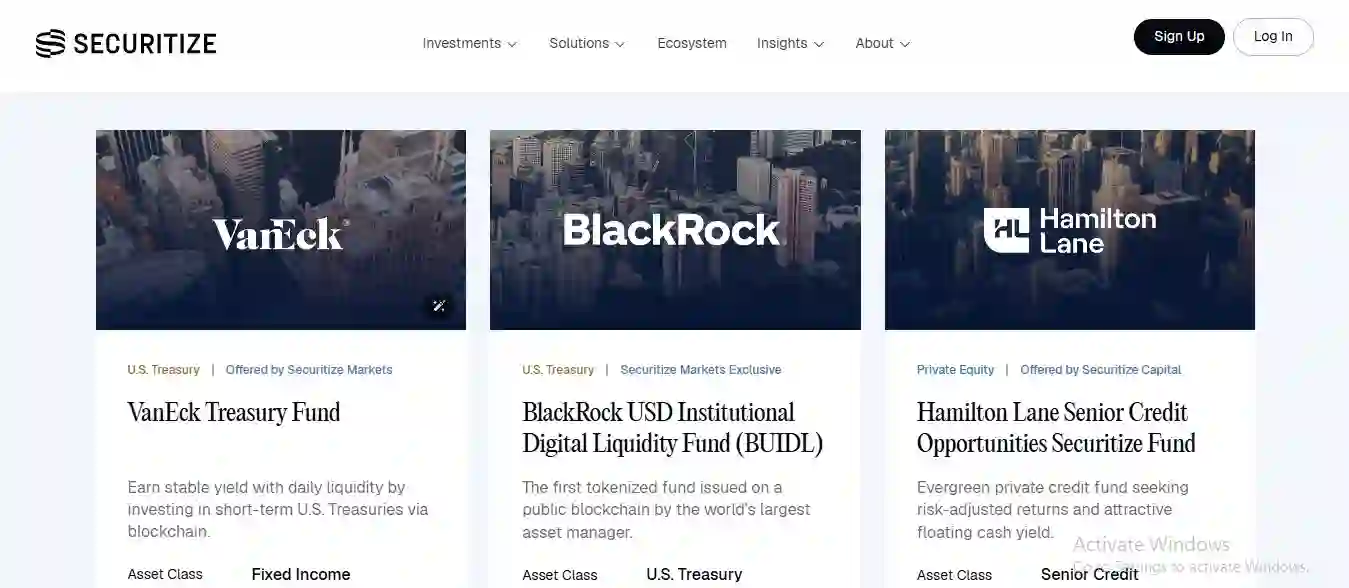
This means the platform not only issues tokenized funds and equities, but also provides regulated primary sales and compliant secondary trading. They tokenize a wide variety of real-world assets, from private credit (like Apollo’s ACRED fund) to treasury and money-market funds (such as BlackRock’s BUIDL).
| Name | Securitize Markets |
| Founding date | 2017 |
| Jurisdiction | United States (Delaware) |
| Token Standards Used | ERC-20 (Ethereum) and multichain tokens via Wormhole |
| Custody Partner | Anchorage, BitGo, Fireblocks, and Copper |
| Notable Issuances | BlackRock’s BUIDL, Apollo’s ACRED, VanEck’s VBILL |

Regulated issuance, tokenized gold
Paxos is the most institutionally conservative platform on this list, and that is its selling point. It operates as a New York State-chartered trust company under NYDFS supervision, meaning customer assets are bankruptcy-remote and every token it issues is backed by reserves verified in monthly third-party attestations. Its flagship RWA product, PAX Gold (PAXG), remains the benchmark for tokenized gold: each token is redeemable for physical gold held in Brink’s vaults in London. Beyond gold, Paxos runs regulated stablecoin issuance (USDP, and white-label issuance for partners) and settlement infrastructure used by major brokerages and payment firms.

For issuers, Paxos is a build-with partner rather than a self-serve platform: its white-listed API model suits enterprises that need a regulated balance sheet behind their token. For investors, PAXG is among the most liquid and widely listed RWA tokens available.

Tokenized treasury yield
Ondo Finance is a DeFi platform that puts real-world assets like U.S. Treasuries and money market funds on-chain. It lets you access safe, regulated investments through crypto, so you can earn traditional yields with the transparency and speed of blockchain. Ondo tokenizes U.S. short-term government bonds with its OUSG token and cash-equivalent yield strategies with USDY.
The platform mainly serves institutional and qualified investors, but DeFi builders and experienced retail users can also use it. If you want a reliable way to bring real-world assets into crypto, Ondo is one of the best platforms for tokenization.
| Name | Ondo Finance |
| Founding date | 2021 |
| Jurisdiction | Globally, with regulated partnerships (U.S., etc.) |
| Token Standards Used | ERC‑20 (ONDO), security-style tokens (OUSG, USDY) |
| Custody Partner | Institutional custodians like Copper and Komainu |
| Notable Issuances | OUSG (tokenized U.S. Treasuries), USDY (tokenized cash yield) |
Retail tokenized money fund
Franklin Templeton was the first major asset manager to put a US-registered mutual fund on a public blockchain, and its Benji platform is still the cleanest retail door into tokenized RWAs. The Franklin OnChain U.S. Government Money Fund (FOBXX) is a ’40 Act money market fund whose shares live on-chain as BENJI tokens — meaning investors get a familiar, SEC-registered product with daily yield, from a $20 minimum, through a consumer mobile app rather than a DeFi wallet. Since launch, Benji has expanded across multiple chains and added institutional features like peer-to-peer transfers and USDC on/off-ramps.

The trade-off is focus: this is one excellent product, not a tokenization marketplace. If you want variety – credit, real estate, equities- you’ll pair Benji with other platforms on this list.
Tokenized stocks & ETFs
Backed Finance is a platform from Switzerland that puts real-world assets like stocks, ETFs, and bonds on the blockchain as bTokens. Each bToken matches the value of the real asset it represents and is fully backed by regulated financial instruments held in custody.
In other words, you can own stocks or bonds directly in your crypto wallet. Backed Finance doesn’t use a whitelist, so once you get your tokens, you can trade them freely on secondary markets. The platform mainly focuses on tokenized traditional assets like public stocks and treasury or bond ETFs, helping you bridge regular finance and DeFi in a safe, regulated way.
| Name | Backed Finance |
| Founding date | 2021 |
| Jurisdiction | Switzerland |
| Token Standards Used | ERC-20 and SPL |
| Custody Partner | Regulated Swiss custodian (via Backed Assets JE) |
| Notable Issuances | Tokenized stocks (e.g., Tesla), ETFs, bond certificates |
Compliant EU issuance (ERC-3643)
Tokeny is a Luxembourg‑based on‑chain finance operating system that helps institutions issue, manage, and distribute tokenized real-world securities in a fully compliant way. The platform uses the ERC‑3643 (“T‑REX”) standard, which embeds regulatory rules into tokens, allowing only verified, eligible investors to hold them.
You can tokenize things like real estate funds, private equity, bonds, and investment funds. Its main market is institutional finance: banks, asset managers, fund issuers, and companies that want to bring traditional securities on-chain.
| Name | Tokeny |
| Founding date | 2017 |
| Jurisdiction | Luxembourg |
| Token Standards Used | ERC‑3643 (T‑REX) |
| Custody Partner | Hex Trust |
| Notable Issuances | Apex Group, SkyBridge Capital, Fasanara Capital |
Institutional tokenized treasuries (USTB/Invesco)
Founded by Compound creator Robert Leshner, Superstate builds SEC-regulated tokenized funds for institutions, and in March 2026 it received the strongest possible endorsement of that model when Invesco took over management of USTB, its ~$900M short-duration US government securities fund. USTB shares exist natively on-chain, with the fund structured under Reg D for qualified purchasers and institutions; Superstate also runs USCC, a crypto-carry fund, and has been an early mover in putting fund share registries directly on-chain rather than mirroring an off-chain database.

The fit here is institutional-first: minimums and eligibility rule out retail, and the product set is deliberately narrow. But for funds and DAOs allocating treasury capital, Superstate now pairs on-chain convenience with a brand-name TradFi manager – a combination only Franklin Templeton and BlackRock/Securitize otherwise offer on this list.
On-chain credit & fund tokenization
Centrifuge is a leading real‑world-asset (RWA) tokenization platform built for structured credit. Through the platform, users are able to convert real-world debt, like invoices, mortgages, treasuries, and consumer loans, into on‑chain tokens. They do this via NFTs, then pool and securitize them into tradable tranches.
The primary market is institutional and on‑chain investors who want exposure to real cash flows through DeFi. Meanwhile, businesses use it to raise liquidity cheaply and transparently.
| Name | Centrifuge |
| Founding date | 2017 |
| Jurisdiction | Cayman Islands |
| Token Standards Used | ERC‑20, ERC‑4626, ERC‑7540, ERC‑1404 (compliance) |
| Custody Partner | Fireblocks, Anchorage and Finoa |
| Notable Issuances | Janus Henderson’s JTRSY treasury fund |
RWA chain + SEC-registered transfer agent
Plume Network is a modular, EVM‑compatible Layer‑1 blockchain built specifically for tokenizing real‑world assets (RWAs) and making them usable in DeFi. The platform integrates compliance, like KYC/AML, at the protocol level, so issuers can easily onboard real-world assets in a legally safe way. Plume is used to tokenize things like treasuries, real estate, commodities, private credit, and even DePIN infrastructure.
| Name | Plume Network |
| Founding date | 2023 |
| Jurisdiction | U.S. / San Francisco |
| Token Standards Used | ERC‑3643 and ERC-20 |
| Custody Partner | Anchorage, Cobo, and Fireblock |
| Notable Issuances | Apollo diversified credit fund, Tokenized treasuries, carbon credits, etc. |
Tokenized T-bills & gold in Asia
Matrixdock, founded by Matrixport in early 2023, is a tokenization platform that brings real-world assets on-chain. Its flagship token, STBT, represents short-term U.S. Treasury bills and reverse repos, and is pegged 1:1 to the U.S. dollar. The platform focuses on transparency and cross-chain access as it uses Chainlink Proof of Reserve to show real-time backing of its assets. It also leverages Chainlink CCIP to allow STBT to move between chains like Ethereum and Arbitrum.
| Name | Matrixdock |
| Founding date | 2023 |
| Jurisdiction | Singapore |
| Token Standards Used | ERC-20, ERC-721, ERC-1400, and BEP-20 |
| Custody Partner | Brinks for gold and STBT assets held via special-purpose vehicle |
| Notable Issuances | STBT and XAUm |
Fractional US real estate
RealT is a pioneer in tokenized real estate. What they do is convert U.S. rental homes into digital shares called RealTokens, letting you own little pieces of real property on the blockchain. The platform stands out as you don’t just hold a token.
Users can actually get a real claim on a legal LLC that owns the property, and you receive weekly rental income in stablecoins like USDC. They focus mostly on residential real estate in U.S. markets, making long-term, income-generating property accessible to anyone, even with small capital.
| Name | RealT |
| Founding date | 2019 |
| Jurisdiction | United States (Delaware LLC) |
| Token Standards Used | ERC-20 (RealTokens) |
| Custody Partner | Self Custody |
| Notable Issuances | Tokenized U.S. residential rental properties |
Every platform in this guide is scored on a 100-point scale across seven weighted factors, then converted to a star rating out of 5. We weight the factors by how much they actually protect and serve you as an investor or issuer. Regulation and security carry twice the weight of user experience, because a beautiful app cannot compensate for an unlicensed issuer. Scores reflect data as of July 2026; we re-score every platform quarterly.
| # | Factor | Weight | What we measure |
| 1 | Regulatory standing & compliance | 20% | Licenses and registrations (SEC transfer agent/broker-dealer, NYDFS trust charter, FINMA/EU prospectus regimes), jurisdiction quality, investor protections, and any enforcement history – verified against regulator databases, not the platform’s marketing page. |
| 2 | Security & asset backing | 20% | Smart-contract audits, custody arrangements, insurance, and critically for RWAs – proof that the real asset exists: reserve attestations, proof-of-reserves feeds, and named custodians. Past incidents and defaults count against this score permanently. |
| 3 | Asset variety & product depth | 15% | The range of real-world assets you can tokenize or access – treasuries, funds, credit, real estate, commodities, equities- and how deep each product actually is beyond the press release. |
| 4 | Liquidity & market access | 15% | How easily you can enter and exit: secondary markets, exchange and DeFi integrations, redemption terms, and who is eligible (retail vs accredited vs institutional-only). |
| 5 | Fees & minimums | 10% | Management fees, issuance costs, spreads, and minimum investments — and whether they’re published or hidden behind a sales call. |
| 6 | Technology & user experience | 10% | Chain support, token standards, API quality, and how much friction sits between you and your first transaction. |
| 7 | External trust signals | 10% | What independent sources say: Trustpilot scores, G2 reviews (G2 maintains a dedicated asset-tokenization-platforms category), App Store / Google Play ratings for retail apps (if available), plus operating history and security incident record. |
A note on external ratings: most RWA platforms serve institutions and DeFi users, so several have little or no Trustpilot/G2 footprint – that’s normal for the category, not a red flag. Where a platform has fewer than ~25 independent reviews, we score this factor on verifiable proxies instead: years in operation without a security incident, quality of institutional backers, and the transparency of its attestations. Where consumer reviews exist in volume (for example RealT’s 350+ Trustpilot reviews or Franklin Templeton’s Benji app ratings), they carry full weight.
How the star rating is calculated: each factor is scored 1–5, multiplied by its weight, and summed. A 4.5+ is exceptional; 4.0–4.4 excellent; 3.5–3.9 solid with trade-offs; 3.0–3.4 usable but with material caveats; below 3.0 doesn’t make this list. Ratings are set by the review team and fact-checked independently; no platform can pay to change its score.
When you look at RWA tokenization platforms, a few key pieces make everything work smoothly. The tech stack isn’t just for developers. Understanding these pieces gives you a clear picture of how these platforms work under the hood.
Each part is built to make tokenized assets safe, compliant, and easy to trade, even if you’re new to crypto.. Here’s a breakdown of the main parts:
1. Token Standards
These are the rules that define how your token behaves. Most RWAs use ERC-20 for simple tokens, ERC-3643 and ERC-1400-style security tokens for more regulated assets. SPL is for Solana-based tokens and token wrappers that let you combine or convert tokens for use across different platforms. These standards make sure your tokens can move on the blockchain and follow the rules.
2. Custody Options
Keeping tokens safe is essential. Platforms use institutional custodians like Anchorage, Fireblocks, or BitGo to hold and secure assets. Some also use on-chain multi-signature wallets, which require multiple approvals to move funds. Others rely on cold custody, storing tokens offline to prevent hacks.
3. Oracles & Proof Mechanisms
Real-world assets need a way to connect on-chain tokens to off-chain real-world assets. Platforms use proof-of-reserves to show that every token is backed by an actual asset. Chainlink oracles feed off-chain data to the blockchain, and attestation flows verify that the data and assets are real.
4. Settlement Rails
This is how your tokens actually move or get traded. Some platforms use on-chain DEXs for instant, automated trading. Others integrate with off-chain broker/dealer networks or regulated exchanges to handle bigger, institutional trades. These rails make it easy for tokens to be bought, sold, or settled securely.
When it comes to fees and the economics of issuing tokenized real‑world assets, the numbers can vary depending on the platform and type of asset. Oftentimes, you’ll face an upfront issuance fee, which covers the legal setup, compliance checks, and smart contract deployment.
On top of that, most platforms take a small percentage of the total value issued.
Real estate tokenizations tend to have higher setup fees because of legal and property transfer requirements. Although recurring costs are usually lower after the initial launch. Some platforms also include network fees, which depend on the blockchain you use, and liquidity fees if your token trades on secondary markets.
Most tokenized RWAs are securities in the eyes of at least one regulator, and the platform you choose determines which rulebook protects you.
In the United States, tokenized funds and equities fall under SEC regimes – issuance typically runs through Reg D (accredited investors), Reg S (offshore), or, for products like Franklin Templeton’s FOBXX, full ’40 Act registration; transfer agents like Securitize are SEC-registered to maintain official ownership records on-chain.
In the EU, MiCA now covers asset-referenced tokens while tokenized securities fall under MiFID II and national prospectus regimes – Luxembourg and Germany lead with blockchain-securities laws used by issuers like Tokeny’s clients. Switzerland offers the DLT Act’s registered-uncertificated-securities regime (the legal basis for Backed’s xStocks), and Singapore and Hong Kong run licensing sandboxes that host issuers like Matrixdock.
Two technical standards matter when you evaluate compliance claims: ERC-3643 (permissioned tokens whose transfers check an on-chain identity registry – the standard Tokeny pioneered) and SEC-registered transfer-agent record-keeping, which makes the token itself the legal ownership record rather than a claim on a database.
On tax: tokenized yield products generally produce ordinary income (treasury yield, rental income) rather than capital gains, and jurisdictions differ on whether on-chain transfers are taxable events. None of this is tax advice, consult a professional in your jurisdiction before allocating size.
(Planning to issue rather than invest? Start with our guide on how to launch a tokenized asset, and compare white label tokenization platform providers.)
Before you trust any real-world asset token, you need to confirm that what you’re buying is backed by an actual asset, issued by a real entity, and handled on-chain with clear proof. Here’s everything you need to consider:
When real-world assets are turned into tokens, you can use them inside DeFi the same way you use regular crypto. You can lock these tokens as collateral on lending platforms to borrow stablecoins.
They can also be placed in liquidity pools that pay interest. This works well because assets like treasuries or business loans do not swing in price as much as crypto, so the system stays more stable.
You see this in Centrifuge, where real assets like invoices or business loans become tokens. These tokens move into DeFi pools and even support lending in larger systems like Maker. You also see it in Maple Finance, where tokenized credit flows into lending pools that fund real businesses.
Lenders then earn on-chain yield that comes from real economic activity. This mix of real assets and DeFi makes borrowing, lending, and yield safer and more open for you.
1. Custody and Asset Security Risks
When you tokenize real-world assets, the biggest question is: Is the real asset safe? We’ve seen what happens when custody breaks down. In 2022, Celsius claimed its tokenized treasury assets were secure.
However, when the company collapsed, users could not access anything because the custodian and the issuer were tied together in the same bankruptcy mess. You want platforms that use independent, regulated custodians, give clear proof of asset ownership, and separate user funds from company funds.
2. Regulatory and Compliance Risks
Regulation is a real risk in RWA tokenization. We already saw this when the China Securities Regulatory Commission told two major brokerages in Hong Kong to pause their tokenization plans. The message was clear that governments can step in anytime when they feel the market is growing faster than their rules.
This is why you want RWA platforms that follow real financial laws, hold the right licenses, share updates, and work with regulators. It helps protect your assets if rules change or a country decides to slow things down.
3. Smart Contract and Technical Risks
Even if the real asset is safe, the smart contract that represents it on-chain can still break. In 2021, BadgerDAO suffered a contract exploit that drained over $120 million from users. This wasn’t an RWA platform, but it showed how one weak contract can damage trust.
Look for platforms that use audited smart contracts, have bug bounty programs, and run risk monitoring tools. The goal is to avoid any contract that can be controlled or drained by attackers.
4. Liquidity and Redemption Risks
Some RWA tokens look great on paper but are hard to sell or redeem when markets get rough. During early RWA experiments around 2020, many tokenized real estate projects had buyers but no secondary market.
People who wanted to exit could not find anyone to buy their tokens. Focus on platforms with active secondary markets, transparent redemption rules, and assets that have clear demand outside crypto.
5. Transparency and Governance Risks
In many RWA setups, trust companies act as the legal bridge between your token and the real asset. This gives the issuer a lot of power over how the asset is held, managed, and shown on-chain. If anything breaks inside that trust layer, you may not have strong on-chain protection.
This is why you should care about who controls the asset, the data, and the rules. When an issuer controls everything, they can change terms, pause actions, or move assets without you seeing it. You want platforms that show things on-chain, use independent audits, and share who makes the decisions and how your asset is handled.
The next phase of RWA growth will be shaped by strong institutional moves. You’ll see more custodians and asset managers roll out real tokenized products, not test pilots. A good signal is the push from Ondo Finance and Ripple.
Ondo brought its OUSG tokenized U.S. Treasuries to the XRP Ledger, with support from BlackRock’s BUIDL fund. Ripple’s setup also lets qualified users mint or redeem these assets with its stablecoin and use built-in identity checks. This shows that large financial players now see tokenization as a working part of capital markets.
Regulation is another big driver. As more assets move on-chain, you can expect more structure around ratings, insurance, and standard rules. The Ondo–Ripple announcement highlighted pieces like KYC, AML, and digital identity features that make issuances safer. These steps create trust and give institutions a clear path to launch new tokenized assets without extra risk.
Growth will also come from new RWA categories. Tokenized treasuries are already growing fast, and private credit could follow. Programmable yields will let issuers build simple rules into how returns move to users. Cross-chain tokenized assets will let you move the same asset across more than one blockchain and open new pools of liquidity.
If you want to understand how the market is shifting, watch a few metrics. Look at the total value locked or assets under management (AUM) for RWA platforms. You should also pay attention to the number of live issuances and how active secondary markets become. These numbers show where demand is rising and which platforms gain real traction through 2025 and 2026.
If you are looking to start with RWA tokenization, the platform you pick really depends on your goals and comfort level.
For Beginners & Small Investors: Consider RealT for its low entry barrier (small investment amounts), straightforward legal ownership via LLCs, and regular stablecoin income distributions.
For Cost-Effective & Regulated Yield: Ondo Finance is the preferred choice for those prioritizing low fees and secure investment in high-quality, regulated assets like U.S. Treasuries and cash equivalents.
For Institutions & Complex Assets: Platforms like Maple Finance, Securitize Markets, and Tokeny are designed to handle large capital, complex asset classes, and maintain rigorous regulatory compliance.
Whatever platform you consider, it is important to do your homework first. Verify who holds the real assets, check independent audits, and confirm the platform’s custody solutions. Look closely at the legal wrapper for each token so you know exactly what rights you hold and how the asset is structured.
What is RWA Tokenization? Real World Assets explained
Real World Asset tokenization in 2025: The shift from hype to infrastructure
Tokenization increases liquidity by turning big, hard-to-sell assets like real estate or bonds into smaller digital pieces you can trade on-chain. This allows you to buy, sell, or swap parts of an asset anytime, without waiting for a traditional buyer.
An RWA token is a digital token that represents a real-world asset like a bond, treasury, or piece of real estate. Unlike stablecoins, which are tied to a single currency like the dollar, RWA tokens give you a piece of an actual asset with real value. This means you can trade, invest, or earn yield from something tangible on-chain.
Tokenized treasuries are generally safe because they represent real government bonds you could normally buy in traditional finance. When you hold them on-chain, you own a digital version backed by actual assets. The main risk comes from the platform or smart contract handling the tokens. If the system has a bug or the issuer fails, your investment could be affected.
To buy tokenized real estate, you open an account on a platform that offers real estate tokens, complete KYC, add funds, and choose the property you want exposure to. Each token represents a share of that property. You can buy, hold, or sell these tokens inside your wallet. Check the minimum investment, fees, and lockup terms so you understand what you own and how you can exit.
RWA tokens are not considered regulated securities by default, but many fall under securities rules depending on how they’re structured. If a token represents ownership in a real-world asset, pays profits, or promises returns, regulators may treat it as a security. Some platforms design their tokens to follow compliance rules, like registering with authorities or limiting who can buy them. This lets you trade or hold them without breaking the law.
Of course, RWA tokens can be used in DeFi, but it depends on the platform and the type of asset. More regulated issuances are coming on-chain, and institutions are running real pilots. This implies that these tokens now fit into lending pools, collateral systems, and yield products. You get access to real-world value inside DeFi without repeating the risks or limits of older crypto assets.
To check proof-of-reserves for an RWA, start by looking for on-chain reports from the platform showing the total assets held versus tokens issued. You can verify these reports using the platform’s smart contract addresses on a blockchain explorer. Some platforms also provide third-party audits or attestations. This allows you to confirm the reserves exist and match what’s tokenized. This also helps you see that the assets backing your tokens are real and accounted for.
There are secondary markets for RWA tokens, but they are still developing. Some platforms let you trade tokenized assets like treasuries, bonds, and real estate with other users. This provides an opportunity to buy or sell before maturity. Liquidity is growing, but not all tokens are easy to trade yet, so it’s important to check each platform and see how active their markets are before you invest.
To evaluate an issuer’s legal wrapper, start by checking what kind of company or fund is backing the token. Look at the jurisdiction and regulations it follows, and see if it has proper licenses to operate. Review the legal documents, like the prospectus or offering memorandum, to understand investor protections and obligations. Make sure the structure clearly separates the token from the issuer’s other assets, so your investment is secure.
An issuer creates and legally backs the token (Ondo issues OUSG; Paxos issues PAXG); a tokenization platform provides the infrastructure for issuance, compliance, and investor management (Securitize, Tokeny). Several companies do both, which is why this guide reviews platforms and issuers together, with each entry labeled by category.
By our weighted scoring, Securitize (4.3/5), Paxos (4.2/5), and Ondo Finance (4.1/5) lead in 2026, with Franklin Templeton and Backed Finance close behind. By on-chain value, BlackRock’s BUIDL (operated by Securitize) remains the largest tokenized fund – see CoinGape’s live RWA screener for current figures.
Securitize, for three reasons: SEC transfer-agent registration, the BUIDL track record, and institutional custody integrations. Institutions should also review our guide to the best institutional custody providers for tokenized assets.











 2M+ Monthly Readers
 50k+ Articles


