Buy
For blockchain builders in 2026, it is critical to get their hands on a solid crypto wallet API. The best wallet API, however, has to be simple. It should have an intuitive interface, perform precise tasks as programmed, and do so without needing to handle users’ private keys.
This guide will cover the best crypto wallet APIs in 2026, shedding light on what makes a strong wallet, key features of individual APIs, and their pros and cons.
When looking for a strong crypto wallet API, users should look for the following five attributes:
The wallet API should not limit itself to a single chain. Covering multiple blockchains, including Bitcoin, Ethereum, Solana, Polygon, and others, is a must. Since most crypto applications work within an interoperable ecosystem, having a multi-chain attribute is a crucial element.
The API should have strong key management functionality. MPC or multi-party computation is a desirable option to have, while HSM-backed key storage and non-custodial architecture are must-haves to ensure that private keys are never exposed to the public.
Crypto wallet APIs should work fast, constructing transactions quickly. Also users should get signing, broadcasting, clear status tracking, and fee estimation data on time, accurately, and in a structured format.
Since millions of transactions could be happening at any given minute, the crypto wallet API should have a strong enough infrastructure to handle high transaction volume. It should be able to handle multiple concurrent users without any downtime. Such a promise should be part of the application’s service level agreement.
The current crypto ecosystem has high regulatory expectations, which means most (if not all) crypto applications must take care of compliance requirements. Therefore, it is imperative for crypto wallet APIs to offer regulatory features such as built-in KYC/AML hooks and transaction monitoring. Providing a track record of security audits further strengthens the API’s trust factor.

Leading this list is CoinStats Wallet API. An all-in-one crypto wallet API, CoinStats offers simplicity. Users can pass any address to get a structured JSON back, complete with full transaction history, profit and loss details, and DeFi positions.
With support for over 120 blockchains through a single endpoint, CoinStats is a versatile option for most builders. It supports Bitcoin xpub, ypub, and zpub keys for HD wallets, all major EVM chains, and over 10,000 DeFi protocols (auto-detected per wallet).
Adding to the versatility of the API is its MCP server, designed specifically for AI agents. The server comes with over 20 wallet, DeFi, and portfolio tools, giving Claude and Cursor access to the data. Token security is high on the list of priorities for this ecosystem, with Token Risks as one of its features. It gives a token contract a risk score and ranks findings in terms of severity.
CoinStats API pricing is also affordable, with free usage giving users 20,000 credits. The official platform states that the pricing scales with how complex the application is.
That said, CoinStats API is a read-only layer. It does not send transactions or run node calls; it only displays details after proper structuring for users.
Users can learn more about it through this Crypto Wallet API guide.

Allium is reportedly an institutional-grade blockchain data platform, with the website describing it as a “system of record for onchain finance.” Thus, the platform serves those with real-time API needs and those who require deep historical analysis.
With over 150 blockchains covered, Allium is said to enable data normalization across all of them. At present, the wallet API covers current and historical token, NFT, and SOL/native balances, and transaction history with human-readable labels. Furthermore, it also reveals realized and unrealized PnL with cost basis.
One API call reveals everything from LP positions and lending to staking, spot, and perps across 19 chains. The API is also known for its speedy performance with its sub-100ms response times. With the addition of automatic reorg handling, it is suitable for crypto enterprises that don’t want to run their own infrastructure, but need some control.
Similar to CoinStats, Allium also offers 20,000 API credits for its free tier. Thus, for teams looking for real-time wallet data at institutional scale, Allium is a good pick.

Unlike most wallet APIs on this list, Crypto APIs reportedly offer a complete enterprise blockchain infrastructure. As a result, beyond the data API, users will also get access to a full stack, complete with wallets, nodes, and webhooks, which makes it suitable for fintechs and regulated environments.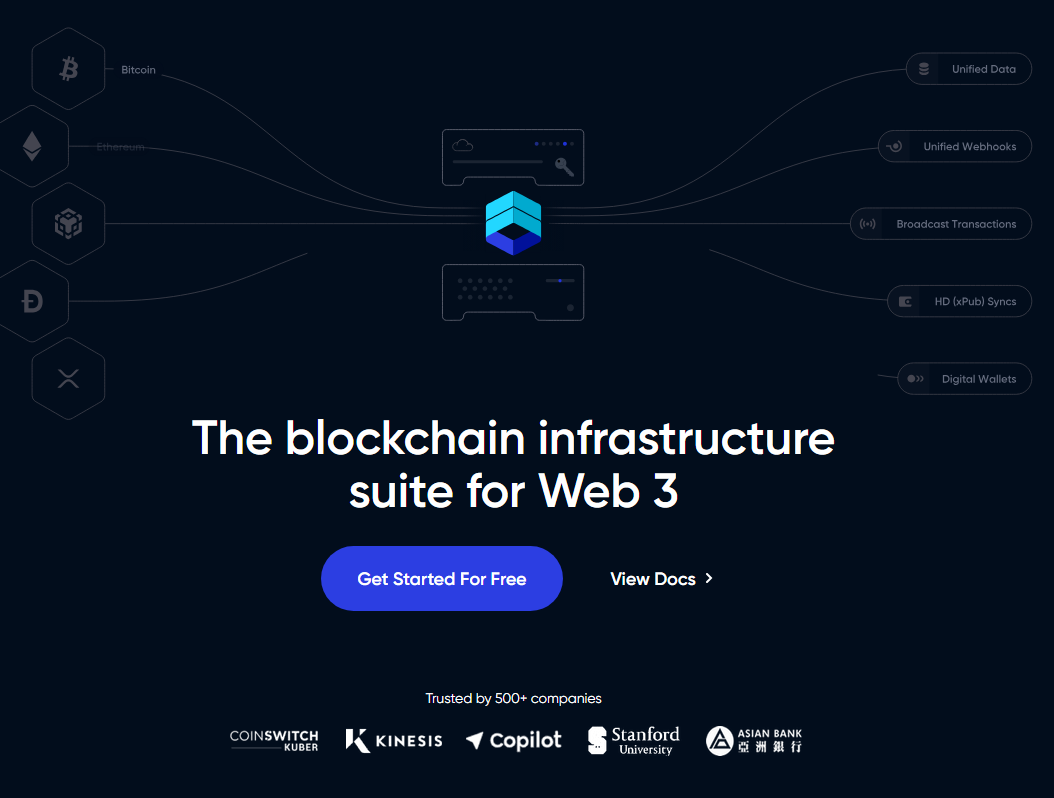
Over 50 blockchains are supported on this platform. Beginners using the free tier, however, will get access to only 20. Since the application is marketed as enterprise-centric, it has features to match. It has ISO/SOC compliance, supports HSM, and helps with generating custodial, non-custodial, and smart-contract wallets. With its dedicated node infrastructure, it can handle over 25,000 requests/sec, with webhook notifications taking less than 100ms.
The platform has gone through multiple evolutions, with the latest one introducing an AI Compatibility layer. The layer ships with 14 MCP servers in addition to an n8n MCP client node, which is designed to connect the blockchain data to Claude, Cursor, VS Code, etc.
Since the API is expansive, Crypto APIs are not particularly beginner-friendly. Therefore, fintechs, exchanges, and enterprises that want to be compliance-ready from the get-go and require a robust blockchain infrastructure that also sends transactions or runs nodes will find Crypto APIs more suitable for their requirements.

The last entry on this list is Moralis. A developer-friendly crypto wallet API, Moralis is described by the official website as a “pre-indexed Web3 data platform” for dApp and wallet builders.
Moralis offers native support for Solana, alongside over 30 blockchains. Designed to be an intuitive API, Moralis places interactivity high on its list of priorities, putting much focus on NFTs and Web3 gaming as well.
Upon running, this wallet API reveals information such as NFT holdings, token balances, transaction history, decoded metadata, and USD pricing. With all the human-readable labels re-applied, the platform focuses much on accessibility.
Beyond the traditional details, Moralis also focuses on its Token API, revealing real-time and historical asset pricing on DEXs. With its NFT API, Moralis offers floor prices of leading NFTs, alongside their trade history.
Streams is also provided by Moralis, which reveals information about webhook events in real time. Thanks to its Powers integrations for large consumer wallets like MetaMask and Blockchain.com, Moralis asserts that its customers have been able to reach over 100 million users so far.
Given this API’s speed and style-centric nature, Moralis is fit for teams wanting fast EVM access without any heavy backend parsing. As such, users should consider it more of a general Web3 dev toolkit than a system that specializes in DeFi.

DeBank’s official website refers to it as having the deepest DeFi protocol-level data of any wallet API. The trade-off, however, is that it is EVM-only, which means no support for Bitcoin, Solana, or any non-EVM chains.
The platform reportedly supports over 100 EVM-compatible chains, though some online sources have given contradictory information about this number. Nevertheless, the platform does make it clear that over 1300 DeFi protocols are supported.
The platform made its way into the market in 2018, starting as a simple DeFi portfolio tracker first. Later, its evolution into a crypto wallet API came with the opening of DeBank Cloud. Now, its expanded ecosystem consists of its very own Layer 2, a Web3 social layer known as Hi!, and a self-custody wallet.
Following a protocol-first data model, the API displays a wallet’s Aave/Compound/Uniswap positions as clean per-protocol breakdowns, with details like supply tokens, debt tokens, USD value, rewards, etc.
The multi-chain approach of DeBank is not universal, however, as some operations require per-chain queries, which makes the API slightly slower than its competition. That said, for EVM-focused DeFi dashboards and tax tools where protocol depth matters more than chain breadth, DeBank is a suitable crypto wallet API.
Choosing the best crypto wallet APIs requires more than just looking at how popular the platform is. Thus, our selection criteria focused on multiple factors, especially accessibility, security, and speed:
How many blockchains does the API support with one integration? Are non-EVM chains included in the mix, such as Bitcoin or Solana? We took these questions into consideration. If the chain is EVM-specific, like DeBank, we ranked it down. But if the chain focused on inclusivity, such as CoinStats, we ranked it high up.
The data that the crypto wallet API reveals should be structured to provide more than just balance. DeFi positions, transaction history with the timeline, and profit-and-loss with cost basis should be visible to users. Whether a platform provides proper interpretation was the key question our analysts looked for when assessing the platforms. DeBank got our point for its protocol-level depth, and CoinStats gained a high rank thanks to its auto-detected DeFi positions across 10,000 protocols.
Is there a free tier available for users that want to test the waters first? And if there is a credit-based pricing structure, does it scale in a predictable fashion? These are the questions we asked, as they helped us look beyond the platform that is simply cheap vs. the one that is reasonably priced for the services it provides. In addition to pricing, a review of the uptime, latency, and clear credit limits also played a role in our assessments.
The question of which crypto wallet API to pick depends on users’ preferences. CoinStats API stands as the best overall option for its inclusivity and thoroughness when it comes to details. Crypto APIs and Allium work for their institutional structures, and DeBank suits those seeking deep DeFi protocol coverage. Moralis, on the other hand, is a friendlier, general API tool.
Builders should pick a wallet API according to the scale of their crypto wallet or application they are developing.











 2M+ Monthly Readers
 50k+ Articles