The CPI Data Are Dropping Today- Where Will Bitcoin Price Go Next?



Highlights
- Bitcoin price holds near $83,300 as markets await CPI data.
- CPI forecasts indicate 3.6% headline inflation and 2.5% core inflation.
- U.S. Bitcoin ETFs attract $176M while Ethereum funds draw $24.84M.
Bitcoin price holds near $83,300 ahead of today’s CPI data, while Ethereum trades around $2,500 and XRP trades at $1.37. Investors await U.S. inflation figures for September, with tomorrow’s PPI report adding another test for cryptocurrency markets and monetary expectations.


CPI Data Arrive Today Before Thursday’s PPI Release
The U.S. consumer price index report arrives today, October 14, 2026, at 8:30 AM ET. The producer price index follows on October 15 at 8:30 AM ET, covering September’s wholesale inflation. Thursday’s PPI report will provide further evidence of producer costs, helping assess whether inflation pressures are broadening.
🚨 #CPI Alert | $BTC in Focus
U.S. inflation data drops today, October 14, at 8:30 AM ET.
📊 Headline CPI forecast 3.6%
📊 Core CPI forecast 2.5%🔥 Will inflation surprise the market?
➡️ Trade the moves with https://t.co/sw35nigKmy. https://t.co/eIOr0JL54e— IBIT (@IBIT_Global) October 14, 2026
Annual headline CPI is forecast at 3.6%, while core inflation is expected to reach 2.5%. Monthly forecasts stand at 0.6% for headline CPI and 0.2% for the core measure, excluding food and energy.
The core reading could carry greater weight because it helps assess price pressures beyond volatile food and energy. A surprise rise may fuel worries over ongoing inflation and restrict hopes of easier Fed policy.
The reduced readings could help to improve risk appetite, ease interest rate worries, and improve conditions for cryptocurrencies. A stronger inflation figure could help boost the dollar and Tbond rates, which could put pressure on Bitcoin ahead of another economic report.


Where Will Bitcoin Price Go Next After CPI?
The relative strength index of Bitcoin is at 50.28, suggesting that it is currently experiencing a state of equilibrium.
The MACD is positive at 45.04, which indicates a small positive bias, but the overall technical picture is still negative.
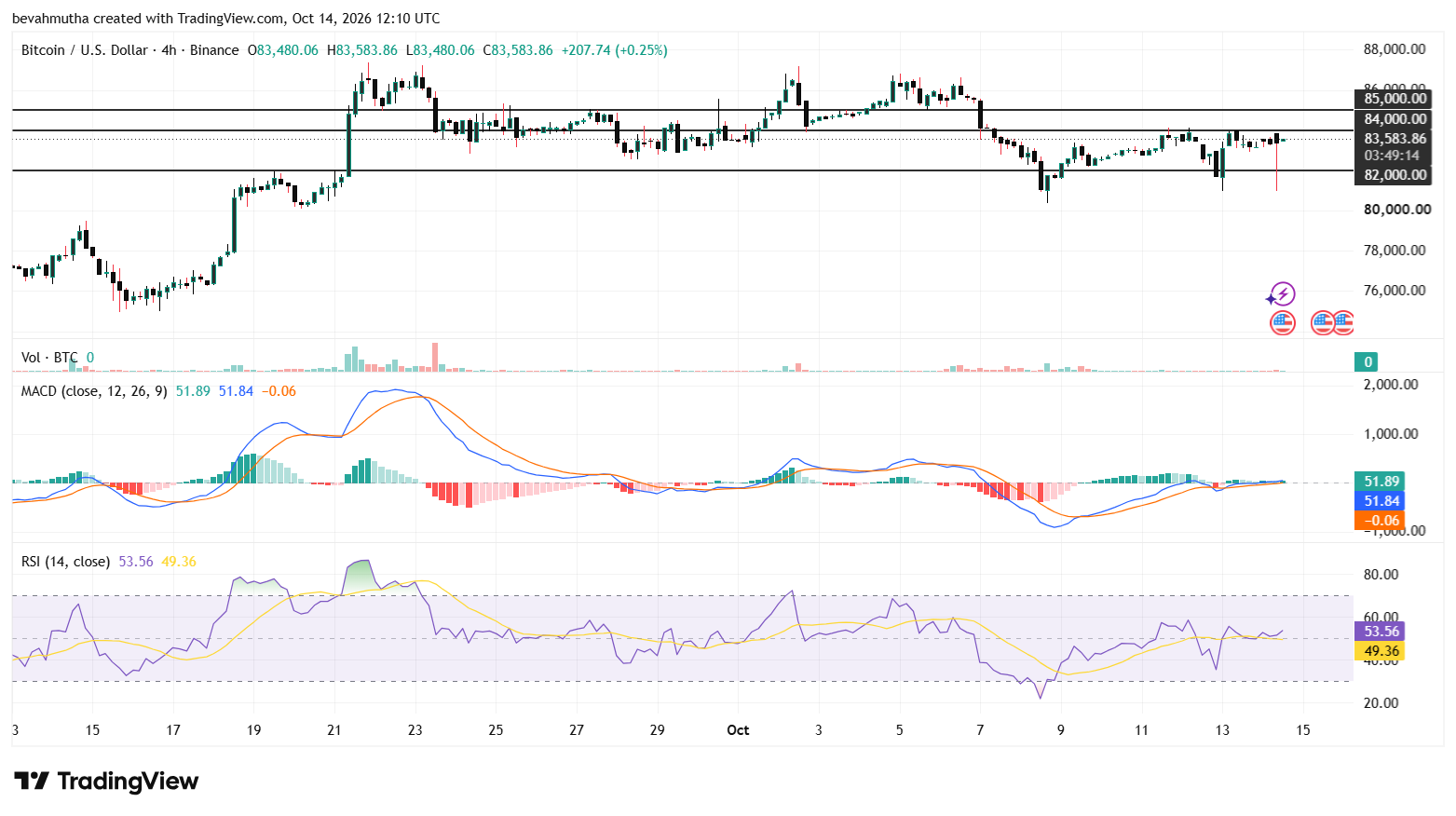
The initial support is at $83,000, and the subsequent lower support is at $82,900 and $82,700. The Bitcoin price must sustain above $83,300 to have a better chance of reaching the resistance level at $84k and $84,500.
A sustained move above those levels could open a path toward $85,000 for the future Bitcoin outlook, especially following weaker inflation figures. Failure to defend support would instead increase the risk of further declines toward the lower support zones.
U.S. Bitcoin ETFs Attract Fresh Capital Before Inflation
U.S. spot Bitcoin ETFs recorded approximately $176 million in net inflows on October 13, strengthening demand ahead of inflation. Fidelity’s FBTC accounted for $103 million, contributing close to three fifths of the total capital entering Bitcoin funds.
U.S. Bitcoin ETFs Draw $176 Million, Ether ETFs Add $24.8 Million
According to SoSoValue, U.S. spot Bitcoin ETFs recorded $176 million in net inflows on October 13, led by Fidelity’s FBTC with $103 million. Spot Ethereum ETFs attracted $24.84 million, with Grayscale’s Ethereum Mini Trust (ETH) leading at $16.73 million.
— Wu Blockchain (@WuBlockchain) October 14, 2026
Spot Ethereum ETFs attracted $24.84 million, with Grayscale’s Ethereum Mini Trust leading the category through inflows of $16.73 million. The combined result brought fresh capital into both markets before economic data potentially changes expectations for interest rates.
ETF subscriptions can provide support while Bitcoin attempts to establish a clearer direction around its range. Subsequent sessions will show whether this demand continues after investors assess the CPI release and Thursday’s producer inflation figures.
Instant Currency Exchange at BestChange with Ease
- Compare Rates Across 1000+ Exchanges
- Access 250+ Cryptocurrencies & Pairs
- Save Time with Real-Time Price Tracking
- Trusted & Verified Exchange Listings

Frequently Asked Questions (FAQs)
1. What are the headline and core CPI forecasts?
2. When is the PPI report, and why does it matter?
Why Trust CoinGape
CoinGape has covered the cryptocurrency industry since 2017, aiming to provide informative insights Read more…to our readers. Our journal analysts bring years of experience in market analysis and blockchain technology to ensure factual accuracy and balanced reporting. By following our Editorial Policy, our writers verify every source, fact-check each story, rely on reputable sources, and attribute quotes and media correctly. We also follow a rigorous Review Methodology when evaluating exchanges and tools. From emerging blockchain projects and coin launches to industry events and technical developments, we cover all facets of the digital asset space with unwavering commitment to timely, relevant information.

24 Hours volume
$21.19B
Market Cap
$1.69T
Max Supply
21M



Delivered every day.
- Insights that move markets
- 100,000 active subscribers

Global ONCHAIN AWARDS 2026