

Trybit vs BitPay: Comparing The Two Crypto Payment Gateways



Thanks to crypto payment gateways, businesses don’t have to build their own payment-processing infrastructure to accept crypto payments. For businesses operating internationally, the gateway choice can impact the assets they can process, the checkout experience they can deliver, and the operational, compliance and settlement costs they need to bear.
The reason: not all gateways approach crypto payments in the same way. For some, the goal is to provide accessibility to more merchants and users, with features like fiat settlement. For others, the goal is to provide an infrastructure for enterprises running crypto-native, high-volume operations.
Two crypto payment gateways to be discussed here are Trybit and BitPay. This article pits these platforms against each other in terms of the assets they support, the settlement and confirmation approaches they take, the security features they have, the integrations they feature, their commissions and fee structure, and their payout methodologies.
What Are Crypto Payment Gateways?
A crypto payment gateway is a platform that processes payments between a customer and a business. Its job is to generate payment requests, detect incoming transactions, and confirm payments to help merchants settle the funds they receive.
Depending on the business type, the settlement can be in the form of fiat, crypto or stablecoins. In addition to this basic feature, crypto payment gateways also offer APIs, plugins, payment links, invoices and other checkout tools.
About Trybit
A global payment gateway, Trybit is said to be designed specifically for businesses conducting high-volume operations. It claims to have a 99.9% uptime, and supports over 40 cryptocurrencies, including Bitcoin and stablecoins. Trybit’s volume-tailored rate system is its USP, offering dynamic pricing according to the scale of business.
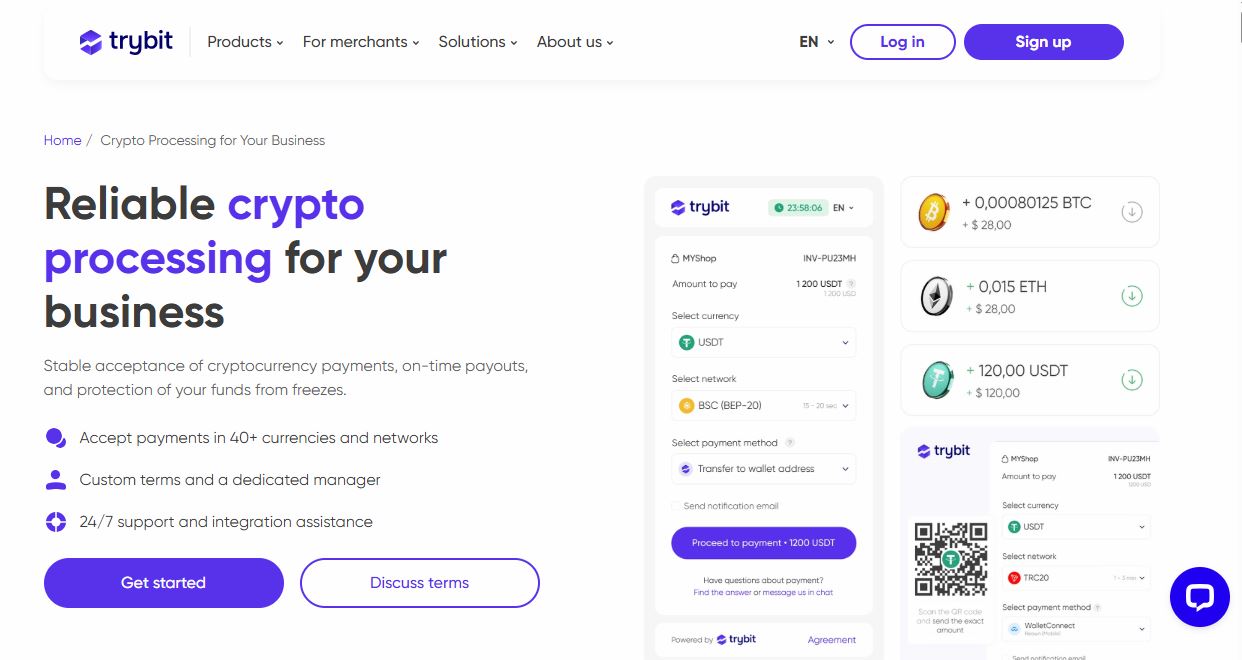
Payment confirmations are said to start from 20 seconds on Trybit. Meanwhile, it also conducts AML transaction checks. Additional security features include chargeback protection, and the platform offers multiple integrations, including supporting Web3 wallet payments through WalletConnect.
About BitPay
BitPay supports upwards of 100 crypto assets according to its business page. Like Trybit, it supports payments through WalletConnect, and also offers online e-commerce integrations. Fiat settlement is available on the platform, and support for invoicing and in-store POS has been highlighted as BitPay’s primary USP. Additional features include payroll, affiliate settlements and B2B payments.

At first glance, it is clear that while BitPay focuses on a broader asset coverage and support for long-established merchants, Trybit’s primary concern is to provide high-volume payment infrastructure to crypto-native enterprises.
Comparing Trybit and BitPay
Supported Cryptocurrencies and Stablecoins
When it comes to Trybit, users get access to over 40 assets. These include high caps such as BTC and ETH, and USDT. The stablecoin support is a standout factor for enterprises that want to stay pegged to the dollar and are concerned with crypto’s price volatility.
In BitPay’s case, the asset selection is larger, with over 100 cryptocurrencies. The platform’s business page highlights that assets such as BTC, ETH and XRP, as well as meme coins like DOGE are supported. Assets on networks like Base, Optimism and Arbitrum are also available on BitPay. The availability of assets, however, will depend on the location of the merchant and the shopper.
In essence, with BitPay, users get a large asset selection. But for businesses whose transactions center around major high caps and stablecoins, Trybit is a better fit.
Payment Confirmation and Settlement
It takes 20 seconds for payment confirmation on Trybit, according to the website. With five years of experience in payment processing, Trybit is said to achieve a 99.9% uptime. Withdrawals on the platform are automatic, based on schedule or amount. And the stablecoin conversion is also automatic.
Bitpay’s approach to payment is through its merchant infrastructure, accessible through online and in-store merchant tools. As the platform locks in the exchange rate when the customer pays the invoice, it ensures that customers don’t overpay. When it comes to fiat conversions, the bank settlement begins on the next business day.
In essence, Trybit’s focus is on fast and automated payment flow within a crypto ecosystem. BitPay’s approach, in comparison, is more merchant-centric. It abstracts crypto away from merchants and gives them a predictable fiat or crypto settlement experience.
Security and AML Checks
Trybit implements security features such as AML transaction checks and chargeback protection into its security suite. For clients, AML screening reduces the risk of problematic transactions that could create issues for the business’s broader crypto operations, a crucial feature for businesses that deal with massive payment volume. Trybit’s verification process consists of a project check and AML/KYT screening on every incoming transaction, which is an original compliance model meant for crypto-native flows.
BitPay’s security suite has a more standard look thanks to features like KYC, AML and transaction monitoring. The platform says that its compliance architecture is enterprise-oriented, which makes merchant verification key to the onboarding process. BitPay’s approach to chargeback exposure is the same as Trybit: using the irreversible nature of blockchain payments.
Both platforms address compliance and security issues, taking the same approach but at a different scale. Trybit’s aim is to screen every transaction via project checks and AML/KYT to prevent future issues. BitPay’s goal is to provide an enterprise-oriented compliance architecture.
Commissions and Fees
Trybit’s pricing structure is client-dependent. This means the client can go with basic pricing, which costs 1.9% per payment processed, or custom pricing, which starts from 0.4% per payment processed. In both cases, Trybit charges 0% for withdrawals.
BitPay opts for a tiered percentage model instead. Merchants processing over $500,000 in monthly income pay 2% plus a $0.25 fixed fee per transaction. That drops to 1.5% if monthly income is between $500,000 and $1 million, and above $1 million, the transaction fee drops further to 1%. However, $0.25 remains the fixed fee for every transaction, regardless of tier.
So with Trybit, the pricing model is more direct and transparent. A high-volume merchant has room to negotiate rates as low as 0.4%, without worrying about any monthly threshold requirements. With BitPay, larger merchants benefit over time, but smaller merchants must pay more until their volume increases.
Integrations and Wallet Support
Trybit offers integrations such as Web3 wallet payments through WalletConnect support. It has also made ready-made integrations with CMS plugins, H2H, API, payment links etc. The platform’s core focus is to support enterprises with crypto-native payment flows, which means it is suitable for businesses with clients that have Web3-ready wallets. It also offers merchant-focused integrations.
BitPay also features merchant-focused integrations such as Shopify, WooCommerce, Magento, email invoicing, in-store POS, presenting a more traditional merchant integration ecosystem. The difference is that these integrations are presented as the standout elements within BitPay.
With Trybit, the clients are businesses that already have crypto-focused integrations, while with BitPay, the focus is on offering crypto payment support through traditional merchants. Both offer flexible integration, but the difference lies in the payment environments they operate in.
Payouts and Withdrawals
Trybit’s emphasis is on mass payouts. It lets businesses automate payments and withdrawals based on specific schedules and amounts, and features a crypto exchange functionality. With this platform, the goal is to automate the manual tasks of moving business funds on a large scale.
BitPay’s focus is on accessibility. It lets businesses use crypto payouts for their employees, affiliates, contractors, and other recipients. Support for bulk payments and one-time payments is also available on Bitpay.
In essence, Trybit introduces operational efficiency, directing its efforts toward automated withdrawal rules and operational flexibility. BitPay puts its efforts into making crypto payouts available for different use cases.
Final Words
With Trybit, the goal is to give proper infrastructure to businesses with high-volume operations working in a fast environment. It reduces manual funds movements through automation and lowers the risk of dubious payments through AML screening.
On the other hand, BitPay’s way is more about giving merchants more support through a larger suite of integrations and multiple settlement options.
Their operational environment is different. Trybit works in a crypto-native ecosystem to make payments more efficient, while BitPay operates within a traditional scenario to make crypto more accessible.
Trybit does not offer a built-in fiat off-ramp, with funds settling directly in crypto or stablecoins to the merchant’s own wallet. Businesses that need fiat can still use it, but they will need an exchange to convert that crypto into fiat after transacting with Trybit. BitPay’s fiat settlement runs through traditional banking rails, requiring a linked bank account, with funds only becoming available the next day.
Simply put, Trybit’s focus is on speed and full custody: merchants get immediate access to their own funds, with fiat conversion left as an extra step. BitPay’s focus is on convenience rather than speed. Merchants don’t need to touch crypto at all, but at the cost of losing the instant-settlement benefit.


- Compounding vs Drawdown: The Math Active Traders Often Underestimate
- A 1960s-Style Evening Is Coming to TOKEN2049 Singapore, Courtesy of ChangeNOW
- Smart Money Signals vs Whale Tracking: What Solana Traders Should Actually Follow in 2026
- Bybit Users Can Now Fund Accounts in USD via OpenPayd
- 3 Meme Coin Launchpads Making it up with AI Trends in 2026