


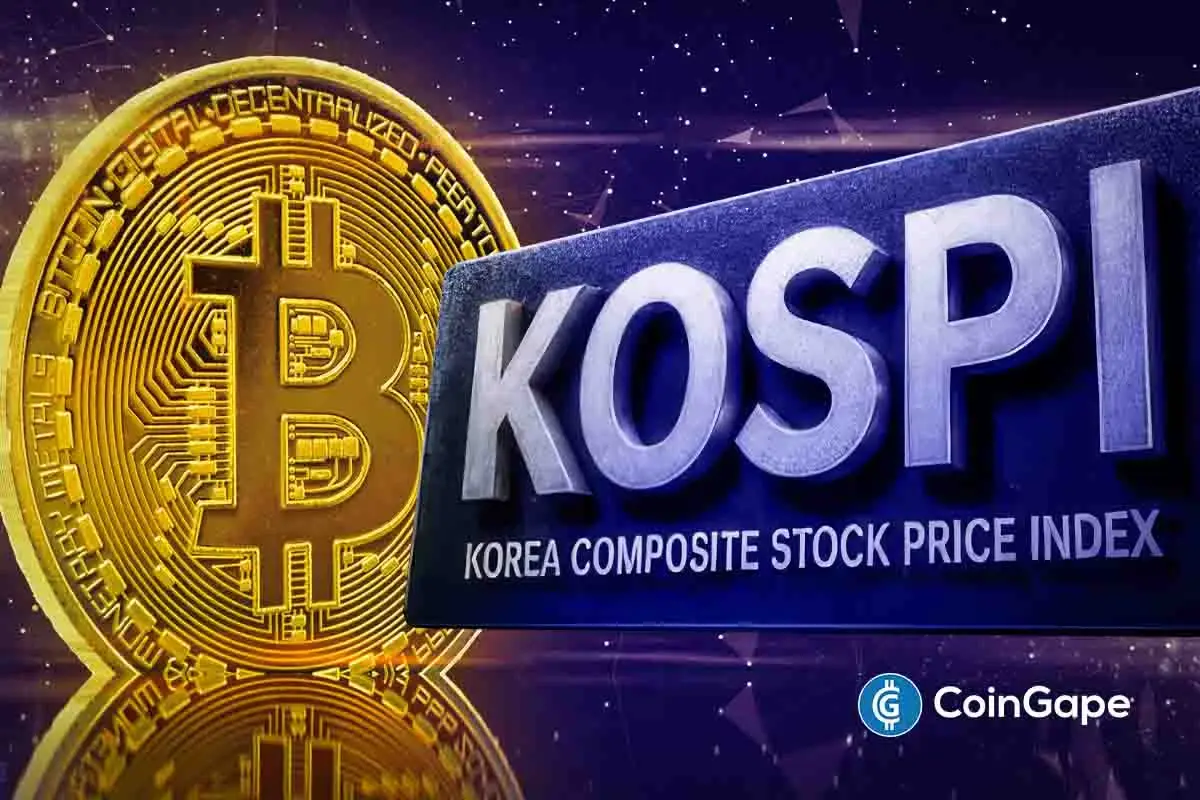
KOSPI Tops Bitcoin Volatility at 63% YTD


Highlights
- KOSPI's year-to-date volatility hit 63%, overtaking Bitcoin's 48% to become more unpredictable than crypto's benchmark asset.
- The index swung nearly ₩2 trillion on August 3, plunging over 20% then rebounding 25% intraday and triggering circuit breakers.
- Samsung and SK Hynix make up over 50% of KOSPI market cap, turning small AI-chip sentiment shifts into whole-market swings.
South Korea’s benchmark KOSPI volatility has hit a historic milestone. The index’s year-to-date return swings have surged to 63%, officially surpassing Bitcoin’s 48% reading, according to Bloomberg data published July 31, 2026.
The development marks a striking reversal: a national stock index now out-volatilizes the asset long branded the world’s most unpredictable.


Circuit Breakers, ₩2 Trillion Swings, and a 25% Intraday Rebound
The latest evidence of KOSPI volatility arrived on August 3, 2026. The index plunged more than 20% from the open, erasing roughly ₩1.1 trillion in market value and triggering circuit breakers.
Then came a stunning 25% intraday rebound. By close, the index sat about 5% lower, after swinging nearly ₩2 trillion in a single session.
That kind of action was not a one-off. Through end-July, the Korea Exchange had already triggered its market-wide circuit breaker nine times in 2026, compared to zero in 2025 and just once in 2024.
The KOSPI circuit breaker triggered earlier this year when SK Hynix shed 15.4% in a single session amid US-Iran tensions, highlighting how geopolitical risk amplifies the index’s already extreme moves.
Samsung Electronics and SK Hynix sit at the heart of the chaos. The two AI memory chip giants account for more than 50% of KOSPI market cap.
When AI sentiment shifts, even slightly, the entire national index follows.
That same concentration that sent KOSPI surging on Samsung’s $950B AI chip deal is the same force that triggered a 30% bear crash from the June peak, wiping $144 billion in market value.
ADD EXTRA DATA POINT HERE: Total assets in Korean leveraged ETFs (from ~$5B to $40B YTD) and % of daily KOSPI volume driven by leveraged products and the two chip stocks (>70% at peak).
Retail investors, locally called “ants”, have poured tens of trillions of won into single-stock and index-leveraged ETFs.
These products magnify both rallies and liquidations. The result: KOSPI volatility now behaves less like a national equity benchmark and more like a high-beta altcoin.
Coin Bureau noted on X that KOSPI’s 63% YTD vol reading now tops Bitcoin’s 48%, a comparison that would have seemed absurd just 12 months ago.


What This Means for Bitcoin and Global Portfolios
The data lands at an interesting time for Bitcoin. While Bitcoin has faced its own macro-driven price pressure, its comparatively lower realized
KOSPI volatility-adjusted profile is reinforcing a narrative of maturation.
Bitcoin’s 48% YTD vol, once the benchmark for extreme risk, now looks tame beside a G20 national equity index.
That shift carries portfolio implications. Investors with broad Asia or semiconductor exposure face concentration risk that rivals crypto-native assets.
Crypto liquidations hit $238M during a single macro shock earlier this year; KOSPI’s intraday swings have at times dwarfed even that scale of capital displacement.
Meanwhile, Strategy, the largest corporate Bitcoin holder, has stayed the course. Michael Saylor clarified claims about a $5B BTC sale, reaffirming that the company remains a net buyer.
That institutional conviction, set against KOSPI’s equity-market chaos, adds weight to Bitcoin’s evolving identity as a store of value, even as the AI rout has spilled over into related stocks and squeezed capital across tech-adjacent positions.
Regulators in Korea have responded with temporary halts on new leveraged ETF listings, but the structural concentration in Samsung and SK Hynix remains unchanged.
Until that changes, KOSPI volatility is unlikely to normalize, and global investors should treat any Korea equity allocation as a concentrated AI-semiconductor bet, not a diversified market position.
Trade derivatives without intermediaries on a leading Perp DEX.
Instant Currency Exchange at BestChange with Ease
- Compare Rates Across 1000+ Exchanges
- Access 250+ Cryptocurrencies & Pairs
- Save Time with Real-Time Price Tracking
- Trusted & Verified Exchange Listings

Why Trust CoinGape
CoinGape has covered the cryptocurrency industry since 2017, aiming to provide informative insights Read more… to our readers. Our journal analysts bring years of experience in market analysis and blockchain technology to ensure factual accuracy and balanced reporting. By following our Editorial Policy, our writers verify every source, fact-check each story, rely on reputable sources, and attribute quotes and media correctly. We also follow a rigorous Review Methodology when evaluating exchanges and tools. From emerging blockchain projects and coin launches to industry events and technical developments, we cover all facets of the digital asset space with unwavering commitment to timely, relevant information.



Delivered every day.
- Insights that move markets
- 100,000 active subscribers

Global Onchain Awards 2026