
Analysts Flag 3 Reasons CLARITY Act Will Not Pass in 2026, Latest Prediction


Highlights
- Analysts have argued that the CLARITY Act bill may not pass in 2026.
- The analysts say that partisan politics, Senate schedule and vote requirements may hinder the bill's passage.
- The falling odds are weighing on Bitcoin, Ethereum, and XRP prices.
The odds of the CLARITY Act passing in 2026 are dropping, and analysts including Galaxy Digital’s Alex Thorn and Anthony Scaramucci have flagged three reasons why this crypto bill might not pass despite Republican senators making multiple concessions in a bid to win bipartisan support.
The bearish outlook towards the bill comes as the odds of the CLARITY Act passing in 2026 drop to 36% on Polymarket.
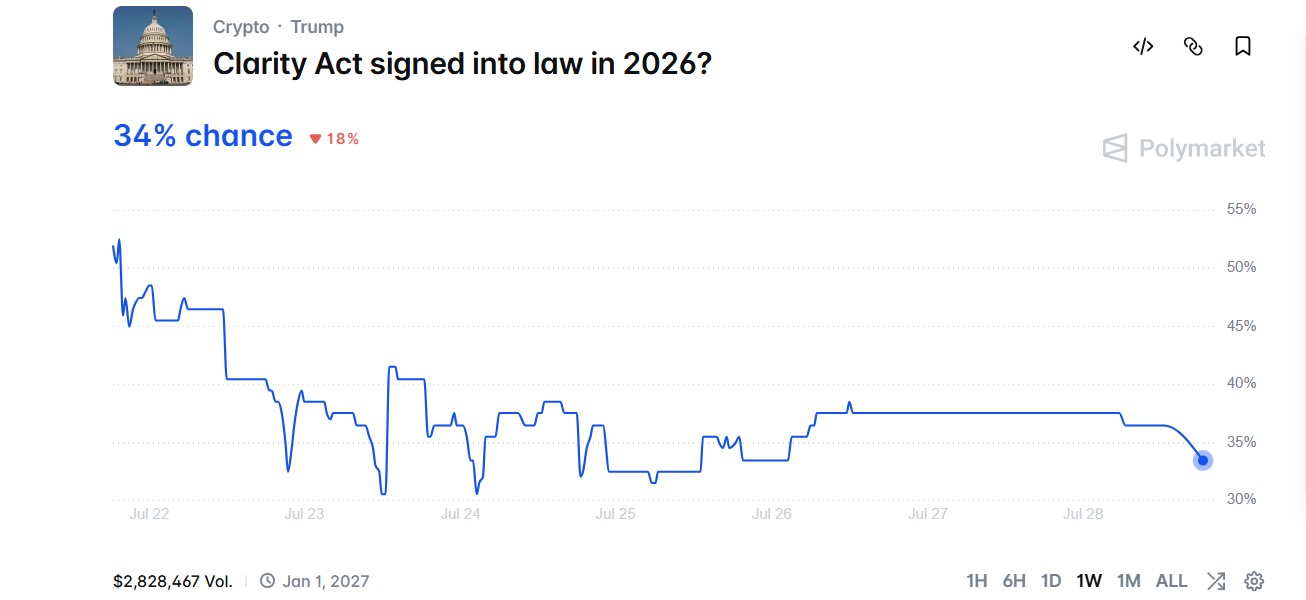
The odds had reached 53% on July 21 after the White House agreed on ethics rules.
Kalshi also shows a 43% chance of President Trump signing the CLARITY Act bill into law by January 2027.


Why CLARITY Act Bill May Not Pass in 2026
Analysts base their arguments on why CLARITY Act may not pass in 2026 on three factors: the vote threshold, partisan politics, and the Senate’s tight schedule.
-
60-vote Threshold Remains Mathematically Challenging
Galaxy’s head of research, Alex Thorn, notes that there is only a 30% chance that CLARITY Act passes because it might not get the required 60 votes.
Thorn notes that Republican senators hold 53 votes. However, two of these senators, Josh Hawley and Rand Paul, are likely to vote no. Another Republican Senator, Mitch McConnell, is also hospitalized and may not vote.
That means that Republicans have 50 votes in favor of the CLARITY bill. They will need another 10 additional votes from the Democratic side to push the bill forward.
The seven Democratic senators who could have added to this vote basket are now pushing back after the latest CLARITY Act text was released, saying that there are no adequate ethics provisions.
-
Tight Senate Schedule
Thorn also adds that the Senate calendar is the “central constraint” to the CLARITY Act bill passing in 2026.
“The calendar is no longer merely an obstacle. It is now the enemy,” Thorn said.
He noted that the Senate needs to begin the voting process for this bill on July 30. However, this is now not possible because the Senate has shelved the crypto bill to deliberate on the Russia sanctions bills and voting on the federal appointments made by President Trump.
That means the voting process for the CLARITY Act may not begin until the week between August 3 and August 7. During that week, the Senate will also break for recess.
Thorn says that if CLARITY does not pass before senators break for recess on August 7, its chances of passing will diminish significantly because Senate business will be consumed by election politics ahead of the November midterm elections.
-
Crypto Remains a Partisan Issue
Skybridge Capital Founder, Anthony Scaramucci also notes that Democratic Senators will not vote in favor of the CLARITY Act as long as President Trump is pushing for the bill.
“They will do everything they can to block it because he wants it,” Scaramucci said.
His sentiments mirror those of Cardano founder Charles Hoskinson, who said that the “Trump narrative” is a threat to the bill’s passage.
Hoskinson notes that as long as crypto remains a partisan issue, Democratic senators will always vote against crypto-related bills, especially now that Trump made $1.4 billion in profits from crypto activities.


What Delayed CLARITY Act Means for Bitcoin, Ethereum and XRP Price
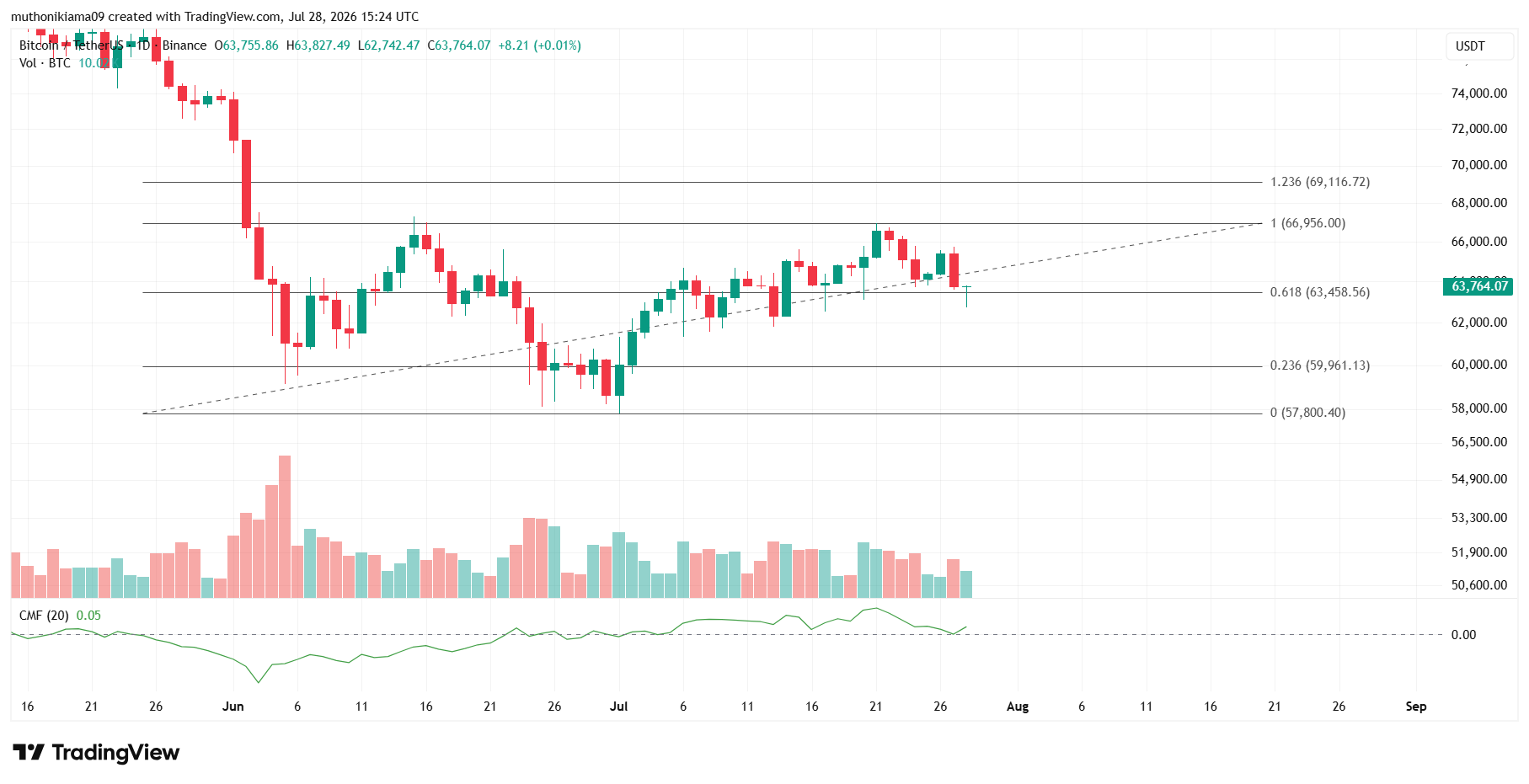
Bitcoin price is down by 1.93% to trade at $63,315 at the time of writing. This drop occurred after the Senate calendar revealed that it was shelving the CLARITY Act to focus on other bills.
The drop seen today after a slight setback on the bill’s passage suggests that BTC price could retest the July 1 low of $57,800 if the odds of the bill passing continue to drop.
A delay could also affect institutional demand for BTC ETFs.
Data from SoSoValue shows that BTC ETFs have posted three straight days of outflows. The outflows began when Democratic Senators opposed the new version of the CLARITY Act.
Ethereum and XRP ETFs saw slight inflows of $9 million and $592,000, respectively, on July 27. But if the prices continue to drop on falling CLARITY Act odds like they are doing now, outflows to these ETFs could return.

A recent CoinGape XRP price analysis also noted that the price faces a drop to $1.01 if the Senate does not vote on the bill before it breaks for recess.
Ethereum price could also retest the July 1 low of $1,500 on pessimism around the bill passing into law before 2026 ends.
Instant Currency Exchange at BestChange with Ease
- Compare Rates Across 1000+ Exchanges
- Access 250+ Cryptocurrencies & Pairs
- Save Time with Real-Time Price Tracking
- Trusted & Verified Exchange Listings

Frequently Asked Questions (FAQs)
1. Will the CLARITY Act pass in 2026?
2. Why are analysts skeptical about CLARITY Act passing?
3. Will the Senate vote on the CLARITY Act bill before August recess?
Why Trust CoinGape
CoinGape has covered the cryptocurrency industry since 2017, aiming to provide informative insights Read more…to our readers. Our journal analysts bring years of experience in market analysis and blockchain technology to ensure factual accuracy and balanced reporting. By following our Editorial Policy, our writers verify every source, fact-check each story, rely on reputable sources, and attribute quotes and media correctly. We also follow a rigorous Review Methodology when evaluating exchanges and tools. From emerging blockchain projects and coin launches to industry events and technical developments, we cover all facets of the digital asset space with unwavering commitment to timely, relevant information.

24 Hours volume
$27.33B
Market Cap
$1.64T
Max Supply
21M



Delivered every day.
- Insights that move markets
- 100,000 active subscribers

CRYPTO IMPACT AWARDS 2026