


Breaking: Bitcoin ETFs Record $225M Outflow as US Treasury Yields Hit 18-Month High


Highlights
- spot Bitcoin ETFs recorded $225.18 million in net outflow.
- This comes as institutional investors rotate to US Treasuries amid rising bond yields.
- 10-year Treasury yield hit 18-month high of 4.71% amid rising oil prices and US debt.
Spot Bitcoin ETFs saw more than $225 million in net outflow on Friday, breaking an inflow streak of almost two weeks. Institutional investors are strategically rotating into U.S. Treasuries amid rising US Treasury yields, oil prices amid the US-Iran war, and Trump’s new global tariffs.


Spot Bitcoin ETFs Record First Outflows After Many Days
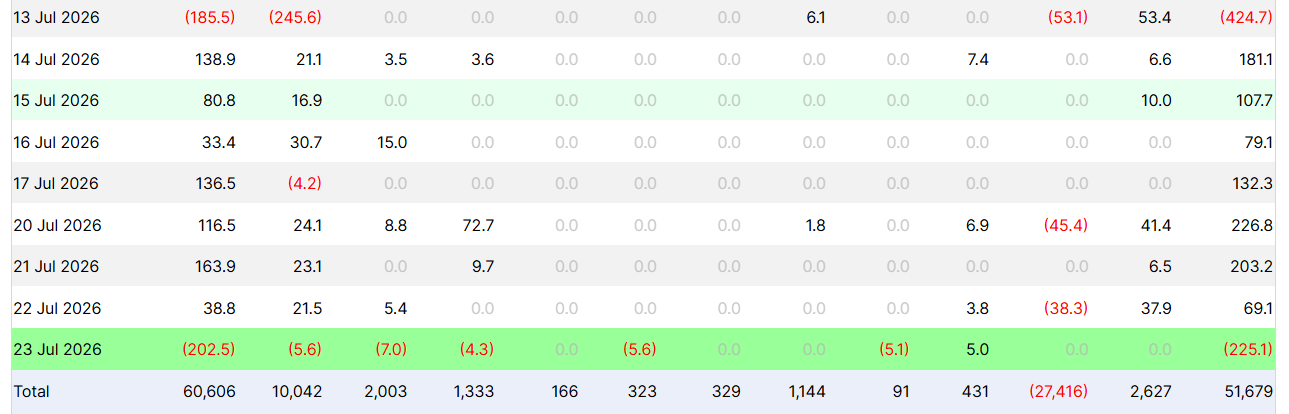
US-listed spot Bitcoin ETFs recorded $225.18 million in net redemptions in the latest session, according to Farside Investors data on July 24. This ended a seven-day period of positive flows that saw nearly $1 billion in inflows.
BlackRock Bitcoin ETF (IBIT) led with a $202.5 million outflow, followed by Bitwise’s BITB and Fidelity’s FBTC. Other exchange-traded funds also saw outflows. In contrast, Morgan Stanley’s MSBT recorded $5 million in inflows.
Just as spot Bitcoin ETF inflows triggered a rebound in BTC price to almost $67K, sentiment among institutional investors has again shifted. Institutions are now rotating capital out of spot Bitcoin ETFs.
BTC price has dropped more than 3% in the last two days amid the US-Iran war escalation and delays in passing the Clarity Act before the August recess.


US Treasury Yields Rising to Record Levels
The latest spot Bitcoin ETF outflows come as institutions rotate to U.S. Treasuries amid rising bond yields. The benchmark 10-year Treasury yield (US10Y) reached about 4.71% on Friday, marking one of its highest levels in 18 months.
10-Year Treasury Yield jumps above 4.7% for the first time since January 2025 🚨 🚨 Houston, we have a problem 😱 pic.twitter.com/cXXR2llFoj
— Barchart (@Barchart) July 24, 2026
Economist Peter Schiff warned that the yield on the 30-year Treasury jumped to 5.18%, its highest since April 2006. He added that the U.S. national debt was $8.35 trillion at that time. However, it has now spiked fivefold to $39.6 trillion.
“The U.S. can’t afford these rates, let alone the much higher rates we’ll soon be forced to pay,” Peter Schiff warned.
Moreover, Trump’s latest global tariff package has heightened concerns about a further deterioration in trade relations between the US and its key partners. In addition, rising oil prices amid escalating US-Iran war have raised chances of Fed rate hikes.
Higher financing costs could increase government interest expenses and potentially lead to additional borrowing and fiscal spending needs, further worsening the trajectory of U.S. debt growth.
Market expert BIT (formerly Matrixport) warned that “Japan may gradually sell U.S. Treasuries to support the rapidly depreciating yen.” Meanwhile, China continues to diversify its foreign exchange reserves by reducing its U.S. Treasury holdings and increasing its gold reserves.
Outflows may continue in spot Bitcoin ETFs as institutional investors rotate capital to less risky assets such as US bonds and gold.
For retail and institutional traders aiming to hedge against geopolitical tensions by mirroring central bank behaviors, using the best platforms to trade tokenized commodities like gold provides an on-chain alternative with 24/7 liquidity.
Instant Currency Exchange at BestChange with Ease
- Compare Rates Across 1000+ Exchanges
- Access 250+ Cryptocurrencies & Pairs
- Save Time with Real-Time Price Tracking
- Trusted & Verified Exchange Listings

Why Trust CoinGape
CoinGape has covered the cryptocurrency industry since 2017, aiming to provide informative insights Read more… to our readers. Our journal analysts bring years of experience in market analysis and blockchain technology to ensure factual accuracy and balanced reporting. By following our Editorial Policy, our writers verify every source, fact-check each story, rely on reputable sources, and attribute quotes and media correctly. We also follow a rigorous Review Methodology when evaluating exchanges and tools. From emerging blockchain projects and coin launches to industry events and technical developments, we cover all facets of the digital asset space with unwavering commitment to timely, relevant information.



Delivered every day.
- Insights that move markets
- 100,000 active subscribers

Global Onchain Awards 2026