


Circle Secures NYDFS Limited-Purpose Trust Charter for Circle New York Trust

Highlights
- Circle (NYSE: CRCL) won a limited-purpose trust charter from NYDFS for Circle New York Trust, cleared to issue USDC under New York Banking Law.
- The charter pairs with Circle's OCC national trust bank approval from July 10, creating a dual state-federal structure rivals like Tether can't currently match.
- USDC leads the market with $1.2T in June volume versus USDT's $573B, and the charter is built to deepen institutional confidence under the GENIUS Act.
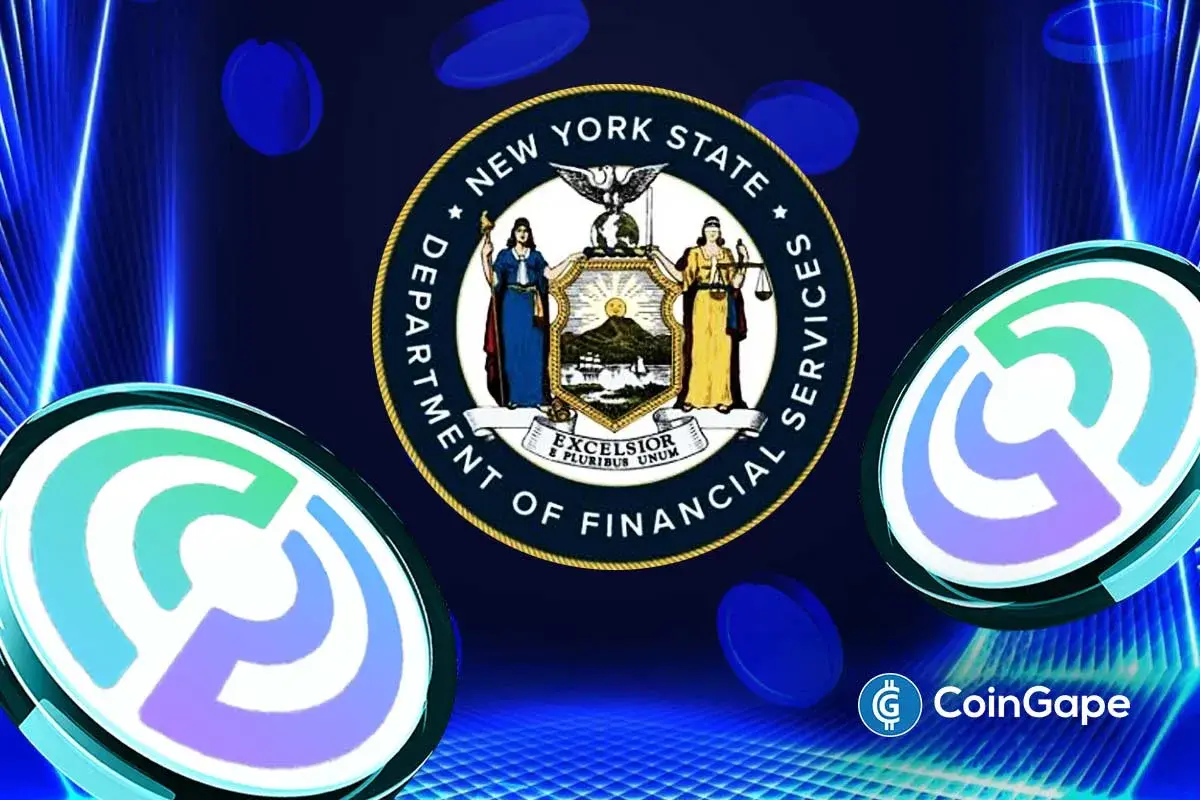
Circle Internet Group (NYSE: CRCL) has received a limited-purpose trust charter from the New York Department of Financial Services (NYDFS) for Circle Internet Trust Company LLC, also known as Circle New York Trust.
The Circle NYDFS trust charter, announced on July 31, 2026, finalizes a dual regulatory structure that pairs state-level USDC issuance oversight with the federal custody powers Circle won from the OCC earlier this month.


What the NYDFS Charter Means for USDC and CRCL Investors
CEO Jeremy Allaire described the approval as a “longstanding objective” for the company. NYDFS is an international standard-setter for digital asset regulation.
Allaire said the charter positions USDC within a “strong, respected framework as digital dollars become central to the global financial system.”
The NYDFS approval arrives just three weeks after Circle secured final OCC authorization for its national trust bank, Circle National Trust.
As CoinGape reported, Circle’s OCC national crypto bank approval sent CRCL stock surging 10% on July 10. That federal charter enables fiduciary digital-asset custody and, eventually, management of USDC reserves under direct federal oversight.
The Circle NYDFS trust charter grants Circle New York Trust fiduciary powers and the right to conduct virtual-currency business under New York Banking Law.
USDC issuance is expected to migrate to the NY entity over time. The OCC national trust bank will handle custody and collateral-trustee functions.
Together, the two charters create a state-federal compliance stack that rivals like Tether cannot currently match.
The timing matters. USDC already leads the stablecoin market by volume. USDC recorded $1.2 trillion in June stablecoin volumes, two times higher than USDT’s $573 billion per on-chain data.
Regulated issuance via a NYDFS trust company is designed to deepen institutional confidence and attract further flows into USDC. The dual-charter structure also sits neatly inside the GENIUS Act framework.
CRCL’s stock outlook ahead of the July 18 GENIUS Act rule deadline was already a top investor question last week.
A fully chartered, bank-grade USDC issuer fits that regulatory architecture cleanly, reducing counterparty risk for large institutional holders.


From BitLicense Pioneer to Full Trust Infrastructure
Circle’s relationship with NYDFS goes back more than a decade. In 2015, it became the very first company to receive a BitLicense, the agency’s foundational virtual-currency operating license.
That early regulatory bet has now compounded into full trust-company status, a more powerful designation that carries fiduciary responsibilities and direct supervisory oversight.
Institutional appetite for regulated USDC infrastructure has been building in parallel. Standard Chartered recently became the first G-SIB to offer institutional access to USDC via a regulated banking channel.
Standard Chartered’s USDC rollout in Dubai showed how deeply the stablecoin has embedded itself into traditional finance. The NYDFS charter is designed to sustain that institutional trust at scale.
Risks remain real. Competition from the new OpenUSD stablecoin and interest-rate sensitivity on reserve income are live concerns.
Baird trimmed its CRCL price target this month and warned that newer stablecoin entrants could erode market share.
But the Circle NYDFS trust charter, stacked on top of OCC custody powers, sets a compliance benchmark that is difficult and slow for rivals to replicate.
Our guide compares top decentralized futures exchanges by liquidity and fees.
Instant Currency Exchange at BestChange with Ease
- Compare Rates Across 1000+ Exchanges
- Access 250+ Cryptocurrencies & Pairs
- Save Time with Real-Time Price Tracking
- Trusted & Verified Exchange Listings
Why Trust CoinGape
CoinGape has covered the cryptocurrency industry since 2017, aiming to provide informative insights Read more… to our readers. Our journal analysts bring years of experience in market analysis and blockchain technology to ensure factual accuracy and balanced reporting. By following our Editorial Policy, our writers verify every source, fact-check each story, rely on reputable sources, and attribute quotes and media correctly. We also follow a rigorous Review Methodology when evaluating exchanges and tools. From emerging blockchain projects and coin launches to industry events and technical developments, we cover all facets of the digital asset space with unwavering commitment to timely, relevant information.



Delivered every day.
- Insights that move markets
- 100,000 active subscribers