USDT Hits $183B and USDC Holds $73B as No Other Stablecoin Breaks the $5B Mark


Highlights
- USDT ($183.4B) and USDC ($72.7B) together hold ~$256B, over 85% of the $302B stablecoin market, per DefiLlama.
- A sharp cliff follows: Sky Dollar ($6.8B), Ethena’s USDe ($4.7B), and WLFI’s USD1 ($4B) all sit near or below $5B.
- Trust, liquidity, and distribution at scale, not just innovation, keep the USDT-USDC duopoly nearly impossible to flip.
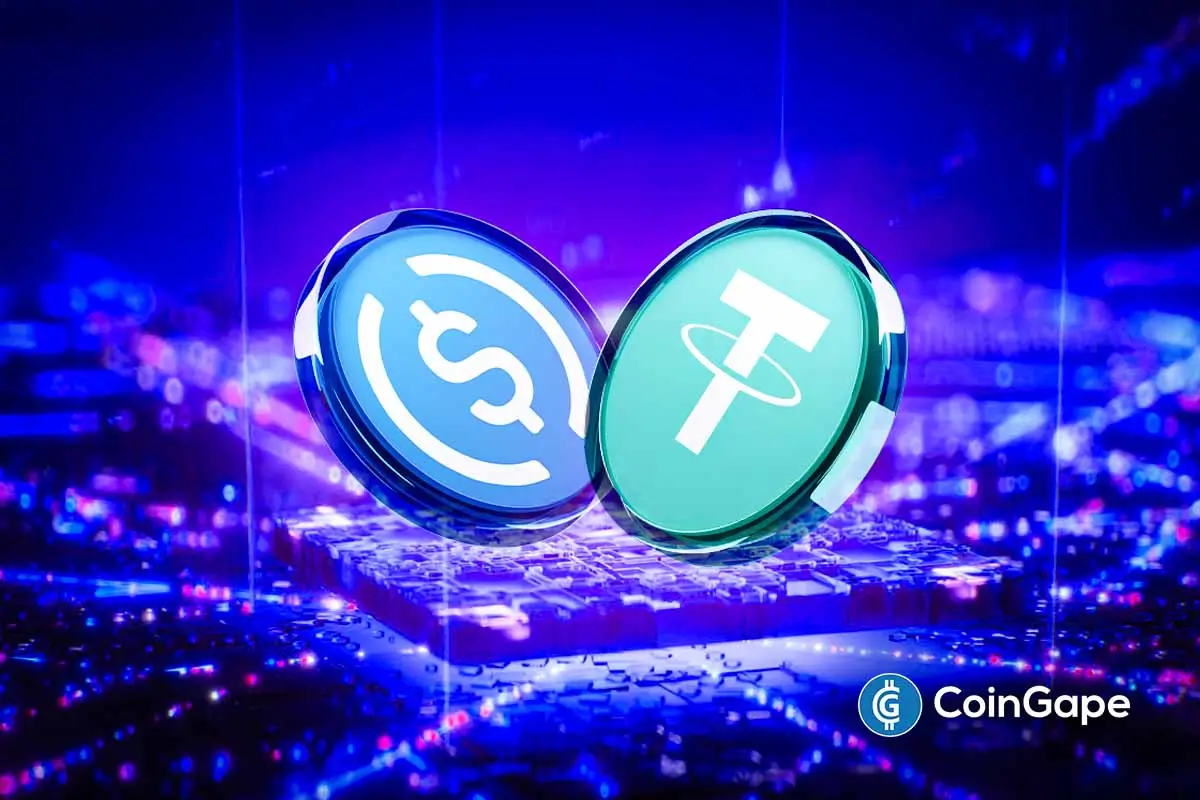
The stablecoin market has never looked more lopsided. Data from DefiLlama shows that Tether’s USDT ($183.4B) and Circle’s USDC ($72.7B) together hold roughly $256B, more than 85% of the total $302B stablecoin market.
No other issuer comes close to the $5B threshold. The gap is not narrowing. It is widening.


A Two-Horse Race With a Cliff After the Second Runner
The numbers from DefiLlama as of October 17, 2026, tell a stark story. USDT leads at $183.4B, commanding 60.6% of the stablecoin market alone. USDC follows at $72.7B, driven heavily by institutional and regulated demand.
Then comes the cliff. Sky Dollar (USDS) sits at $6.8B. Ethena’s USDe follows at $4.7B. World Liberty Financial’s USD1 holds $4B. PayPal’s PYUSD sits at $2.8B. Ripple’s RLUSD trails at $2.4B.
Tether CEO Paolo Ardoino has pointed to AI agents as the next frontier for USDT adoption.
He predicts as many as one trillion AI agents will transact in USDT within 15 years.
Agents spending USDT is the future. https://t.co/2HLBrmG3DA
— Paolo Ardoino 🤖 (@paoloardoino) October 15, 2026
Ethena is making calculated moves to escape the challenger trap. The protocol recently entered crypto neobanking with a new app to take USDe beyond DeFi.
It also teamed with FalconX on a $1 billion secured facility for USDe backing assets. Both moves signal that USDe is building real-world utility, but at $4.7B, it remains a fraction of the giants.
USD1 is pursuing a payments angle. Mesh recently acquired Bluvo after a WLFI partnership, a deal designed to deepen USD1’s payment rails. Yet at $4B, USD1 still sits well below the threshold that could threaten the two leaders.


Why Flipping the Duopoly Remains Nearly Impossible
Trust and liquidity are the core barriers. USDT dominates trading pairs and emerging-market corridors. USDC leads in regulated, institutional contexts.
Circle’s distribution strategy is accelerating that lead. Visa recently moved USDC prefunding into live operations on Visa Direct.
Circle paid out $819M to distribution partners in H1 2026 alone, reinforcing network lock-in.
Payment infrastructure is also expanding. Coinbase expanded its Marqeta partnership to bring stablecoin-backed payment cards to businesses. These rails make USDC harder to displace in corporate finance.
Traditional finance is circling the space. Wells Fargo’s CEO confirmed the bank is preparing for potential stablecoin opportunities in the US. New bank-issued stablecoins, however, are more likely to deepen USDC’s institutional moat than challenge it.
Regulatory scrutiny adds another layer. A US Senate probe recently found USDT present in 84% of sanctioned Iran’s wallets. Tether has since defended its compliance posture.
The controversy has not dented USDT’s dominance, but it gives regulators a lever that could reshape the stablecoin market in ways no competitor currently can.
For now, the data is unambiguous. Breaking through the $5B ceiling requires more than innovation.
It demands liquidity, regulatory trust, and distribution at a scale that only two issuers have built, and neither shows signs of giving ground.
Instant Currency Exchange at BestChange with Ease
- Compare Rates Across 1000+ Exchanges
- Access 250+ Cryptocurrencies & Pairs
- Save Time with Real-Time Price Tracking
- Trusted & Verified Exchange Listings

Why Trust CoinGape
CoinGape has covered the cryptocurrency industry since 2017, aiming to provide informative insights Read more… to our readers. Our journal analysts bring years of experience in market analysis and blockchain technology to ensure factual accuracy and balanced reporting. By following our Editorial Policy, our writers verify every source, fact-check each story, rely on reputable sources, and attribute quotes and media correctly. We also follow a rigorous Review Methodology when evaluating exchanges and tools. From emerging blockchain projects and coin launches to industry events and technical developments, we cover all facets of the digital asset space with unwavering commitment to timely, relevant information.



Delivered every day.
- Insights that move markets
- 100,000 active subscribers

Global ONCHAIN AWARDS 2026