
CLARITY Act on July 4, 2026: Deal or Delay?



Highlights
- The CLARITY Act passed the House 294–134 and cleared Senate Banking Committee 15–9, but no Senate floor vote is scheduled yet.
- Analysts like Bitwise’s Ryan Rasmussen say a July 4 passage is “very unlikely,” with Polymarket odds dropping to ~50–60% for 2026 enactment.
- Senator Cynthia Lummis warns delays past August recess could push final passage into 2027 amid competing congressional priorities.
As the United States of America prepares for its 250th birthday celebrations, the eyes of the crypto industry and lawmakers are also on July 4, 2026. After spending years asking Washington for clearer rules, will President Trump’s desk finally deliver the Digital Asset Market Clarity Act, also known as the CLARITY ACT?
The Act is one of the most important crypto regulatory proposals ever to advance through Congress. The legislation, which passed the House last year in a bipartisan 294-134 vote, aims to establish a long-awaited clear framework for digital assets.
It would classify decentralized cryptocurrencies such as Bitcoin and Ethereum as digital commodities under the Commodity Futures Trading Commission (CFTC). At the same time, securities like tokens would be left under the Commodity Futures Trading Commission (CFTC).
Why the CLARITY Act Matters
For many years, regulatory uncertainty has pushed innovation and crypto companies overseas. Supporters say that the Bill could bring an end to this matter.
In addition to defining regulatory jurisdiction, the Act includes provisions affecting stablecoin oversight, anti-money laundering compliance, blockchain validators, and decentralized finance (DeFi).
Industry backing remains strong. Coinbase and Ripple are among more than 200 crypto institutions recently urging the Senate to advance the bill. These major players argue that delays could continue to place America in a weak position in the global digital asset race.
Senate Banking Chair, Tim Scott said the CLARITY Act could help expand the crypto industry from $3T to $30T.
July 4 is also the White House target. During a speech at Consensus Miami, Patrick Witt, executive director of the President’s Council of Advisors for Digital Assets, said that the passage of the Clarity Act by Independence Day could be a ” tremendous birthday present for America”
Why a July 4 Deal Looks Increasingly Unlikely
While the White House continues to push for a July 4 signing, the Senate’s timeline tells a different story. On May 114, the bill advanced out of the Senate Banking Committee with a bipartisan 15-9 vote, and on June 1, it was added to the legislative calendar.
However, since then nothing much has moved, with lawmakers yet to schedule a floor vote.
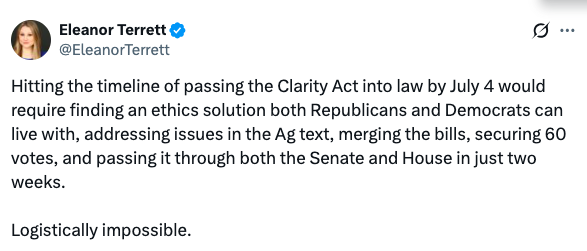
Time is quickly becoming the bill’s biggest obstacle, as expert Eleanor Terret recently pointed out that there are only 16 legislative days before the July 4 recess. She said that this leaves a little room to resolve remaining issues, reconcile versions of the bill, and secure the 60 votes needed to clear the chamber. Hence, signing the bill before independence day it is logistically impossible.
Even if lawmakers can find the time, several issues still need to be resolved. Among them are ethics provisions championed by Senator Kirsten Gillibrand and differences between Senate committees over key parts of the legislation.
The bill is also competing for Congress’ attention with other pressing priorities, including defense legislation, and surveillance law reauthorization.


What Happens Next?
While supporters remain hopeful, market watchers are becoming more cautious. Ryan Rasmussen, analyst at Bitwise, recently said full passage of the Clarity Act before July 4 appears “very unlikely.” Prediction market Polymarket is also sharing the same sentiment, with the odds of the bill becoming law in 2026 falling to around 50%-60%, down from roughly 75% in May.
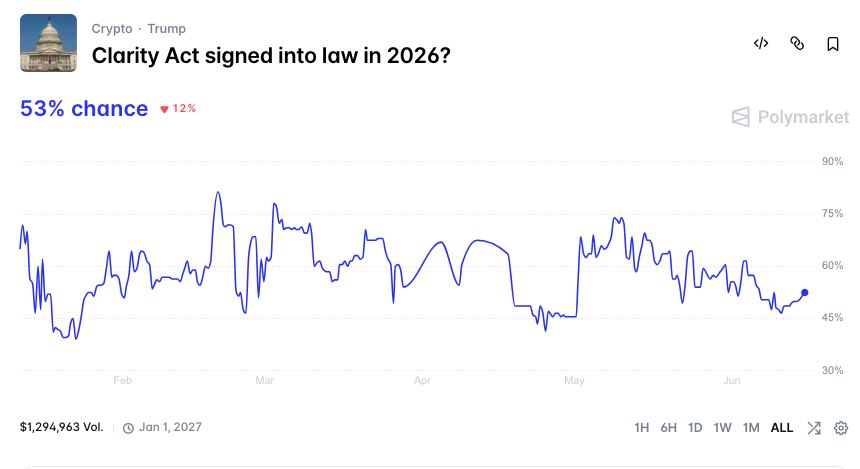
Senator Cynthia Lummis has warned that if lawmakers miss the window before the August recess, the legislation could easily slip into the political uncertainty surrounding the 2026 midterm elections. This raises the likelihood of a delay until 2027.
That’s why the next few weeks matter so much. The White House is still pushing for a July 4 victory. However, the Senate’s crowded schedule and unresolved negotiations point to a more likely outcome. It could be a deal later this year rather than a signing ceremony on Independence Day. Whether it’s a deal or a delay, the crypto industry is watching closely.
Frequently Asked Questions (FAQs)
1. What is the CLARITY Act?
2. Will the CLARITY Act pass by July 4, 2026?
3. Why does the bill matter for crypto?
Why Trust CoinGape
CoinGape has covered the cryptocurrency industry since 2017, aiming to provide informative insights Read more…to our readers. Our journal analysts bring years of experience in market analysis and blockchain technology to ensure factual accuracy and balanced reporting. By following our Editorial Policy, our writers verify every source, fact-check each story, rely on reputable sources, and attribute quotes and media correctly. We also follow a rigorous Review Methodology when evaluating exchanges and tools. From emerging blockchain projects and coin launches to industry events and technical developments, we cover all facets of the digital asset space with unwavering commitment to timely, relevant information.



Delivered every day.
- Insights that move markets
- 100,000 active subscribers

CRYPTO IMPACT AWARDS 2026



- Arthur Hayes Cashes Out $22M ETH, ENA & UNI Portfolio, Here’s Why
- Franklin Templeton Adds $150M in sgBENJI Shares to XRP Ledger
- XRP Ledger Holder Count Reaches All-Time High of 8.24 Million Amid Price Weakness Near $1.30
- Crypto Exchange HTX Joins Bitget and MEXC in Restricting Services for Russian Users
- Argentine Judge Clears President Javier Milei of Fraud in LIBRA Meme Coin Scandal
- What’s Next for SpaceX Stock Price as $40B Debt Deal Faces Headwinds After Global AI Rout
- Top Reasons Behind the Bitcoin Price Crash Below $80K
- Pi Network Price Prediction as Major Desktop Upgrade Rolls Out – Will PI Hold $0.078?
- Cardano Price Outlook as Dijkstra Testnet and Node 11.2 Advance Protocol Upgrade
- XRP Price Forecast as Whale Selling Pressure Outweighs ETF Inflows – Is a Crash to $1 Imminent?
- Bitcoin Price Prediction Ahead of US Midterms: Will BTC Crash Below $70K?